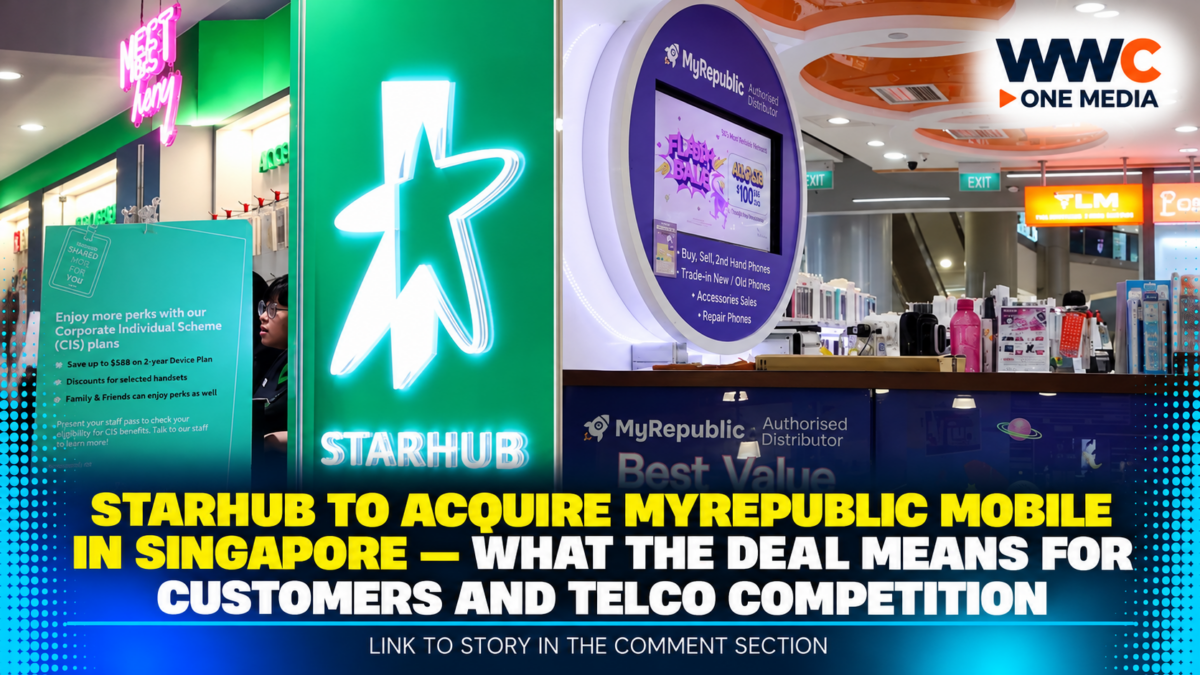
Singapore’s telecommunications industry is entering another phase of consolidation as StarHub moves to acquire MyRepublic’s mobile business, bringing the two companies’ broadband and mobile operations under a single corporate owner.
Announced on October 8, the acquisition builds on StarHub’s earlier takeover of MyRepublic’s Singapore broadband business and strengthens its strategy of operating multiple consumer brands across different market segments.
The transaction is expected to be completed by April 30, 2027, subject to the fulfillment of the required conditions by both parties.
For consumers, the companies say the immediate impact should be limited. MyRepublic Mobile will retain its existing brand and offerings, while customers are expected to remain on their current plans and services without disruption.
The deal also comes as Singapore’s telecom operators face intense price competition, pressure on mobile revenue and growing expectations to invest in network infrastructure.
The question now is whether greater scale will help operators strengthen their services while preserving the affordable plans that have made smaller mobile providers attractive to consumers.
What Is Included in the StarHub-MyRepublic Deal?
Under the agreement, StarHub will acquire MyRepublic’s Singapore mobile business, completing a multiyear expansion of its relationship with the company.
StarHub had already acquired full ownership of MyRepublic’s broadband business in 2025. The latest transaction will extend that ownership to the mobile business, bringing the two operations under StarHub’s corporate umbrella.
MyRepublic Mobile will continue operating under its own brand, allowing StarHub to serve customers through different service offerings rather than relying on a single consumer brand.
The financial terms are linked to the performance and size of the mobile business rather than a single fixed purchase price.
According to The Straits Times, the transaction value will depend on the number of active 4G and 5G subscribers, their average revenue per user and subscriber lifetime.
StarHub will also pay additional cash amounts when specified customer-migration milestones are achieved:
- An additional S$1 million when 25,000 subscribers have migrated to StarHub’s network.
- A further S$1 million when 50,000 subscribers have migrated by March 14, 2027.
These payments are separate from the transaction’s underlying value.
The structure ties part of the financial consideration to the migration of MyRepublic Mobile customers onto StarHub’s network.
What Happens to MyRepublic Mobile Customers?
For existing customers, the companies say the acquisition will not immediately change their mobile experience.
MyRepublic Mobile will retain its brand and current offerings, and customers are expected to continue using their existing plans and services without disruption.
The network transition is already underway. MyRepublic’s 5G customers have used StarHub’s network through an existing wholesale arrangement, while its 4G customers have been progressively migrated from M1’s network.
That earlier migration provides a foundation for the ownership transition, reducing the need for customers to undergo an entirely new network change when the acquisition is completed.
StarHub has also stated that the acquisition will not result in workforce reductions arising from the transaction.
However, customers should distinguish between the announced ownership change and any future commercial decisions. The companies have promised continuity under the current arrangement, but any future changes to pricing or plan availability would need to be assessed based on subsequent announcements.
For now, there is no announced requirement for MyRepublic Mobile customers to change their existing plans simply because of the acquisition.
Why StarHub Wants MyRepublic’s Mobile Business
The acquisition supports StarHub’s strategy of expanding its consumer business while building greater scale across its mobile and broadband operations.
By combining ownership of MyRepublic’s broadband and mobile businesses, StarHub can strengthen its position across multiple parts of Singapore’s connectivity market.
The company has argued that greater scale will help support investment in network reliability, service innovation and customer experience.
StarHub Chief Executive Officer Nikhil Eapen said the transaction completes a process that began with the company’s investment in MyRepublic Broadband in 2021.
StarHub has also been expanding its multi-brand strategy, which allows it to target customers with different budgets and service preferences.
The strategy reflects a broader industry reality: consumers increasingly expect reliable connectivity at competitive prices, while operators must finance network upgrades and maintain service quality.
For StarHub, the acquisition adds customers and strengthens its ability to serve different segments of the mobile market.
The longer-term commercial benefit, however, will depend on how effectively the company integrates the business and manages costs while maintaining the appeal of the MyRepublic Mobile brand.
MyRepublic Mobile Has About 85,000 Subscribers
MyRepublic’s mobile business recorded approximately 85,000 active subscribers and generated a net profit of S$2.4 million for the 12 months ended June 30, 2026, according to The Straits Times.
Its blended average revenue per user was approximately S$13 per month.
These figures provide a snapshot of the business StarHub is acquiring and help explain why the deal’s value depends on subscriber numbers and customer revenue.
The mobile operation also gives StarHub an established customer base rather than requiring the company to attract every subscriber independently.
At the same time, the relatively modest scale of the business illustrates the challenges facing smaller mobile providers in a competitive market where larger operators have more resources to invest in networks, marketing and service development.
The acquisition allows StarHub to expand through an existing business while retaining the MyRepublic name for customers who prefer its positioning.
Singapore’s Telecom Industry Faces Growing Consolidation Pressure
StarHub’s acquisition is part of a wider restructuring of Singapore’s telecommunications industry.
Mobile operators have been contending with intense price competition and pressure on average revenue per user, making it more difficult to grow revenue through conventional consumer mobile services alone.
StarHub’s mobile-service revenue fell 10.5 percent year on year to S$245.3 million in the first half of 2026, according to figures cited by The Straits Times.
Singtel also reported a 3.1 percent year-on-year decline in Singapore operating revenue for its first quarter, attributing the decrease partly to continued price competition.
These pressures have encouraged industry participants to look for ways to increase operating scale, share infrastructure and improve efficiency.
Mobile virtual network operators, or MVNOs, are particularly exposed to these dynamics.
An MVNO sells mobile services under its own brand but relies on another company’s network infrastructure rather than operating a complete nationwide mobile network of its own.
This model can reduce the investment required to enter the market, but smaller providers may struggle to compete as larger operators pursue aggressive pricing and invest in next-generation connectivity.
StarHub has already taken steps to consolidate mobile customers from other providers, including migrating redONE customers to its budget brand, eight.
The company has also been reported to be in discussions with Keppel over a potential transaction involving M1, although those talks are separate from the MyRepublic acquisition.
Together, these developments point to an industry in which partnerships, acquisitions and customer migrations are becoming increasingly important strategic tools.
Could Consolidation Mean Higher Mobile Prices?
One of the biggest questions surrounding telecom consolidation is whether fewer independent providers could eventually weaken price competition.
Consumers have benefited from competition among established operators and smaller brands offering lower-cost mobile plans. If consolidation reduces the number of independent competitors, customers may have fewer alternatives over time.
However, an acquisition does not automatically mean prices will rise.
StarHub has said it intends to preserve the MyRepublic Mobile brand and its distinct customer offering. Maintaining multiple brands can allow an operator to target different consumer groups while continuing to compete on price and service.
Greater scale may also help operators fund network improvements, strengthen reliability and support newer technologies.
The ultimate effect on consumers will depend on how StarHub manages its brands, whether competitors continue to offer attractive alternatives and how the market evolves after the transaction.
For now, the companies have emphasized service continuity rather than announced price changes.
What Happens Next?
StarHub expects to complete the acquisition by April 30, 2027, subject to the required conditions being fulfilled.
Until then, the companies will need to complete the transaction process while continuing the migration of MyRepublic Mobile customers onto StarHub’s network.
The acquisition will give StarHub ownership of both MyRepublic’s Singapore broadband and mobile businesses, completing a multiyear expansion of its relationship with the provider.
For customers, the immediate priority is continuity of service. For the industry, the deal raises broader questions about how operators can balance investment, profitability and competition as Singapore’s telecommunications market matures.
WWC ONE MEDIA G,A