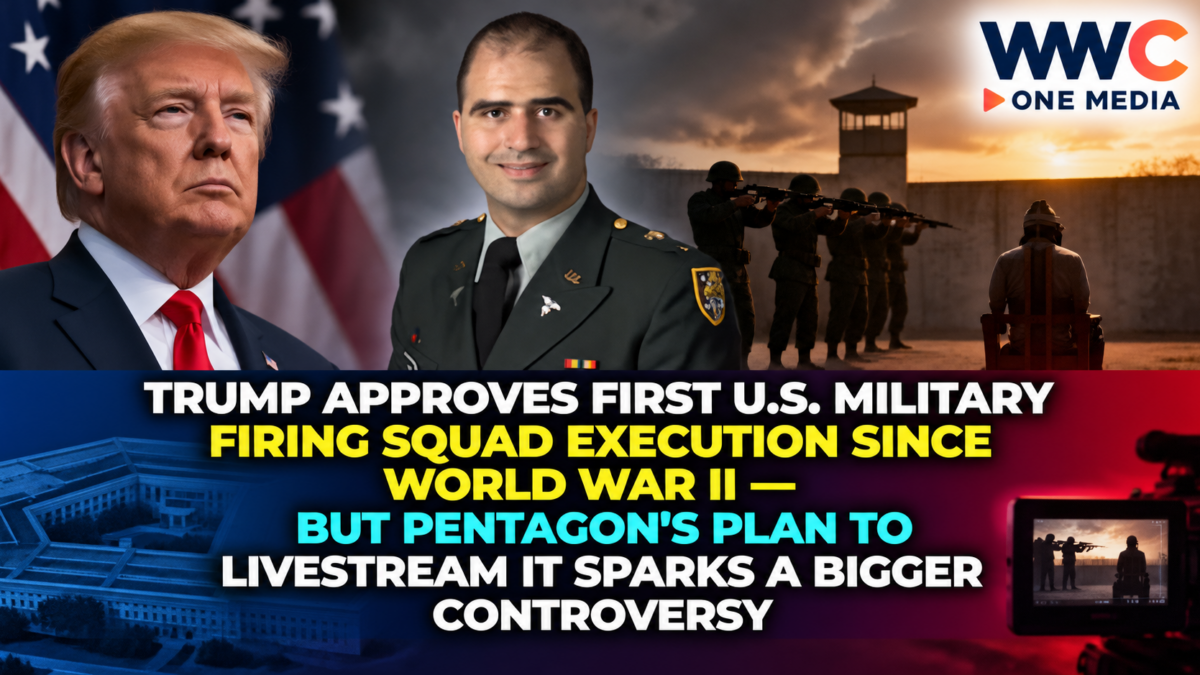
WASHINGTON — The United States military is preparing to carry out its first execution in 65 years, with President Donald Trump approving the death by firing squad of a former Army major convicted in one of the deadliest shootings on an American military installation.
But it is not just the method of execution generating international attention.
The Pentagon also plans to livestream the killing, a highly unusual decision that could transform a long-standing military punishment into an unprecedented public event.
Former Army psychiatrist Nidal Malik Hasan, convicted of murdering 13 people and attempting to kill 32 others during the November 5, 2009, shooting at Fort Hood, Texas, is scheduled to be executed on December 3, 2026.
Defense Secretary Pete Hegseth publicly confirmed the plan on October 8, while the Pentagon subsequently told news organizations that the execution would be broadcast online.
The Financial Times, Associated Press, CBS News and The Washington Post reported that the decision marks a major departure from decades of American military practice, both in its use of a firing squad and its intended public visibility.
The Fort Hood shooting that shocked America
The case dates back nearly 17 years to November 5, 2009, when Hasan opened fire inside the Soldier Readiness Processing Center at Fort Hood, now known as Fort Cavazos.
The installation was a major deployment and training center for American military personnel.
Hasan, an Army psychiatrist, killed 13 people and wounded 32 others in an attack that became one of the deadliest incidents of violence on a US military base.
Investigators examined Hasan’s extremist beliefs and opposition to American military operations overseas.
During his 2013 court-martial, Hasan represented himself and acknowledged responsibility for the shooting. A military jury convicted him of 13 counts of premeditated murder and 32 counts of attempted murder, sentencing him to death.
Hasan was paralyzed after being shot by police responding to the attack. He has since been held at the United States Disciplinary Barracks at Fort Leavenworth, Kansas.
December 3: A historic execution date
13
People killedFort Hood attack, 2009
32
People woundedFort Hood attack, 2009
65
Years since last US military executionLast carried out in 1961
Dec. 3
Scheduled execution2026, subject to legal proceedings
Sources: Associated Press, CBS News and Al Jazeera, October 2026.
The Pentagon has scheduled Hasan’s execution for December 3 at Fort Hood, Texas.
If carried out, it would be the first execution conducted by the United States military since 1961, when former Army soldier John Bennett was executed by hanging.
It would also mark the military’s first use of a firing squad since 1945, in the aftermath of World War II.
These historic distinctions concern executions carried out under military authority. Civilian executions under state and federal systems have followed a separate history.
According to reporting by The Wall Street Journal and The Washington Post, Trump’s approval followed a recommendation from Hegseth, who supported the use of a firing squad.
Pentagon’s livestream plan creates a new controversy
Perhaps the most extraordinary element of the case is the Pentagon’s intention to make the execution viewable online.
Military executions have traditionally been tightly controlled, with access limited to authorized witnesses, officials and, in some circumstances, representatives of victims’ families or the press.
This proposed livestream would dramatically expand public access.
Hegseth has argued that the execution should demonstrate the seriousness of Hasan’s crimes and the consequences of attacking fellow American service members.
For the administration, the decision is being presented as an expression of military accountability and justice for the victims.
But making an execution available online raises a different set of questions.
Human rights advocates and opponents of capital punishment have long argued that state executions raise profound ethical issues, particularly concerning human dignity and the risk of cruel or degrading punishment.
Broadcasting an execution could intensify that debate by transforming a judicially authorized punishment into material capable of being circulated, replayed and distributed worldwide.
The Washington Post noted that there is no established military regulation explicitly authorizing the public broadcasting of an execution, creating questions about how the Pentagon intends to implement its plan.
Why Trump chose a firing squad instead of lethal injection
The approval of a firing squad comes amid wider changes to federal execution policy under the Trump administration.
In recent years, lethal injection has become increasingly controversial because of difficulties obtaining execution drugs, concerns about prolonged procedures and litigation over potentially painful executions.
The administration has moved to expand the availability of alternative methods, including firing squads, electrocution and gas asphyxiation.
Reuters reported on October 6 that Hasan’s execution follows this wider policy shift.
However, the use of a firing squad in his case does not mean that lethal injection has been abandoned throughout the American justice system.
Individual states have their own execution laws, while military executions operate under a distinct legal framework.
Could Hasan’s execution still be stopped?
Although Trump has approved the method and the Army has announced an execution date, Hasan’s death is not legally inevitable.
Military capital cases are subject to extensive procedural safeguards, and federal courts may review legal challenges.
Legal experts interviewed by the Associated Press and Al Jazeera said Hasan may still seek judicial intervention capable of delaying the execution.
His history of representing himself and expressing little interest in avoiding the death penalty has raised questions about whether he will pursue all available legal options.
The Associated Press also reported concerns about his access to legal counsel around the announcement.
The December 3 date therefore represents the military’s current plan, not a guarantee that the execution will occur as scheduled.
A public execution could reverse nearly 90 years of American practice
The controversy extends beyond military law into American history.
Public executions were once part of the United States’ criminal justice system, sometimes drawing enormous crowds.
One of the most widely recognized final public executions occurred in Owensboro, Kentucky, in 1936, when Rainey Bethea was hanged before thousands of spectators.
In subsequent decades, execution procedures became increasingly restricted and shielded from public audiences.
An Associated Press historical analysis published October 9 notes that the Pentagon’s livestream plan could fundamentally reverse that development.
Supporters of transparency argue that the public should be able to examine how the government carries out its most severe punishment.
Opponents contend that broadcasting someone’s death risks creating a spectacle rather than advancing justice.
The internet creates another unprecedented challenge
The proposed livestream would also create major questions for technology companies.
A government execution made available online could be recorded, reposted, edited and distributed across social media platforms.
That raises questions about existing rules governing graphic violence and whether platforms would treat official government footage differently from other recordings of deaths.
Technology publication The Verge contacted several major online platforms, including YouTube, TikTok, Meta, Twitch and others, seeking clarification about whether they would permit such a broadcast.
At the time of its reporting, those platforms had not provided responses establishing how the planned execution would be handled.
The bigger picture: Justice, deterrence or spectacle?
The Fort Hood shooting left families mourning loved ones, survivors facing lifelong consequences and the American military confronting a devastating attack from within its ranks.
The conviction and death sentence were the outcome of formal military legal proceedings.
For those supporting the execution, the focus is on accountability for the victims and the gravity of Hasan’s crimes.
For opponents of capital punishment, the decision raises serious concerns about the state’s power to take a life, the method selected and the broader implications of publicizing an execution.
The Pentagon’s unprecedented broadcast plan adds another dimension.
It could create a historical precedent for making the death penalty a widely accessible public event in an era when digital footage can circulate indefinitely.
The real controversy may ultimately be less about whether the military has the authority to carry out Hasan’s sentence — and more about whether the government should turn that execution into a livestream watched around the world.
That question could shape the future of American military justice long after the Fort Hood case is resolved.