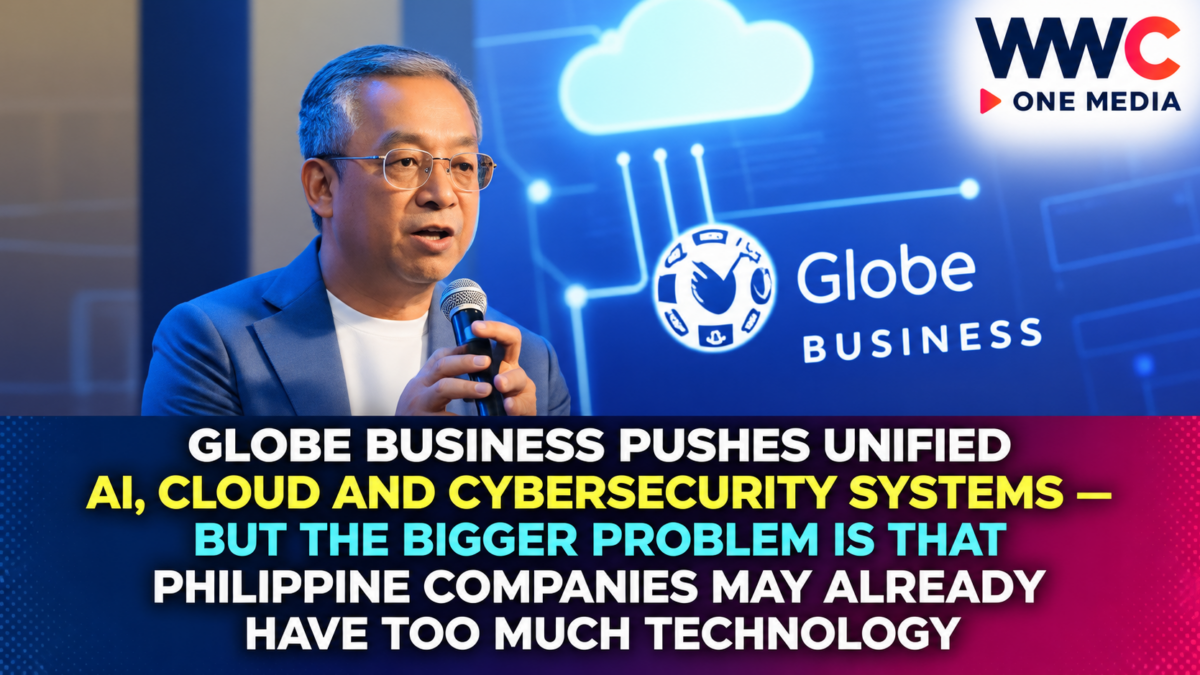
MANILA — Philippine companies have spent years buying cloud platforms, cybersecurity tools, productivity applications, analytics software and artificial intelligence systems.
Now Globe Business says the next competitive advantage may come from doing something much less glamorous:
making all of those technologies actually work together.
Globe Business is pushing what it calls:
Intelligent Transformation.
Instead of treating:
Connectivity
Cloud
Cybersecurity
Application programming interfaces
Business applications
and
Artificial intelligence
as separate technology investments, Globe wants companies to connect them into a single operating environment.
The shift reflects an increasingly common corporate problem.
Businesses have spent years:
digitizing
automating
and
moving workloads to the cloud.
But many now find themselves managing dozens—or even hundreds—of disconnected applications.
Globe Business says enterprises manage an average of about:
120 applications.
And every additional system can create another:
data silo
security vulnerability
integration problem
or
manual workflow.
That means the next stage of digital transformation may not be about buying more software.
It may be about finally connecting what companies already own.
GLOBE SAYS THE PROBLEM IS NO LONGER A LACK OF TECHNOLOGY
For years, Philippine enterprises were told they needed to:
digitize.
Businesses responded by buying:
ERP platforms
CRM systems
Cloud subscriptions
Collaboration software
Cybersecurity tools
and
AI applications.
But adoption happened department by department.
Finance bought one system.
Marketing bought another.
Human resources added another.
Operations used something different.
Eventually, organizations ended up with multiple technology stacks that did not communicate properly.
That creates a new challenge:
fragmentation.
120 APPLICATIONS CAN BECOME 120 DIFFERENT DATA SILOS
An application may work perfectly on its own.
But business value declines if its information cannot reach another system.
For example:
A customer places an order online.
The sales system receives it.
But inventory information sits somewhere else.
Billing uses another database.
Logistics operates on another platform.
Customer service cannot immediately see what happened.
Employees then start manually moving information between systems.
That creates:
delays
errors
and
duplicate work.
Integration is supposed to remove those barriers.
GLOBE WANTS APIS TO BECOME THE CONNECTIVE TISSUE
One of the technologies Globe Business is emphasizing is:
APIs, or application programming interfaces.
APIs allow different software systems to communicate.
Instead of an employee manually copying information from one platform into another, an API can move the data automatically.
That sounds technical.
But the business impact can be straightforward.
A sale can automatically update:
inventory
billing
delivery
and
customer records.
That turns separate applications into something closer to one operating system.
CONNECTIVITY IS STILL THE FOUNDATION
None of this works without reliable connectivity.
Cloud platforms.
Remote employees.
AI applications.
Digital payments.
IoT devices.
Cybersecurity systems.
They all depend on:
networks.
That explains why Globe Business continues positioning connectivity as the foundation underneath more sophisticated enterprise services.
Its portfolio now extends well beyond traditional internet access into:
cloud connectivity
data centers
software-defined networking
IoT
and
managed infrastructure.
GLOBE IS TRYING TO BECOME MORE THAN A TELCO
This is the larger strategic shift.
Traditional telecommunications companies made money by selling:
mobile service
landlines
and
internet connections.
But enterprise customers increasingly want technology partners capable of handling:
Cloud
Cybersecurity
Applications
Data
and
AI.
Globe is therefore trying to move higher up the technology stack.
Instead of simply providing the pipe carrying the data, it wants to help businesses manage what happens:
inside the pipe.
CORPORATE DATA REVENUE HIT A RECORD ₱11 BILLION
The strategy already appears to be producing growth.
Globe Business said Corporate Data revenue reached a record:
₱11 billion
during the first six months of 2026.
That was up:
15% year over year.
It marked the first time since 2023 that first-half Corporate Data revenue growth returned to:
double digits.
Second-quarter Corporate Data revenue reached another record:
₱5.9 billion.
Demand came from both:
core internet connectivity
and
ICT services.
BUSINESS APPLICATIONS WERE A MAJOR DRIVER
Globe specifically highlighted strength in:
Business Application Solutions.
That category includes tools that help companies manage areas such as:
Enterprise resource planning
Productivity
Customer engagement
and
Business processes.
The growth demonstrates an important change in the enterprise telecom market.
Customers are increasingly buying:
solutions
rather than simply:
bandwidth.
GLOBE SPENT ₱26.3 BILLION IN THE FIRST HALF
Supporting that growth requires infrastructure.
Globe invested approximately:
₱26.3 billion
in capital expenditures during the first half of 2026.
About:
91%
went toward data-related initiatives.
That includes investments designed to increase:
network capacity
and
service quality.
The scale of that spending demonstrates why enterprise digital transformation remains strategically important to telecom operators.
More business applications ultimately generate more:
data traffic.
AI IS THE NEWEST LAYER
Artificial intelligence has become the most visible part of Globe Business’ strategy.
But executives are warning customers not to treat AI as a magic solution.
Globe Business vice president Glenn Estrella has repeatedly argued that organizations should first fix:
broken processes.
His warning is simple:
If a process is inefficient before AI is introduced, automation can simply make the inefficiency happen:
faster.
That is an important distinction.
AI works best when companies already understand how the process is supposed to function.
THIS IS WHY “INTELLIGENT TRANSFORMATION” IS DIFFERENT FROM DIGITAL TRANSFORMATION
Traditional digital transformation often focused on replacing:
paper
with
software.
A company might move documents to the cloud.
Install an ERP system.
Launch an e-commerce website.
Adopt digital payments.
Intelligent transformation attempts to go one step further.
The systems are supposed to:
communicate
analyze information
and
automatically respond.
That is where AI becomes more valuable.
CONSIDER A RETAIL BUSINESS
Imagine a retailer operating:
50 stores.
Its systems generate data from:
Point-of-sale terminals
Inventory
Customer loyalty programs
Online stores
Social media
and
Supply chains.
If those platforms remain separate, management may receive incomplete information.
But integrate them and AI can potentially identify:
which products will sell
where stock should be moved
and
which customers should receive promotions.
That is the type of outcome Globe is trying to demonstrate.
CYBERSECURITY BECOMES EVEN MORE IMPORTANT WHEN EVERYTHING IS CONNECTED
Integration creates opportunity.
It also creates risk.
When systems communicate, a breach in one platform can potentially spread into another.
That means cybersecurity must be built into the architecture.
Globe Business offers services spanning:
Network security
Endpoint protection
Cloud security
Identity management
Security monitoring
and
Incident response.
That fits the unified-system strategy.
Security cannot be added only after systems are connected.
It needs to operate across the entire environment.
GLOBE SAYS PHILIPPINE BUSINESSES ARE ALREADY MAJOR CYBER TARGETS
Globe’s cybersecurity materials cite research suggesting a very high proportion of Philippine organizations have experienced security incidents.
The company says:
94% of Philippine businesses
have experienced some form of cybersecurity breach.
Whether the precise percentage differs by survey methodology, the broader threat is real.
Companies are processing more:
customer data
payments
and
cloud workloads
than ever before.
That creates more potential entry points for attackers.
AI MAKES CYBERATTACKS MORE SOPHISTICATED TOO
AI does not benefit only legitimate businesses.
Attackers can use it for:
Phishing
Social engineering
Malware development
and
Automated reconnaissance.
That creates an escalating technology race.
Companies use AI to identify threats.
Attackers use AI to find vulnerabilities.
Integrated security platforms can help organizations respond more quickly because alerts from multiple systems can be analyzed together.
PHILIPPINE SMEs FACE AN EVEN BIGGER CHALLENGE
Large corporations can afford dedicated:
IT departments
and
cybersecurity teams.
Small businesses often cannot.
Yet Philippine SMEs represent nearly the entire domestic business population.
Globe cites government data showing SMEs account for roughly:
99.6% of registered Philippine businesses
and nearly:
67% of employment.
That means improving small-business technology adoption could have significant economic impact.
COST REMAINS ONE OF THE BIGGEST BARRIERS
Many SMEs assume AI requires enormous budgets.
Globe argues that is increasingly incorrect.
Some entry-level AI tools can cost around:
₱1,200 per month.
Businesses can experiment before committing to larger deployments.
That allows a restaurant, retailer or professional-service company to automate smaller tasks first.
Examples might include:
Marketing copy
Customer responses
Inventory analysis
or
Internal reporting.
The point is to start where returns are measurable.
BUT SMEs CAN CREATE THE SAME FRAGMENTATION PROBLEM AS LARGE COMPANIES
Cheap software creates another danger.
A small business may subscribe to:
one accounting app
one messaging system
one e-commerce platform
one CRM
and
several AI tools.
Suddenly the company has:
six subscriptions
but no unified workflow.
The owner then manually transfers information between them.
That defeats much of the purpose of automation.
The solution is not necessarily more software.
It is better integration.
CLOUD IS CENTRAL TO THE STRATEGY
Cloud computing makes integration easier because applications can interact without all infrastructure sitting inside one office.
Businesses can scale resources up or down.
Employees can access systems remotely.
Data can be centralized.
Globe offers cloud services spanning:
Software as a service
Platform as a service
and
Infrastructure as a service.
Cloud adoption also creates recurring revenue opportunities for enterprise providers.
GLOBE IS WORKING WITH GLOBAL CLOUD PLAYERS
Globe has strengthened relationships with companies including:
Amazon Web Services
and
Google Cloud.
At Mobile World Congress 2026, Globe highlighted how AWS supported modernization of:
infrastructure
data security
and
AI-driven customer experiences.
These partnerships matter because no telecom company can realistically build every technology itself.
The winning model is increasingly:
telecom infrastructure + global cloud platforms + local enterprise support.
ASEAN MAKES THE OPPORTUNITY BIGGER
Globe is also positioning the strategy around:
regional expansion.
The ASEAN Digital Economy Framework Agreement is expected to make cross-border digital business easier through areas including:
Digital trade
Data flows
Electronic payments
Cybersecurity
and
Emerging technology.
For Philippine companies, that could make expanding across Southeast Asia easier.
But regional expansion requires technology systems that can scale across:
countries
currencies
and
regulations.
CONNECTED SYSTEMS BECOME EVEN MORE IMPORTANT ACROSS BORDERS
Imagine a Philippine retailer expanding into:
Indonesia
Vietnam
and
Thailand.
Without integration, the company may operate separate:
inventory systems
payment systems
and
customer databases
in each country.
That quickly becomes difficult to manage.
A unified digital architecture can make regional growth easier.
This is why Globe increasingly links enterprise technology with ASEAN expansion.
THE PHILIPPINES HAS A STRONG SME GROWTH OUTLOOK
Recent regional business surveys have shown relatively high confidence among Philippine small businesses.
CPA Australia’s Asia-Pacific Small Business Survey found:
79%
of surveyed Philippine small businesses reported growth in 2025.
Around:
89%
expected to grow in 2026.
That was among the strongest optimism levels in the markets surveyed.
Growth creates technology demand.
A small company can survive with basic systems.
A rapidly expanding one usually cannot.
GROWTH MAKES BAD SYSTEMS BREAK FASTER
This is one of the most overlooked business problems.
A company can tolerate inefficient processes when it has:
10 employees
and
100 customers.
At:
500 employees
and
100,000 customers,
the same inefficiency becomes extremely expensive.
Orders get lost.
Customer service slows.
Reporting becomes inaccurate.
Security gaps multiply.
Technology therefore becomes increasingly important as businesses scale.
UNIFIED SYSTEMS CAN ALSO REDUCE COSTS
Integration is not only about growth.
It can remove repetitive work.
Employees may spend hours:
copying data
reconciling reports
and
checking multiple applications.
Automation can eliminate part of that work.
That allows people to focus on tasks requiring:
judgment
creativity
and
customer interaction.
For businesses facing wage and operating-cost pressure, those savings matter.
CUSTOMER EXPERIENCE IS ANOTHER MAJOR TARGET
Consumers increasingly interact with companies across:
Websites
Mobile apps
Social media
Call centers
and
Physical stores.
The problem is that these channels often operate separately.
A customer may complain through Facebook.
Then call customer service.
The call-center employee may have no record of the earlier conversation.
Unified customer systems can solve that.
They create one view of the customer across channels.
AI BECOMES MORE POWERFUL WHEN THE DATA IS UNIFIED
This may be the biggest technological argument behind Globe’s strategy.
AI is only as useful as the information it can access.
If customer data sits in:
20 different systems,
the AI sees only fragments.
Connect those systems and AI can analyze:
purchases
complaints
interactions
and
preferences
together.
That can improve:
recommendations
fraud detection
forecasting
and
customer service.
The value therefore comes from integration before intelligence.
APIs MAY BECOME ONE OF THE MOST VALUABLE ENTERPRISE TOOLS
APIs sound technical.
But their economic importance is enormous.
They allow companies to build an:
ecosystem.
Banks use APIs to connect fintech applications.
Retailers use them to connect logistics providers.
Hotels connect reservation systems.
Telecom operators connect messaging and authentication services.
Once businesses become API-enabled, adding new partners becomes easier.
That creates speed.
And speed increasingly determines competitive advantage.
THE BIGGER COMPETITION IS NOT JUST PLDT VERSUS GLOBE
In enterprise technology, Globe competes with much more than another telecom operator.
It competes directly or indirectly with:
Cloud providers
Cybersecurity firms
Software vendors
Systems integrators
and
Managed-service providers.
That means Globe cannot win simply by offering internet connectivity.
It needs to demonstrate that it can orchestrate technology across multiple vendors.
That is the commercial logic behind the unified-system message.
ENTERPRISE CUSTOMERS ALSO WANT FEWER VENDORS
Managing many technology suppliers creates administrative complexity.
Each vendor has:
contracts
support desks
billing
and
security requirements.
Large businesses increasingly prefer consolidated relationships where one provider helps manage multiple technologies.
That does not necessarily mean one company supplies every product.
It means one partner helps make them work together.
Globe wants to occupy that role.
THIS COULD INCREASE CUSTOMER STICKINESS
From Globe’s perspective, unified enterprise services have another major advantage:
switching becomes harder.
A company can relatively easily change an internet provider.
But replacing a partner deeply integrated into:
Cloud
Cybersecurity
Applications
and
Networks
is much more complicated.
That creates longer-term customer relationships.
It can also increase recurring revenue.
THE STRATEGY IS ALREADY SHOWING UP IN GLOBE’S NUMBERS
The record:
₱11 billion
in first-half Corporate Data revenue provides evidence that enterprise demand is growing.
The:
15% year-over-year increase
was particularly notable because corporate technology spending can slow when economic conditions weaken.
Instead, businesses appear to continue investing in:
connectivity
ICT
and
applications.
That suggests digital infrastructure is increasingly treated as essential rather than optional.
BUT THERE IS A RISK: COMPANIES CAN OVERBUY TECHNOLOGY
The industry’s biggest danger may actually be:
technology overload.
Executives often buy new software because competitors are using it.
AI has intensified that behavior.
Every department wants an AI tool.
But if companies cannot measure:
return on investment,
subscriptions can become expensive clutter.
That makes disciplined implementation critical.
Technology should solve a defined problem.
Not simply satisfy pressure to appear innovative.
AI PILOTS NEED TO BECOME REAL BUSINESS SYSTEMS
Many organizations already have AI:
pilot projects.
Far fewer have AI running mission-critical operations at scale.
The difference lies in:
Data quality
Integration
Security
and
Governance.
A chatbot demonstration can be built quickly.
An AI system connected to real:
customer records
financial information
and
operational workflows
requires much stronger architecture.
That is where enterprise technology providers see the largest opportunity.
HUMAN JUDGMENT STILL MATTERS
Globe’s own executives emphasize that AI does not replace:
common sense.
That may sound obvious.
But it matters.
AI can automate tasks.
It can identify patterns.
It can generate predictions.
But management still needs to decide:
what problem should be solved
and
whether the recommendation makes business sense.
Automation without oversight can amplify mistakes.
THE BIGGER STORY: PHILIPPINE COMPANIES MAY BE ENTERING THE “POST-DIGITAL TRANSFORMATION” ERA
For more than a decade, businesses were told:
Go digital.
Move to the cloud.
Launch an app.
Automate your operations.
Collect more data.
Add cybersecurity.
Now many companies have done exactly that.
The new problem is that all those investments often operate separately.
That is why Globe Business’ message is changing.
The next competitive advantage may not come from adding the:
121st application.
It may come from making the first:
120 applications
work together.
For Globe, that creates an important business opportunity.
Its enterprise revenue is already growing.
Corporate Data revenue hit a record:
₱11 billion
in the first half.
Cloud adoption continues.
Cybersecurity spending is increasing.
AI experimentation is spreading from large companies into SMEs.
And regional digital integration could give Philippine businesses access to much larger ASEAN markets.
But the companies that gain the most will probably not be those that simply buy the most technology.
They will be the ones that connect:
Networks
Data
Applications
Security
and
AI
into one operating system for the business.
Globe Business is betting that the next phase of Philippine digital transformation will not be won by companies with the most software — but by those that can finally make all their technology behave like one intelligent system.