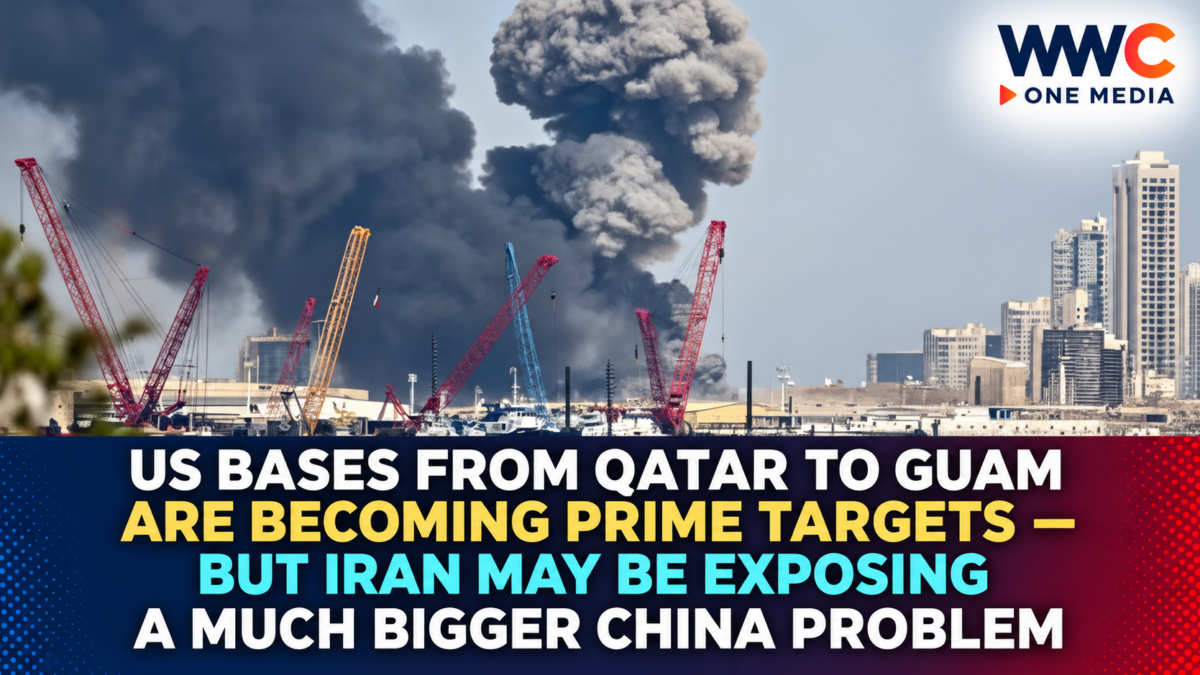
For decades, America’s sprawling network of overseas military bases was one of its greatest strategic advantages.
Those bases allowed U.S. bombers, fighter jets, warships, intelligence units and troops to operate thousands of miles from American territory while reassuring allies that Washington could respond rapidly to a crisis.
But the war with Iran is exposing an uncomfortable weakness in that strategy.
The bases that allow the United States to project military power abroad are increasingly becoming some of the easiest high-value targets for adversaries armed with ballistic missiles, cruise missiles and inexpensive attack drones.
That is the warning behind a new Bloomberg Opinion column by James Stavridis, a retired four-star U.S. Navy admiral and former NATO supreme allied commander.
And the implications extend far beyond Iran.
If Tehran can repeatedly threaten American facilities across the Middle East, military planners must confront an even more difficult question:
What happens to large U.S. bases in Japan, Guam, South Korea and potentially other Indo-Pacific locations during a conflict with China?
IRAN HAS TURNED AMERICAN BASES INTO A FRONT LINE
The theoretical vulnerability of overseas military bases has become a real battlefield problem in 2026.
Since the U.S.-Israel war with Iran began in late February, Tehran has repeatedly launched drones and missiles at American military facilities and other U.S. assets around the Middle East.
Iranian attacks have struck or targeted U.S. positions in Qatar, Bahrain, Iraq, Jordan, Kuwait and the United Arab Emirates during different stages of the conflict. Reuters reported in September that Iran retaliated against renewed American strikes by attacking U.S. assets in Jordan, Bahrain and Iraq.
Al Udeid Air Base in Qatar — the largest U.S. military installation in the Middle East — has become one of the most prominent targets.
The base hosts a critical American command-and-control presence and has repeatedly come under Iranian attack during the conflict. Reuters confirmed this week that Al Udeid has been targeted by Iran since the war began.
That represents a major reversal of the traditional logic behind forward deployment.
A facility designed to place American combat power closer to an adversary also places thousands of personnel, aircraft, fuel storage sites, communications systems and other equipment closer to that adversary’s missiles.
18 AMERICAN TROOPS KILLED, MORE THAN 750 WOUNDED
The danger is no longer hypothetical.
By early September, the United States had reported 18 military personnel killed and more than 750 wounded during the Iran conflict, according to Reuters.
Earlier in the war, Iranian missile and drone attacks repeatedly forced American forces to defend military installations throughout the Gulf.
Even distant locations have not been completely beyond Iran’s reach.
In March, Reuters reported that Iran fired long-range ballistic missiles at the joint U.S.-UK installation on Diego Garcia in the Indian Ocean — a base long regarded as valuable partly because of its distance from the Persian Gulf.
The lesson for American planners is stark.
Moving forces farther from an enemy increases safety — but modern long-range weapons are steadily shrinking what counts as “far enough.”
THE NEW THREAT IS CHEAPER THAN THE BASE IT IS ATTACKING
There is also an economic imbalance working against large military installations.
Modern American air bases can contain billions of dollars in aircraft, radar systems, fuel, ammunition, communications equipment and infrastructure.
Attack drones can cost only a tiny fraction of that amount.
An adversary does not necessarily need to destroy an entire base.
Damaging a runway, fuel depot, electrical system, radar installation or ammunition storage facility may be enough to interrupt operations.
Large missile barrages can also force defenders to expend expensive interceptors.
That creates what military planners increasingly describe as a cost-exchange problem: an attacker can potentially launch relatively inexpensive weapons while the defender burns through far more costly missiles attempting to stop them.
The Pentagon’s own 2026 National Defense Strategy acknowledges the need for more cost-effective defenses against large missile barrages and specifically calls for expanded counter-drone capabilities.
AMERICA’S BIG BASE MODEL WAS BUILT FOR A DIFFERENT ERA
After World War II and throughout the Cold War, U.S. forces built or operated from enormous installations across Europe and Asia.
The system worked because forward bases delivered several major advantages.
Aircraft could operate closer to potential battlefields.
Ships could be repaired and resupplied without returning to the continental United States.
Troops could train with allies.
And their physical presence acted as a political tripwire: attacking the host country also risked directly killing American troops.
But technological changes are weakening the assumption that these installations can operate relatively safely behind the front lines.
Precision-guided ballistic missiles, cruise missiles, autonomous systems and long-range drones allow adversaries to strike infrastructure hundreds or even thousands of kilometers away.
The question is therefore shifting from whether a base can be attacked to whether American forces can continue operating after it is attacked.
THE BIGGER NIGHTMARE IS CHINA
Iran has demonstrated the vulnerability.
China could potentially test it on a much larger scale.
A conflict over Taiwan or the wider western Pacific could place some of America’s most important regional installations inside heavily contested missile zones.
Those include facilities on Okinawa and elsewhere in Japan, American installations in South Korea and critical military infrastructure on Guam.
The concern is serious enough that the Pentagon is spending heavily to create a far more sophisticated defense network around Guam.
The Defense Department’s FY2026 Pacific Deterrence Initiative includes development of a persistent 360-degree integrated air-and-missile defense system for Guam, combining Aegis, radar and other missile-defense capabilities.
Guam matters because it is far enough from mainland China to serve as an important logistics, bomber, submarine and command hub while remaining close enough to support Indo-Pacific operations.
That strategic value also makes it an obvious priority for protection.
THE PENTAGON’S ANSWER: STOP PUTTING EVERYTHING IN ONE PLACE
The U.S. Air Force has already been changing how it prepares for war.
Instead of concentrating aircraft, personnel and supplies at a small number of enormous bases, the military is increasingly training to disperse forces among many smaller locations.
The concept is known as Agile Combat Employment, or ACE.
The idea is simple: if an enemy can identify and target a handful of giant air bases, give it dozens of smaller operating locations instead.
Aircraft can move between them.
Fuel and weapons can be distributed.
Smaller teams can operate with less centralized support.
And destroying one installation no longer cripples the entire campaign.
The Air Force demonstrated this approach during its large-scale 2025 Indo-Pacific exercises, dispersing aircraft and personnel to multiple operating locations across the region specifically to practice functioning in “highly contested environments.”
In South Korea this year, Seventh Air Force also practiced continuing operations after assuming its primary air-operations center had become unusable. Personnel and capabilities were dispersed among multiple locations so commanders could continue directing missions.
That exercise reveals how dramatically U.S. planning assumptions are changing.
The Pentagon is no longer merely preparing to prevent bases from being hit.
It is preparing to fight after important bases have already been disabled.
THE PHILIPPINES COULD BECOME PART OF THAT DISTRIBUTED NETWORK
This debate has major implications for the Philippines.
The Philippines and United States are treaty allies, while Washington has access to selected Philippine military facilities under the Enhanced Defense Cooperation Agreement.
Those facilities remain Philippine bases — they are not U.S.-owned military bases — an important distinction that is frequently blurred in public discussion.
But Philippine geography makes the country increasingly important to American distributed operations in the Indo-Pacific.
During Balikatan 2026, U.S. Air Force units practiced operating with a reduced footprint and supporting Agile Combat Employment concepts in the Philippines.
The 21st Air Task Force also transitioned into an Air Expeditionary Wing during Balikatan and operated from Clark Air Base while practicing centralized command combined with distributed execution
Pentagon budget documents are even more explicit about the strategic logic.
A U.S. Air Force FY2027 budget document describes efforts to support advanced basing and distributed operations across a chain running from Japan through Taiwan and the Philippines, with the stated objective of strengthening deterrence against Chinese aggression.
That does not mean war is inevitable.
But it does mean the Philippines sits squarely inside the emerging debate over how U.S. forces might survive and operate during a major Indo-Pacific confrontation.
DISPERSAL CREATES A NEW PROBLEM
Breaking one giant base into dozens of smaller locations makes forces harder to destroy.
It also makes them harder to supply.
Every dispersed airfield needs some combination of fuel, ammunition, spare parts, communications equipment, security and maintenance crews.
Moving those supplies across islands and oceans during wartime would be extraordinarily difficult.
China would not need to attack every airfield simultaneously.
It could target ports, fuel ships, transport aircraft, communications networks and logistics hubs.
That means the future of American military power in Asia may depend as much on logistics as on fighter jets or aircraft carriers.
A stealth fighter without fuel, missiles or a usable runway is not much of a deterrent.
BASE DEFENSE COULD BECOME ONE OF AMERICA’S MOST EXPENSIVE MILITARY PROBLEMS
The United States therefore faces three broad choices.
It can spend heavily to harden existing installations with missile defenses, shelters, redundant runways and underground infrastructure.
It can disperse personnel and aircraft across more locations.
Or it can move more combat capability onto submarines, ships, long-range aircraft and unmanned platforms that are harder to locate and strike.
In reality, Washington will probably need some combination of all three.
But every option is expensive.
Missile defenses require large numbers of interceptors.
Dispersed operations require more logistics.
Long-range aircraft and submarines are extraordinarily costly.
And hardening infrastructure across dozens of bases could require years of construction.
The Iran war has already strained American inventories. Reuters reported this month that sustained Middle East operations have depleted important U.S. munitions and imposed tens of billions of dollars in costs, while replenishing some weapons could take years.
By July, Reuters estimated the direct financial cost of the Iran war had already exceeded $37.5 billion, with the administration seeking nearly $90 billion more.
EVEN EUROPEAN BASES ARE FACING NEW SECURITY THREATS
The challenge is not limited to missiles in the Middle East or Pacific.
On October 8, British counterterrorism police said two men had been arrested after allegedly breaching the perimeter of RAF Molesworth, a British installation used by U.S. and NATO personnel.
The incident came after a separate suspected plot involving RAF Fairford, another British base used by the United States. Authorities have said the incidents are not currently believed to be connected
The nature of those threats is very different from a ballistic missile attack.
But together they highlight a broader reality: large, identifiable military installations are increasingly vulnerable to conventional strikes, drones, sabotage, cyberattacks and other forms of disruption.
CLOSING THE BASES ISN’T AN EASY ANSWER EITHER
There is an obvious response to vulnerable forward bases:
Bring the troops home.
But doing so would create other strategic problems.
American bases reassure allies.
They allow forces to react quickly.
They reduce the enormous distances aircraft and ships must travel from the United States.
And perhaps most importantly, their presence strengthens deterrence.
An adversary considering an attack on Japan, South Korea or another American partner knows that U.S. forces could immediately become involved because they are already there.
Removing those forces might protect American personnel from an initial strike while simultaneously making aggression appear less risky.
The strategic challenge therefore is not simply to eliminate overseas bases.
It is to make them survivable enough that attacking them does not eliminate America’s ability to fight back.
IRAN MAY BE GIVING CHINA A LESSON — AND THE U.S. A WARNING
That may ultimately be the biggest significance of what is happening in the Middle East.
Iran is not China.
Its economy, military budget, industrial capacity and conventional military capabilities are dramatically smaller.
Yet Tehran has still managed to impose serious costs on an American military that has dominated conventional warfare for decades.
By September, the U.S. had acknowledged 18 military deaths and more than 750 wounded in the Iran conflict.
The United States has responded with enormous military power, including carrier operations, airstrikes, missile defenses and additional deployments.
But the conflict has revealed that U.S. bases themselves are no longer guaranteed sanctuaries.
And every military strategist in Beijing can study the same lessons.
Where are American aircraft concentrated?
Which runways are indispensable?
Where is the fuel stored?
Which ports sustain the fleet?
Which communications nodes connect commanders to forces?
How many missile-defense interceptors are available?
And how quickly can damaged facilities return to operation?
Those questions are becoming just as important as how many F-35s, bombers or aircraft carriers America possesses.
THE AGE OF THE INVULNERABLE OVERSEAS BASE MAY BE OVER
America’s worldwide base network remains one of the foundations of its military power.
But the definition of a useful base is changing.
The future may belong less to enormous installations filled with aircraft parked wing-to-wing and more to networks of smaller, dispersed and rapidly movable forces connected across many locations.
Guam is being hardened.
American forces in Korea are practicing distributed command.
U.S. airmen are training for decentralized operations in the Philippines.
And the Pentagon is investing specifically in countering large missile barrages and unmanned aircraft.
Iran has made the urgency impossible to ignore.
The real test, however, would come against an adversary with a much larger missile arsenal and the industrial capacity to sustain a prolonged high-intensity conflict.
That is why America’s overseas-base problem is no longer merely a Middle East problem.
It is becoming one of the central questions hanging over any future confrontation with China.
And in the Pacific, the answer could determine whether U.S. forces can keep fighting after the first missiles land.