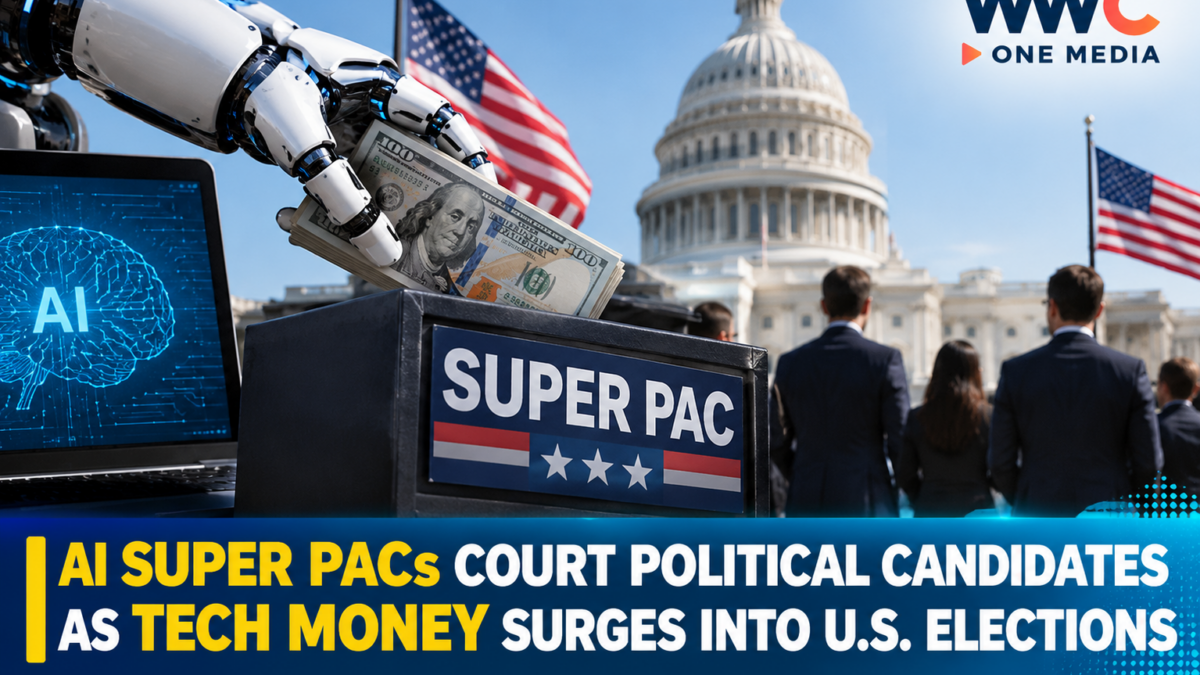
WASHINGTON — Artificial intelligence is no longer just transforming technology and business. It is increasingly becoming part of the political money game, as AI-linked groups pour millions of dollars into U.S. election campaigns.
A new editorial cartoon published by The Korea Times on Oct. 7, titled “AI Super PACs Court Candidates,” uses satire to highlight the growing relationship between artificial intelligence companies, political spending and candidates.
The cartoon reflects a broader development in the 2026 U.S. election cycle: technology companies and AI interests are becoming significant players in campaign financing, using political advertising and outside groups to promote candidates and influence debates over AI regulation.
AI Money Enters the Political Arena
Reporting by the Los Angeles Times found that two networks of super PACs connected to Anthropic and OpenAI had spent more than $38 million on efforts to influence congressional races by June. The groups have supported candidates across different parts of the country while advancing competing approaches to AI regulation.
Super PACs can raise and spend unlimited amounts of money independently of candidates, making them an important vehicle for outside political spending in U.S. elections.
In some contests, AI-backed groups have reportedly spent more on advertising than the candidates themselves, illustrating how financial support from technology interests can become a major factor in competitive races.
Candidates Are Also Turning to AI
The influence does not run only from technology companies toward candidates.
Candidates themselves are increasingly using AI tools for campaign operations, including communications and advertising. A Washington Post analysis found that dozens of congressional campaigns reported payments to AI companies during the 2026 election cycle, although the extent and purposes of that use varied.
That development has created a complicated political landscape in which AI can simultaneously serve as a campaign tool, a policy issue and a source of political funding.
The Regulation Debate Is Getting Bigger
AI-related campaign spending is also connected to a larger argument over how the technology should be regulated.
The competing AI-backed political networks have supported different approaches to regulation, with disagreements over the role of federal versus state governments and how strict oversight should be.
At the same time, concerns about AI-generated political advertising and deceptive content are growing. Recent research has tracked tens of millions of dollars in political advertisements involving AI, highlighting questions about transparency, disclosure and the potential influence of synthetic media on voters.
The Korea Times cartoon captures that tension through satire: as AI becomes more powerful, the technology industry is also becoming more deeply embedded in the political system that will ultimately decide how AI is governed.
And that raises the bigger question for the 2026 election cycle: if AI money can help court candidates today, how much influence could it have over the rules governing AI tomorrow?
WWC ONE MEDIA G,A