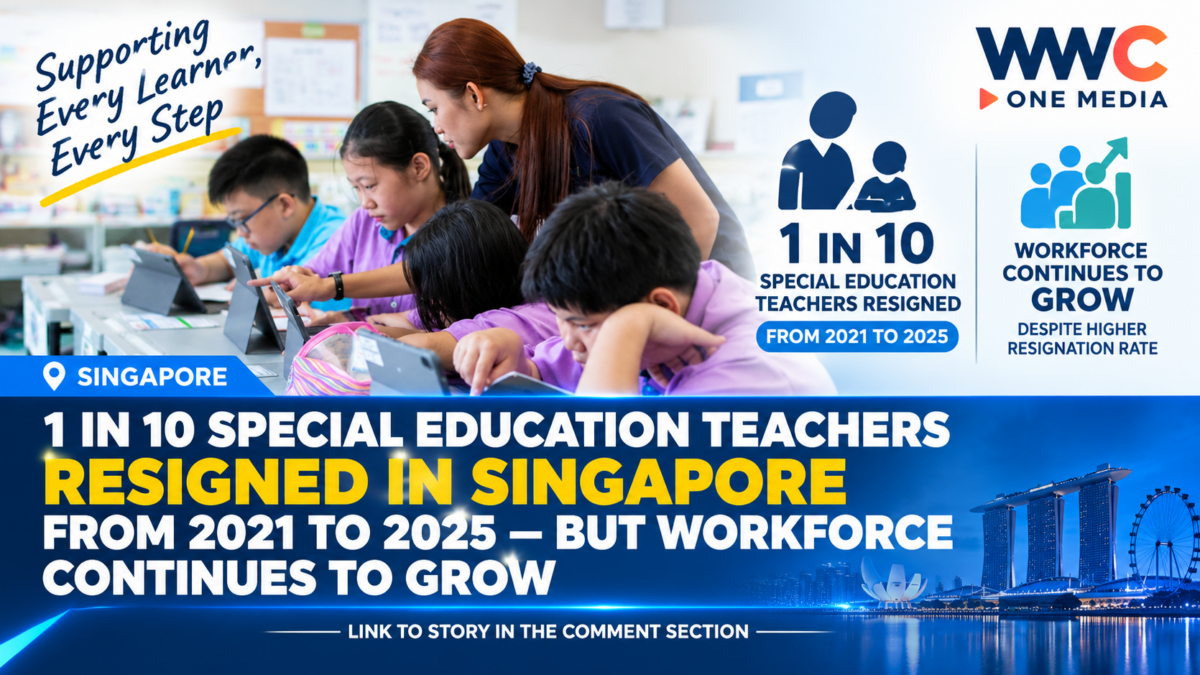
SINGAPORE — About one in 10 special education (SPED) teachers in Singapore resigned between 2021 and 2025, with job changes, personal reasons and family commitments among the most commonly cited reasons, Education Minister Desmond Lee said in Parliament.
The figures, released in a written parliamentary reply on Oct. 6, provide the first publicly disclosed attrition rate specifically for teachers working in Singapore’s SPED schools. These educators work under social service agencies that operate the schools rather than being part of the Ministry of Education’s mainstream educator pool.
Student Numbers Are Growing Faster
Despite the resignations, Singapore’s SPED teaching workforce expanded during the same period.
The number of SPED teachers increased from about 1,600 in 2021 to 1,900 in 2025, an increase of roughly 18%.
However, student enrolment grew more quickly, rising from around 7,000 to 9,000 — approximately 28% — following the opening of five additional SPED schools.
The figures highlight the challenge facing the sector: recruiting more educators while keeping pace with a growing number of students requiring specialized educational support.
Government Moves to Improve Pay and Retention
Lee said the Ministry of Education has been working with social service agencies to strengthen recruitment, remuneration and professional development for SPED educators.
Salary guidelines were updated in 2024, with the sector adopting recommended salary ranges and stronger performance-based remuneration.
For 2024 to 2026, SPED classroom teachers could receive salary increases of up to 12%, while teacher aides could receive increases of up to 15%. By 2026, SPED teachers are expected to earn between S$3,000 and more than S$7,000 a month, while teacher aide salaries are expected to range from S$2,000 to more than S$4,000.
More Support to Reduce Teachers’ Workload
The government is also trying to reduce the pressure on SPED teachers through additional staffing and administrative support.
A shared pool of relief teachers has been introduced so educators can be covered when they are away for training or leave.
The Ministry of Education is also onboarding SPED schools onto Parents Gateway, a platform used for communication between schools and parents. Half of the SPED schools are expected to be onboarded by the third quarter of 2027.
A leadership development programme for the SPED sector was also introduced in 2025 as part of efforts to strengthen professional development and career opportunities.
SPED Sector Faces Rising Demand
The latest figures come as Singapore prepares for further expansion of special education services.
Three additional SPED schools are planned for the early 2030s to accommodate growing demand, including students with autism and intellectual disability.
The situation also differs significantly from mainstream schools. MOE previously reported that mainstream teachers had an annual resignation rate of around 2%, or roughly one in 50 educators, over the past five years.
The contrast underscores the particular workforce pressures facing SPED schools as enrolment increases.
With student numbers rising faster than the SPED teaching workforce, Singapore’s next challenge may be more than recruiting teachers — it could be keeping enough experienced educators in the classroom to meet growing demand.
WWC ONE MEDIA G,A