TAIPEI — Taiwan Semiconductor Manufacturing Co. has delivered another blockbuster quarter as the global artificial-intelligence infrastructure boom continues funneling enormous orders toward the world’s most important chip manufacturer.
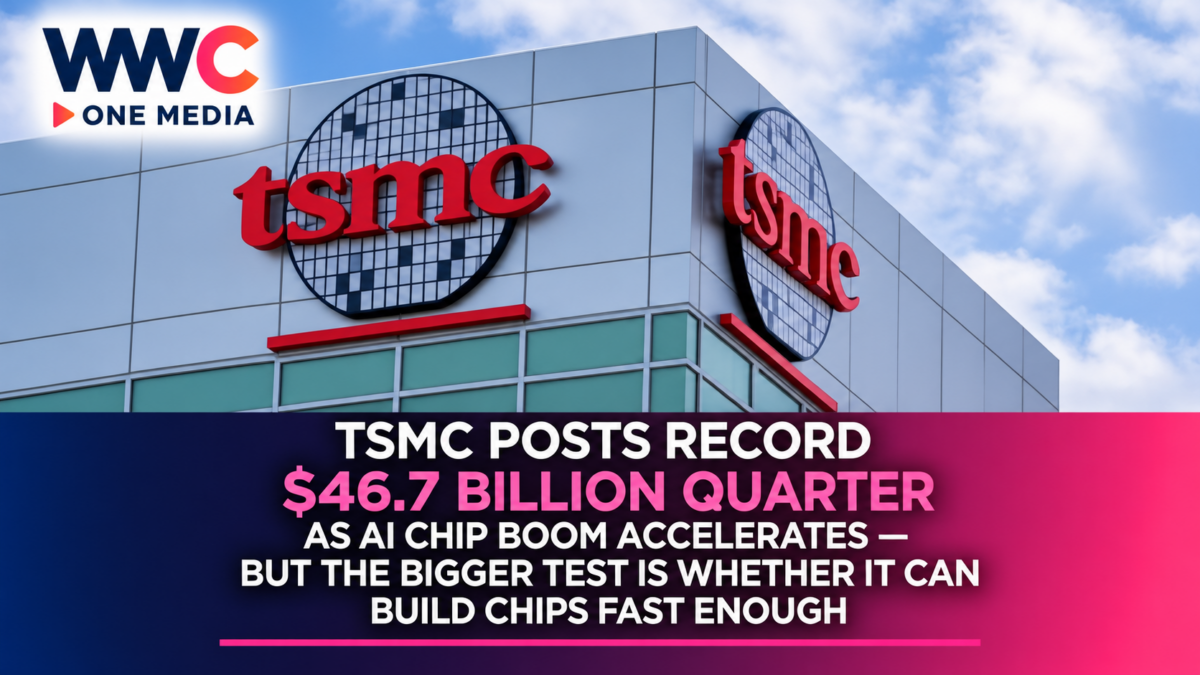
TSMC reported third-quarter revenue of approximately:
NT$1.49 trillion
or around:
US$46.7 billion.
That represented roughly:
50% year-over-year growth
and exceeded analysts’ expectations of approximately:
NT$1.46 trillion.
The result was:
a new quarterly revenue record.
And it reinforces an extraordinary reality surrounding the semiconductor industry:
The AI boom is not simply boosting companies selling artificial-intelligence software.
It is creating unprecedented demand for the factories capable of manufacturing the chips underneath it.
TSMC sits at the center of that supply chain.
Its customers include:
Nvidia
Apple
AMD
Broadcom
and many of the technology companies developing custom AI processors.
FIRST, AN IMPORTANT CORRECTION ABOUT SEPTEMBER
The CNBC headline describes September sales as another record.
But the underlying numbers require a more precise explanation.
TSMC’s August revenue reached:
NT$514.81 billion.
That remains the company’s monthly record.
July revenue was:
NT$467.58 billion.
With Q3 revenue totaling approximately:
NT$1.49 trillion,
September revenue works out to roughly:
NT$508 billion,
depending on the exact unrounded quarterly figure.
That means September remained extraordinarily strong.
But it appears to have been:
slightly below August’s monthly record.
The real record was the quarter.
TSMC JUST BEAT WALL STREET AGAIN
Analysts surveyed through LSEG had expected approximately:
NT$1.46 trillion
in third-quarter revenue.
TSMC produced approximately:
NT$1.49 trillion.
That means the world’s largest contract chipmaker exceeded an already aggressive market forecast.
The reason is becoming familiar:
Artificial intelligence.
Demand for high-performance computing has overwhelmed large portions of the semiconductor manufacturing supply chain.
And many of the most valuable AI chips in the world ultimately pass through TSMC factories.
NVIDIA IS ONE OF THE BIGGEST DRIVERS
Nvidia designs the dominant GPUs powering modern generative AI systems.
But Nvidia does not operate leading-edge semiconductor factories.
TSMC manufactures the chips.
That includes generations of Nvidia processors used in:
AI training
AI inference
Cloud computing
and
Large-scale data centers.
As Nvidia sells more Blackwell and next-generation accelerators, TSMC receives more manufacturing demand.
That creates one of the most important relationships in the entire AI economy.
THE AI BOOM IS MOVING FROM CHIPS TO ENTIRE DATA CENTERS
The demand story is becoming much larger than individual processors.
Companies including:
Microsoft
Amazon
Meta
OpenAI
and
Anthropic
are committing hundreds of billions of dollars toward AI infrastructure.
That infrastructure requires:
GPUs
CPUs
Networking chips
Custom accelerators
High-bandwidth memory
and
Advanced packaging.
TSMC manufactures many of the logic chips used across that ecosystem.
That means every new AI data-center project potentially creates more demand for TSMC wafers.
TSMC’S ADVANCED CAPACITY HAS BEEN RUNNING NEAR FULL UTILIZATION
Industry analysts have reported extremely strong utilization at TSMC’s advanced nodes.
Demand is particularly strong for:
5-nanometer
4-nanometer
and
3-nanometer
manufacturing.
Those processes are used for many high-performance processors.
AI accelerators typically require cutting-edge manufacturing because chip designers need:
More transistors
Higher efficiency
and
Lower power consumption.
The more sophisticated the AI model becomes, the more valuable advanced manufacturing becomes.
2-NANOMETER IS NOW MOVING FROM PROMISE TO REVENUE
TSMC’s next major growth engine is:
2-nanometer technology.
The company has already begun producing 2nm chips.
During the second quarter, 2nm reportedly contributed approximately:
3% of wafer revenue.
That share should increase as production scales.
The transition is important because advanced nodes carry:
Higher prices
and
Higher technological barriers.
Customers are willing to pay significantly more for improved:
Performance
Energy efficiency
and
Transistor density.
THE FIRST 2NM SMARTPHONE CHIPS ARE ARRIVING
The technology is also moving beyond data-center processors.
MediaTek has introduced flagship smartphone processors manufactured using TSMC’s:
2nm process.
That means 2nm is beginning to appear in commercial consumer devices.
Smartphones remain a major source of semiconductor demand.
As manufacturers upgrade premium devices to 2nm, TSMC could gain another significant revenue stream beyond AI servers.
APPLE REMAINS ANOTHER ENORMOUS CUSTOMER
AI receives most of the headlines.
But Apple remains one of TSMC’s most important customers.
TSMC manufactures processors used in:
iPhones
Mac computers
iPads
and other Apple products.
September traditionally benefits from the launch cycle surrounding new Apple devices.
That means TSMC’s Q3 strength probably reflects a combination of:
AI accelerator demand
and
premium smartphone production.
The diversification matters.
TSMC is not completely dependent on one AI customer.
BUT HIGH-PERFORMANCE COMPUTING HAS BECOME THE DOMINANT BUSINESS
TSMC’s revenue mix has shifted dramatically.
High-performance computing now represents the largest portion of the company’s business.
That category includes:
AI accelerators
Server processors
Data-center chips
and
Other high-end computing silicon.
This is a major transformation.
Only a few years ago, smartphones dominated the company’s revenue mix.
Today, AI infrastructure is changing the center of gravity.
TSMC HAS BECOME THE FACTORY BEHIND THE AI ECONOMY
This is why TSMC occupies such an unusual strategic position.
Nvidia designs chips.
Apple designs chips.
AMD designs chips.
Broadcom helps customers design chips.
Hyperscalers increasingly design their own custom processors.
But many of them depend on:
TSMC to manufacture them.
That gives the Taiwanese company extraordinary importance.
Companies that compete fiercely with one another can still depend on the same foundry.
TSMC CONTROLS AN ENORMOUS SHARE OF THE FOUNDRY MARKET
TrendForce estimated TSMC held roughly:
72.5%
of the global foundry market during the second quarter.
Samsung Foundry followed at approximately:
5.9%.
China’s SMIC held around:
5.4%.
The gap is enormous.
And at the most advanced process nodes, TSMC’s technological lead is even more strategically important.
That creates a moat that is extraordinarily difficult to replicate.
BUILDING A COMPETING FAB IS NOT JUST ABOUT MONEY
Governments around the world are spending billions trying to increase domestic chip production.
But money alone does not guarantee success.
Leading-edge semiconductor manufacturing requires:
Thousands of specialized engineers
Ultra-clean factories
Precision equipment
Complex chemical processes
and
Years of manufacturing experience.
Even tiny defects can dramatically reduce yield.
Yield measures how many functioning chips emerge from each wafer.
A competitor can technically produce an advanced chip and still lose money if yields are too low.
TSMC has spent decades perfecting that process.
SAMSUNG REMAINS THE MOST IMPORTANT ADVANCED FOUNDRY RIVAL
Samsung is one of the few companies capable of competing at advanced nodes.
But its foundry operation has struggled with:
Yield
Customer concentration
and
Profitability.
Samsung remains enormously important in memory.
Its latest quarterly profit surge demonstrates how powerful the AI memory boom has become.
But in contract chip manufacturing, TSMC still maintains a huge lead.
INTEL IS TRYING TO REBUILD ITS FOUNDRY BUSINESS
Intel is also attempting to become a major contract manufacturer.
The company has invested heavily in:
New U.S. fabs
Advanced manufacturing
and
Foundry services.
Washington views Intel as strategically important because the United States wants more domestic leading-edge manufacturing.
But winning major outside customers remains difficult.
TSMC has decades of trust with chip designers.
That customer relationship is another competitive advantage.
JAPAN IS ALSO TRYING TO CREATE A NEW COMPETITOR
Japan is backing:
Rapidus
with approximately:
$15 billion
in government support.
Rapidus aims to begin mass production of:
2nm chips.
The objective is to rebuild Japan’s advanced semiconductor manufacturing capability.
But producing test chips and building profitable mass production are very different challenges.
Rapidus still needs:
Customers
High yields
and
Scale.
TSMC already has all three.
THAT MAKES TSMC A GEOPOLITICAL ASSET
TSMC is not merely a corporation.
It has become a strategic national asset.
The world’s dependence on Taiwanese semiconductor manufacturing means governments increasingly view the company through a:
National-security lens.
Advanced chips are essential for:
Artificial intelligence
Weapons
Telecommunications
Automobiles
Robotics
and
Cloud infrastructure.
That makes Taiwan’s semiconductor industry one of the most geopolitically important industrial systems on Earth.
THE “SILICON SHIELD” REMAINS PART OF THE TAIWAN STORY
Analysts sometimes describe TSMC as part of Taiwan’s:
“Silicon Shield.”
The idea is that Taiwan’s importance to the global technology economy gives other countries a powerful incentive to preserve stability across the Taiwan Strait.
But dependence is also a vulnerability.
Any major disruption to Taiwan’s chip production could create enormous shortages around the world.
That is one reason TSMC is expanding internationally.
TSMC IS SPENDING HUNDREDS OF BILLIONS IN THE UNITED STATES
TSMC has committed enormous investment to:
Arizona.
Its announced U.S. investment plans total approximately:
$265 billion.
The expansion includes multiple:
Semiconductor fabs
Advanced packaging facilities
and
Research infrastructure.
The goal is to create a large-scale advanced semiconductor ecosystem in the United States.
That represents one of the largest foreign manufacturing investments in U.S. history.
ARIZONA IS ABOUT RESILIENCE — NOT REPLACING TAIWAN
It would be misleading to say TSMC is moving out of Taiwan.
It is not.
The company’s most advanced research and manufacturing remains deeply rooted in Taiwan.
Arizona creates:
Geographic diversification.
That reduces risk if supply chains are disrupted.
But Taiwan will remain the center of TSMC’s manufacturing system for years.
TSMC IS ALSO REPORTEDLY CONSIDERING TEXAS
Reuters recently reported that TSMC is evaluating a potential investment in:
Texas.
The discussions are preliminary.
Nothing has been finalized.
But the possibility shows how quickly American AI infrastructure demand is expanding.
Texas offers:
Large amounts of land
Energy infrastructure
and
A growing semiconductor ecosystem.
A major TSMC expansion there would deepen the company’s U.S. footprint further.
BUT ELON MUSK’S TERAFAB PROJECT CREATED CONFUSION
Recent reports suggested TSMC might play a major role in Elon Musk’s enormous:
Terafab
semiconductor project.
Musk later clarified that his companies plan to build and operate the facility themselves.
TSMC could potentially:
lease capacity
or
participate in some form,
but it will not run the project.
That distinction matters because speculation temporarily pushed semiconductor stocks around.
It also shows how desperate major AI companies are to secure future chip supply.
AI DEMAND MAY BE OUTRUNNING THE WORLD’S ABILITY TO BUILD CHIPS
This may be the most important part of the story.
The industry does not simply have a demand problem.
It has a:
capacity problem.
AI customers want more:
GPUs
Advanced packaging
HBM
and
Foundry capacity
than the supply chain can easily deliver.
That creates bottlenecks.
TSMC can build more factories.
But semiconductor fabs take years to construct.
That means demand can grow faster than supply.
ADVANCED PACKAGING MAY BE JUST AS IMPORTANT AS WAFERS
One of TSMC’s biggest bottlenecks involves:
CoWoS
advanced packaging.
CoWoS allows large AI processors to be combined with:
High-bandwidth memory
and
Other chiplets
into a tightly integrated package.
Nvidia’s most powerful accelerators depend heavily on advanced packaging.
That means producing the GPU die itself is only part of the problem.
The chips also need to be packaged.
For several years, CoWoS capacity has been one of the industry’s biggest constraints.
TAIWAN IS EXPANDING ADVANCED PACKAGING CAPACITY
Taiwan recently broke ground on a new advanced-packaging industrial park in:
Kaohsiung.
TSMC will be a central participant.
The project includes:
Technology-validation facilities
and
Talent-development infrastructure.
Operations are expected later this decade.
The investment reflects a major shift in the semiconductor industry.
Packaging is no longer a low-value final step.
For AI chips, it is becoming one of the most technically important parts of the product.
THAT MEANS TSMC CAN CAPTURE MORE VALUE
Historically, a foundry primarily manufactured semiconductor wafers.
Now TSMC increasingly participates in:
Wafer fabrication
Advanced packaging
and
System integration.
That increases the amount of revenue it can generate from each AI processor.
It also deepens customer dependence.
A company using TSMC for both fabrication and packaging becomes even more embedded in its ecosystem.
CAPITAL SPENDING HAS RISEN TO $60 BILLION–$64 BILLION
TSMC has raised its planned 2026 capital expenditure to:
$60 billion to $64 billion.
Earlier guidance had been lower.
That is an extraordinary amount of money.
It reflects management’s confidence that demand is not temporary.
Semiconductor companies do not spend $60 billion on factories because of a one-quarter boom.
They invest because they expect years of customer demand.
But that also creates risk.
WHAT IF THE AI BOOM SLOWS?
The biggest question surrounding TSMC is the same question surrounding:
Nvidia
Broadcom
Samsung
and
AI data-center builders.
Can today’s level of spending continue?
Technology companies are committing unprecedented amounts of capital to AI infrastructure.
If those investments produce strong returns, demand could continue for years.
If returns disappoint, hyperscalers may reduce capital spending.
That would eventually reach TSMC.
A foundry cannot completely escape the economic cycle.
TSMC’S CUSTOMERS ARE SPENDING AT HISTORIC LEVELS
Amazon, Microsoft, Google and Meta are spending enormous amounts building:
AI data centers
Cloud capacity
and
Custom chips.
Those companies have some of the strongest balance sheets in corporate history.
That gives the current AI cycle unusual durability.
Unlike the dot-com boom, many of today’s biggest infrastructure spenders are already highly profitable.
But even profitable companies will eventually demand a return on investment.
CUSTOM AI CHIPS COULD ACTUALLY HELP TSMC
One interesting twist is that Nvidia losing some market share does not necessarily hurt TSMC.
Why?
Because many Nvidia competitors also use:
TSMC.
If Amazon develops more Trainium chips, TSMC can manufacture them.
If Google expands TPUs, TSMC may benefit.
If Broadcom produces more custom accelerators for hyperscalers, TSMC can benefit.
If AMD gains market share, TSMC can benefit.
That makes TSMC less dependent on which chip designer ultimately wins.
TSMC CAN WIN EVEN WHEN ITS CUSTOMERS FIGHT EACH OTHER
This is perhaps the company’s most powerful strategic advantage.
Nvidia versus AMD.
Google versus Microsoft.
Amazon versus OpenAI partners.
Custom silicon versus merchant GPUs.
All of those companies can battle for market share.
TSMC can manufacture chips for multiple sides.
It is the semiconductor equivalent of selling equipment to every army.
That position dramatically reduces customer-specific risk.
APPLE PROVIDES ANOTHER BUFFER
Smartphones provide another source of diversification.
Apple remains one of TSMC’s largest customers.
The annual iPhone cycle creates massive orders.
Consumer electronics are more cyclical than AI infrastructure right now.
But they provide revenue that does not depend entirely on data centers.
The combination of:
AI
Smartphones
Automotive
and
High-performance computing
helps stabilize the business.
2NM COULD PUSH PRICES EVEN HIGHER
Advanced semiconductor wafers become more expensive with each generation.
The move from:
5nm
to
3nm
to
2nm
requires increasingly complicated manufacturing.
Customers generally accept higher wafer prices because better chips provide:
More performance
and
Lower power use.
That gives TSMC pricing power.
If 2nm adoption accelerates quickly, revenue can grow even if wafer shipment volumes grow more slowly.
MARGINS WILL BE THE NEXT BIG TEST
Revenue is only one side of the story.
Investors will focus heavily on:
Gross margin
during TSMC’s October 15 earnings call.
The company guided Q3 gross margin to roughly:
65% to 67%.
That is extraordinary profitability for a manufacturer.
But international fabs can create margin pressure.
Production costs in:
Arizona
and other overseas locations
can be higher than in Taiwan.
The question is whether pricing and advanced-node economics can offset those costs.
OVERSEAS EXPANSION IS STRATEGICALLY IMPORTANT BUT EXPENSIVE
Governments want TSMC to manufacture chips in more countries.
Customers want geographic resilience.
But duplicating supply chains costs money.
TSMC needs:
Engineers
Suppliers
Equipment
and
Utilities
in each location.
That can reduce efficiency.
So global diversification lowers geopolitical risk while potentially raising operating costs.
That trade-off will increasingly matter.
THE OCTOBER 15 EARNINGS CALL MAY MATTER MORE THAN TODAY’S SALES NUMBER
TSMC’s September sales complete the quarter.
The real information comes next week.
Investors will want answers on:
2027 AI demand
2nm capacity
CoWoS expansion
Gross margins
Capital spending
Arizona production
and
Customer concentration.
They will also listen carefully for any sign that AI customers are delaying orders.
So far, the numbers suggest the opposite.
THE SEMICONDUCTOR BOOM IS SPREADING ACROSS ASIA
TSMC is not the only company benefiting.
Samsung has reported extraordinary gains from AI memory demand.
SK Hynix has benefited from:
HBM shortages.
Taiwanese component makers are reporting record orders.
Optical networking suppliers are seeing explosive growth.
AI infrastructure is therefore creating a broad industrial boom across:
Taiwan
South Korea
Japan
and
Southeast Asia.
The semiconductor cycle is becoming one of Asia’s biggest economic growth engines.
MEMORY SHORTAGES COULD BECOME ANOTHER BOTTLENECK
An AI accelerator is useless without memory.
High-bandwidth memory has become critical.
Demand has grown so quickly that HBM and DRAM supply is tight.
That can increase chip-system costs.
But it also demonstrates how strong end-demand remains.
The AI boom is now stressing almost every part of the semiconductor supply chain simultaneously.
ENERGY MAY EVENTUALLY BECOME THE BIGGEST LIMITATION
Even if TSMC can manufacture enough processors, another constraint is emerging:
Electricity.
AI data centers consume enormous amounts of power.
Technology companies are signing deals involving:
Nuclear power
Natural gas
Renewables
and
Grid infrastructure.
If enough electricity cannot be delivered, data-center construction could slow.
That would eventually reduce semiconductor demand.
In other words, the next bottleneck may not be chips.
It may be power.
TSMC IS NOW ONE OF THE BEST REAL-TIME INDICATORS OF THE AI BOOM
This is why investors monitor TSMC’s monthly sales so closely.
Most semiconductor companies report earnings:
quarterly.
TSMC publishes revenue:
every month.
That gives investors an unusually frequent look into demand across the global chip industry.
When TSMC revenue accelerates, it can signal strength at customers months before those companies report their own results.
That makes its sales numbers a global AI barometer.
THE LATEST DATA SAY THE BOOM IS STILL VERY MUCH ALIVE
For now, the signal remains strong.
July revenue:
NT$467.58 billion.
August:
NT$514.81 billion.
September:
roughly NT$508 billion based on the reported quarterly total.
Third-quarter revenue:
approximately NT$1.49 trillion.
Year-over-year Q3 growth:
about 50%.
This is not the profile of an AI semiconductor cycle that has suddenly stalled.
BUT 50% GROWTH BECOMES HARDER TO REPEAT
The biggest challenge now is mathematics.
The larger TSMC becomes, the harder it is to maintain:
40%
or
50%
growth.
Eventually, comparisons become much tougher.
Investors will therefore increasingly focus on:
2027 orders
and
Capacity commitments.
If customers continue booking supply years in advance, the growth story remains intact.
If orders begin slowing, the market may react quickly.
THE BIGGER STORY: TSMC IS NO LONGER JUST MAKING CHIPS — IT IS BECOMING THE BOTTLENECK OF THE AI ECONOMY
The record Q3 numbers show how central TSMC has become.
Nvidia needs it.
Apple needs it.
AMD needs it.
Custom-chip designers need it.
Cloud companies indirectly need it.
Governments need it.
And competitors are spending tens of billions trying to replicate capabilities TSMC spent decades building.
That gives the company extraordinary pricing power and strategic importance.
But it also creates a new challenge.
TSMC now has to expand quickly enough to prevent its own manufacturing capacity from limiting the AI boom.
It is spending up to:
$64 billion this year
to build more capacity.
It is expanding:
2nm production.
It is adding:
advanced packaging.
It is building:
in the United States.
And Taiwan continues expanding the semiconductor ecosystem at home.
For investors, the next question is no longer whether AI demand exists.
The latest quarter answers that clearly.
The question is whether TSMC can manufacture enough of the world’s most advanced chips without sacrificing:
Margins
Yield
or
Execution.
TSMC just delivered a record $46.7 billion quarter as AI demand accelerated — but the next phase of the boom may be decided not by how many chips customers want, but by how quickly the world’s dominant foundry can actually build them.