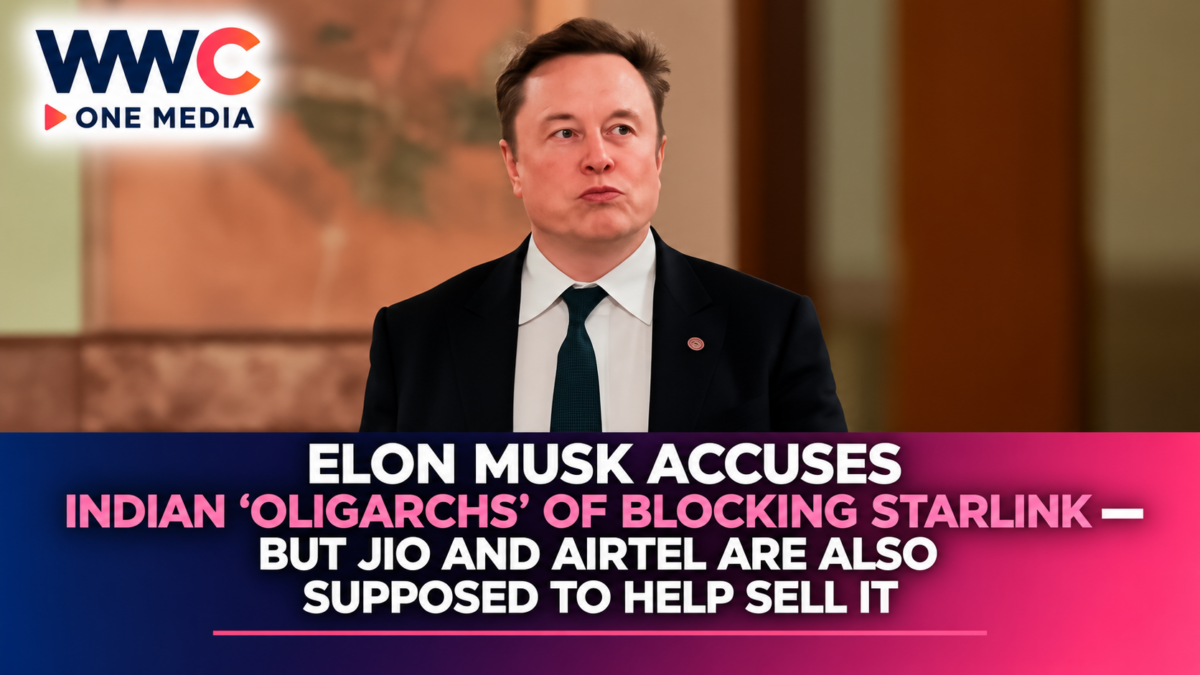
NEW DELHI — Elon Musk has launched one of his sharpest attacks yet on India’s telecom establishment, accusing unnamed “oligarchs” of delaying Starlink’s commercial launch to protect what he called a “monopolistic chokehold” over Indian consumers.
The accusation immediately sent attention toward two companies:
Reliance Jio
and
Bharti Airtel.
Together, the two groups dominate large parts of India’s mobile and broadband market.
But there is a major complication.
Both Jio and Airtel already have agreements with Musk’s SpaceX to:
help distribute Starlink equipment and services in India.
That makes the dispute far more complicated than a simple:
Musk versus India’s telecom giants
story.
Starlink has already won an important Indian telecom license.
Its infrastructure is reportedly largely ready.
Its ground gateways have been built.
And its local security architecture has been designed around Indian requirements.
But the company still cannot switch on commercial service.
The final roadblocks are:
Security approvals
and
Spectrum assignment.
And Musk is clearly losing patience.
MUSK SAYS STARLINK IS BEING BLOCKED BY “OLIGARCHS”
Musk wrote on X that Starlink was being prevented from launching by:
“certain oligarchs”
who wanted to maintain what he described as a:
“monopolistic chokehold on the Indian people.”
He did not identify anyone by name.
He added:
“You can guess who they are.”
The implication quickly drew attention toward India’s most powerful telecom businesses.
Reliance Jio is controlled by the group led by:
Mukesh Ambani.
Bharti Airtel was founded by billionaire:
Sunil Bharti Mittal.
Together, they represent an enormous portion of India’s mobile customer base.
But Musk did not provide evidence publicly showing either company had directly prevented Starlink from obtaining regulatory approvals.
INDIA’S GOVERNMENT REJECTED THE ACCUSATION
India’s communications ministry pushed back almost immediately.
It said the country’s satellite communications rules are:
fair
transparent
and
nondiscriminatory.
Government officials said Starlink is not being treated differently from other satellite broadband applicants.
Starlink, Jio Satellite Communications and OneWeb have all obtained early authorizations.
All still face regulatory requirements before full commercial service can begin.
That distinction matters.
The government’s position is essentially:
Starlink has not been singled out.
STARLINK ALREADY HAS ITS KEY TELECOM LICENSE
This is perhaps the most important factual point.
Starlink received India’s:
Global Mobile Personal Communication by Satellite, or GMPCS, license
on:
June 6, 2025.
That authorization allows the company to offer satellite-based communications services across India.
The Department of Telecommunications publicly lists:
Jio Satellite Communications
OneWeb India
and
Starlink Satellite Communications
as GMPCS licensees.
So Starlink is not waiting for permission to exist as a satellite operator.
It already has that.
What it still needs is permission to actually use specific spectrum commercially and satisfy remaining technical and security conditions.
THE LICENSE DOES NOT AUTOMATICALLY GIVE STARLINK SPECTRUM
India’s Department of Telecommunications makes this clear.
A GMPCS license:
does not automatically confer spectrum rights.
A separate frequency assignment is required.
That spectrum allocation is crucial because satellite operators need access to radio frequencies to communicate between:
Satellites
Ground stations
and
Customer terminals.
Without spectrum, Starlink cannot operate commercially no matter how many satellites it has overhead.
SECURITY CLEARANCE IS THE OTHER MAJOR ROADBLOCK
India also requires satellite operators to satisfy strict security rules.
Those requirements are particularly sensitive because satellite broadband can operate in places where traditional telecom infrastructure is weak or absent.
Authorities want confidence that they can address issues involving:
Lawful interception
User identification
Data localization
Gateway control
and
National-security monitoring.
SpaceX says it has spent years adapting Starlink’s Indian operations to meet these requirements.
STARLINK SAYS 20 GATEWAY SITES ARE ALREADY BUILT
At the India Mobile Congress, Starlink Business Operations Vice President:
Lauren Dreyer
said SpaceX has already built roughly:
20 gateway sites
inside India.
Those sites reportedly contain:
hundreds of antennas.
Gateway stations connect satellites in orbit with terrestrial internet networks.
They are essential infrastructure for Starlink’s service.
Dreyer said the company is operationally ready to begin once final approvals are granted.
That makes the delay particularly frustrating from SpaceX’s perspective.
INDIA HAS A HUGE CONNECTIVITY OPPORTUNITY
Musk argues Starlink can serve areas traditional telecom infrastructure struggles to reach.
That includes:
Mountainous regions
Rural communities
Remote villages
Coastal zones
and
Border areas.
India’s own government acknowledges this potential.
The Ministry of Communications has said satellite broadband can help connect locations that are difficult to reach with:
Fiber
Microwave links
or
Cellular towers.
That gives Starlink a potentially important role in India’s digital infrastructure.
THE SATELLITE BROADBAND MARKET COULD REACH $1.9 BILLION
Deloitte estimates India’s satellite broadband market could reach roughly:
$1.9 billion by 2030.
That may appear small compared with India’s massive mobile-phone industry.
But satellite broadband serves a different market.
Its strongest use case is not replacing cheap urban fiber.
It is connecting places where terrestrial networks are:
Too expensive
Too slow to build
or
Physically impossible to deploy.
India has hundreds of millions of potential users outside dense urban centers.
That creates a strategically attractive opportunity.
BUT STARLINK WILL STRUGGLE TO COMPETE WITH INDIA’S MOBILE PRICES
India has some of the world’s cheapest mobile-data prices.
That creates a major challenge for Starlink.
Satellite broadband requires:
A specialized terminal
Satellite capacity
Gateway infrastructure
and
Expensive launches.
That means Starlink will probably struggle to undercut ordinary 4G, 5G or fiber service in densely populated areas.
Its strongest business case is likely to be:
Remote broadband
rather than
Mass-market urban internet.
THIS IS WHY MUSK’S “MONOPOLY” ARGUMENT IS COMPLICATED
Jio and Airtel may dominate Indian telecom.
But Starlink is not necessarily offering a direct replacement for their main businesses.
Satellite connectivity is especially valuable where:
mobile towers do not exist
or
fiber is unavailable.
In dense cities, terrestrial broadband is often:
Faster
Cheaper
and
Higher capacity.
That makes satellite internet more complementary than purely competitive in many locations.
Which makes what happened in 2025 particularly interesting.
AIRTEL SIGNED A PARTNERSHIP WITH STARLINK
Bharti Airtel announced an agreement with SpaceX to explore bringing Starlink to India.
The deal envisioned Airtel potentially selling:
Starlink equipment
through its retail network.
It also included potential cooperation around:
Enterprise connectivity
and
Rural broadband.
The partnership was conditional on Starlink receiving all required government approvals.
Airtel therefore occupies an unusual position.
It is simultaneously:
a potential competitor
and
a potential distribution partner.
JIO SIGNED A STARLINK AGREEMENT TOO
Reliance Jio announced a similar agreement shortly afterward.
Jio said it planned to offer Starlink solutions through its:
Retail network
and
Online storefronts.
It also discussed installing and activating terminals for customers.
Again:
the same company that could compete with Starlink’s satellite business is also positioned to help distribute it.
That makes Musk’s latest comments particularly striking.
JIO AND AIRTEL MAY COMPETE WITH STARLINK WHILE SELLING IT
This kind of relationship is not as strange as it first sounds.
Telecom companies frequently compete in one layer while cooperating in another.
Jio could offer its own satellite service for some customers while reselling Starlink to others.
Airtel could use:
OneWeb
for enterprise connectivity while also offering:
Starlink
where it makes commercial sense.
From the telecom companies’ perspective, the objective may be simple:
If customers want satellite broadband, keep them inside the broader Jio or Airtel ecosystem.
JIO ALREADY HAS ITS OWN SATELLITE AMBITIONS
Reliance Jio is not entering this market only as a Starlink reseller.
Its satellite unit has its own GMPCS authorization.
Jio has worked with:
SES
on satellite connectivity.
That means Reliance is building a direct alternative to Starlink.
This explains why Jio’s relationship with SpaceX can simultaneously involve:
Partnership
and
Competition.
AIRTEL HAS ONEWEB
Bharti Airtel has an even more direct satellite connection.
Its parent group has historically been a major investor in:
Eutelsat OneWeb.
OneWeb operates its own low-Earth-orbit satellite constellation.
Unlike Starlink’s consumer-heavy model, OneWeb has focused heavily on:
Enterprise
Government
Aviation
and
Telecom backhaul.
So Airtel already has a strategic satellite platform before Starlink even launches.
INDIA’S SATELLITE MARKET IS BECOMING CROWDED
The competitive landscape includes:
Starlink
Jio Satellite Communications
OneWeb
and potentially
Amazon’s Project Kuiper.
Amazon Kuiper’s Indian licensing application has been under examination.
If approved, India could eventually host multiple large satellite broadband constellations.
That should benefit customers through:
More competition
Lower prices
and
Better coverage.
But it also raises difficult spectrum-management issues.
SPECTRUM BECAME A MAJOR POLITICAL BATTLE
Before the 2025 partnerships, Musk and Mukesh Ambani’s Reliance were on opposing sides of a major policy debate.
The question was:
How should India allocate satellite spectrum?
Reliance argued that important spectrum should be:
auctioned.
Starlink favored:
administrative allocation.
Satellite operators argued auctions are poorly suited to global satellite systems because spectrum is typically shared across operators.
India ultimately moved toward administrative assignment.
That decision was more favorable to Musk’s position.
JIO HAD ARGUED AUCTIONS WOULD CREATE A LEVEL PLAYING FIELD
Reliance argued that satellite broadband could increasingly compete with terrestrial telecom operators.
Traditional telecom companies pay enormous amounts for spectrum through auctions.
From Jio’s perspective, allowing satellite competitors to obtain spectrum through administrative allocation risked creating an uneven playing field.
Starlink countered that satellite spectrum is fundamentally different.
The disagreement exposed the commercial tension between Musk and Ambani long before Musk’s latest attack.
THE 2025 PARTNERSHIPS APPEARED TO CREATE A TRUCE
When Jio and Airtel both announced deals with Starlink, it seemed like the major telecom battle had cooled.
Instead of trying only to stop or outcompete SpaceX, India’s biggest telecom companies would participate in Starlink’s distribution.
That appeared commercially pragmatic.
But today’s dispute suggests the underlying tensions never fully disappeared.
Musk clearly believes the launch process is taking too long.
INDIA HAS REAL SECURITY CONCERNS ABOUT STARLINK
The government has another reason for caution.
Indian authorities have previously recovered Starlink equipment in sensitive incidents.
In 2024, terminals were reportedly discovered during:
Law-enforcement operations
and
Military-related investigations.
That alarmed officials because Starlink was not officially operating commercially in India at the time.
Authorities wanted to know whether satellite terminals could be used illegally inside Indian territory.
MUSK SAYS STARLINK BEAMS WERE DISABLED OVER INDIA
Musk has repeatedly said Starlink service was not active in India during those incidents.
SpaceX said its satellite beams were switched off over the country.
The company argued that terminals may have been brought into India illegally from outside.
That did not eliminate government concerns.
Satellite signals do not follow national borders in the same way fiber cables do.
Governments therefore want precise controls over:
Where service works
and
Who can access it.
STARLINK’S GLOBAL SCALE MAKES INDIA HARD TO IGNORE
Starlink has become the world’s dominant low-Earth-orbit broadband constellation.
Recent estimates put the network at around:
11,000 satellites
in orbit.
Starlink reportedly serves more than:
13 million users
across more than:
160 countries and territories.
The service has become a major revenue source for SpaceX.
India is one of the largest major internet markets where Starlink has still not fully launched.
That makes approval strategically important.
INDIA COULD BECOME ONE OF STARLINK’S MOST IMPORTANT MARKETS
India has more than:
1.4 billion people.
Even if Starlink captures only a small percentage of the population, that could represent millions of customers.
The biggest opportunities may include:
Rural households
Schools
Businesses
Mining
Maritime operations
Emergency response
and
Remote government facilities.
That is why SpaceX has been willing to spend years navigating India’s approval process.
BUT MASS-MARKET ADOPTION WILL DEPEND ON PRICE
Starlink’s technical capabilities are impressive.
But affordability will decide its reach.
India’s broadband market is extremely price-sensitive.
Jio fundamentally transformed the telecom market by driving mobile-data costs down.
A Starlink package priced at levels common in wealthier countries would struggle to attract mass-market Indian consumers.
SpaceX may therefore need:
Lower hardware prices
Special Indian plans
or
Carrier subsidies
to achieve scale.
THAT MAY BE WHY JIO AND AIRTEL ARE SO IMPORTANT
The partnerships could help solve the affordability problem.
India’s telecom companies already have:
Distribution networks
Customer-service infrastructure
Billing relationships
and
Retail stores.
They could potentially bundle Starlink with:
Mobile service
Enterprise connectivity
or
Rural broadband packages.
That could dramatically reduce Starlink’s customer-acquisition costs.
So despite Musk’s anger, SpaceX may still need the very telecom companies his comments appear to criticize.
DIRECT-TO-CELL COULD EVENTUALLY MAKE THE COMPETITION MUCH BIGGER
The longer-term issue goes beyond Starlink dishes.
SpaceX is rapidly expanding:
direct-to-device satellite connectivity.
This technology allows ordinary smartphones to communicate with satellites.
The U.S. Federal Communications Commission is already advancing additional spectrum rules for these services.
SpaceX has acquired substantial spectrum and is developing Starlink Mobile.
If direct-to-cell becomes widespread, the boundary between:
Satellite operator
and
Mobile carrier
begins to disappear.
THAT COULD EVENTUALLY THREATEN TRADITIONAL TELECOM MODELS
Today’s Starlink requires a specialized terminal for high-speed broadband.
Tomorrow’s Starlink could communicate directly with smartphones.
Initially, direct-to-cell may handle:
Text messages
Emergency communications
and
Basic data.
Over time, capabilities could improve.
If satellite networks eventually provide meaningful mobile broadband everywhere, incumbent telecom companies would face a much bigger competitive threat.
That future may explain why spectrum policy matters so much today.
JIO HAS ITS OWN MASSIVE FINANCIAL EVENT COMING
The timing is also interesting for Reliance.
Jio Platforms is preparing what Reuters reports could become:
India’s largest-ever IPO.
The company is expected to launch the offering on:
October 21.
It aims to raise roughly:
$3.8 billion.
A listing would bring even more scrutiny to Jio’s growth strategy across:
Telecom
AI
Cloud computing
and
Satellite connectivity.
STARLINK IS ALSO BECOMING MORE IMPORTANT TO SPACEX
Starlink has evolved from a speculative SpaceX side project into one of its most important businesses.
Satellite broadband provides recurring subscription revenue.
That cash can help support:
Rocket development
Starship
and
Space infrastructure.
India therefore matters not only as a telecom opportunity.
It matters to the broader economics of Elon Musk’s space empire.
THE U.S. GOVERNMENT ALSO HAS AN INTEREST
The Starlink dispute is occurring while Washington and New Delhi continue negotiating broader:
Trade
Technology
and
Strategic cooperation.
Reuters reports the U.S. has promoted Starlink as part of its broader engagement with India.
That gives the licensing battle a geopolitical dimension.
India must balance:
Foreign investment
Domestic telecom interests
National security
and
Strategic relations with Washington.
That is why a simple commercial approval can become politically complicated.
THE BIGGER STORY: STARLINK’S BIGGEST INDIA PROBLEM MAY NO LONGER BE TECHNOLOGY
SpaceX has already solved many of the difficult technical problems.
The satellites exist.
The terminals exist.
The gateway network is being built.
The telecom license has been granted.
Jio and Airtel have distribution agreements.
India itself acknowledges satellite broadband can help close connectivity gaps.
And yet commercial service still has not started.
That means the final obstacles are increasingly about:
Regulation
Security
Spectrum
and
Political trust.
Musk says powerful business interests are deliberately standing in Starlink’s way.
India’s government says that accusation is wrong and insists every satellite provider is subject to the same rules.
Jio and Airtel have not publicly become Musk’s declared enemies.
In fact, on paper, they are still his commercial partners.
And that may be the strangest part of this entire story.
Elon Musk is accusing unnamed Indian “oligarchs” of helping keep Starlink offline — but the two telecom giants everyone immediately thinks of are also the companies SpaceX may need most if it wants Starlink to reach millions of Indian customers.