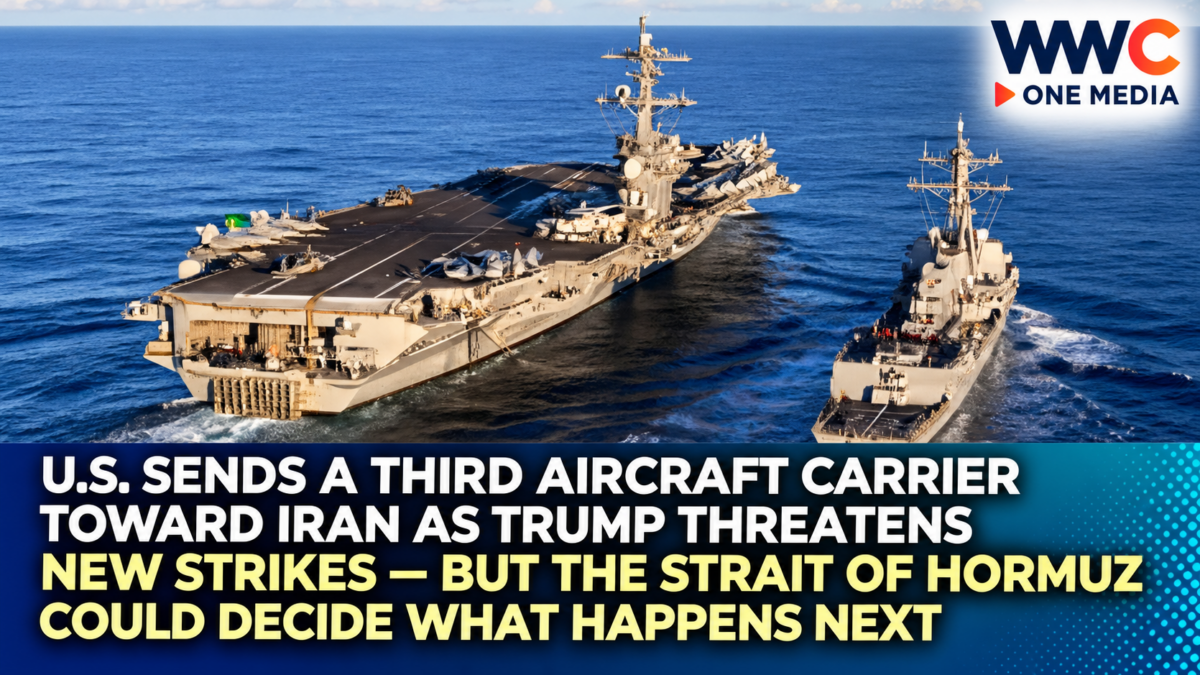
WASHINGTON — The United States is preparing a major new military buildup around Iran, sending another aircraft carrier strike group and thousands of additional troops toward the Middle East as President Donald Trump warns that large-scale attacks could resume after the November midterm elections.
The move comes as the nearly eight-month U.S.-Iran conflict remains trapped in a dangerous stalemate centered increasingly on one of the world’s most important energy chokepoints: the Strait of Hormuz.
The Wall Street Journal reported that the USS Theodore Roosevelt carrier strike group and additional amphibious forces are being deployed toward the region, potentially adding roughly 9,000 to 10,000 U.S. personnel once the buildup is complete.
The deployments could leave the United States with three aircraft carriers and two amphibious groups near Iran by late November, dramatically expanding the military options available to Trump if diplomacy collapses.
And Trump has made clear that renewed military action remains possible.
He has signaled that strikes against Iran could restart after the November 3 midterm elections if Tehran does not accept terms Washington considers sufficient.
That makes the coming weeks critical.
Because while the shooting has slowed at times, the underlying conflict remains unresolved.
Trump Rejected Iran’s Latest Hormuz Offer
Iran recently offered a new diplomatic proposal aimed at ending hostilities and restoring shipping through the Strait of Hormuz.
The plan, delivered through Qatari mediators, would have reopened the strait within roughly seven days while restarting negotiations with Washington.
In return, Tehran sought concessions including:
an end to the U.S. naval blockade,
sanctions relief,
access to frozen Iranian funds,
and renewed negotiations over Iran’s nuclear program.
Trump rejected the proposal.
Reuters reported that he characterized Iran’s offer as inadequate and argued that Tehran was making concessions because it had been weakened economically and militarily.
That rejection immediately reduced hopes for a near-term peace deal.
It also intensified speculation that Washington is preparing for another major round of strikes.
Hormuz Is the Real Center of the Conflict
The Strait of Hormuz is only around 21 miles wide at its narrowest point.
But its economic importance is enormous.
Before the war, roughly one-fifth of the world’s oil and liquefied natural gas trade moved through the waterway.
Major exporters including:
Saudi Arabia,
Iraq,
Kuwait,
Qatar,
and the United Arab Emirates
depend heavily on access to the strait.
That means even limited disruptions can send shock waves through global energy markets.
Iran understands that leverage extremely well.
The ability to threaten shipping through Hormuz gives Tehran economic influence far beyond the size of its conventional military.
Shipping Has Recovered — But It Is Still Dangerous
There has been some improvement.
Reuters reported that September LNG shipments through Hormuz reached their highest monthly level since the war began, with roughly 19 to 21 cargoes crossing during the month depending on the tracking service used.
Qatar and the UAE accounted for much of that traffic.
But normal conditions have not returned.
Some vessels have conducted so-called “dark transits,” switching off automatic identification systems while passing through the area to reduce their visibility.
U.S. naval protection also remains important for commercial traffic.
That means shipping may be moving again, but companies still consider the route dangerous.
Insurance costs remain elevated.
Tankers face attack risks.
And one new escalation could disrupt flows almost immediately.
Oil Is Still Above $100
The market reflects that uncertainty.
Brent crude settled at roughly $102.25 per barrel on October 2, while U.S. West Texas Intermediate ended around $91.11.
Oil had jumped more than $4 a barrel the previous day after reports of the U.S. military buildup and concerns about global fuel supply.
That shows how sensitive energy markets have become to military developments.
A carrier deployment can move oil.
A failed peace proposal can move oil.
A tanker attack can move oil.
And any serious interruption of Hormuz could create a far larger shock.
Diesel Has Become an Even Bigger Problem
The crisis is not only about crude oil.
Refined fuels—especially diesel—have become increasingly scarce.
The combination of:
Middle East disruptions,
Russian refinery outages,
export restrictions,
and reduced global refining capacity
has driven diesel prices sharply higher.
That is politically dangerous for Trump.
Diesel powers:
trucks,
construction machinery,
farm equipment,
freight trains,
and industrial equipment.
So high diesel prices eventually feed into the cost of food and consumer goods.
That turns a military conflict thousands of miles away into a domestic inflation problem.
G7 Countries Are Now Releasing Emergency Fuel
The pressure became serious enough that the United States pushed allies to tap emergency supplies.
Reuters reported that European governments agreed to release fuel reserves in an attempt to reduce prices and stabilize markets.
The broader G7 effort involves releasing oil and refined products from strategic reserves.
The Trump administration has also considered restricting U.S. diesel exports to protect domestic consumers.
But energy companies have warned that export restrictions could distort markets and ultimately reduce incentives for U.S. refiners to produce more fuel.
So Washington faces a difficult contradiction.
Trump wants to increase pressure on Iran.
But the conflict is simultaneously increasing fuel prices for American consumers.
The War Has Already Cost Tens of Billions
The economic cost goes far beyond gasoline.
The nonpartisan Congressional Budget Office estimated in September that the war had already cost the United States roughly $38 billion, with additional expenses projected at approximately $3 billion per month.
The CBO also estimated the conflict could add around 0.5 percentage point to U.S. inflation during the first three months of 2027.
That is a significant economic risk.
Higher oil prices increase inflation.
Higher inflation can force the Federal Reserve to maintain higher interest rates.
Higher interest rates then increase:
mortgage payments,
credit-card rates,
business borrowing costs,
and government debt-service costs.
So the Iran conflict increasingly affects far more than defense spending.
The Bond Market Is Feeling the Pressure Too
Higher energy prices are also helping drive government borrowing costs upward.
Recent market moves have pushed U.S. Treasury yields higher as investors worry that persistent fuel inflation could keep monetary policy tighter for longer.
Financial markets are therefore reacting to two overlapping risks:
geopolitical escalation
and
renewed inflation.
That combination is especially difficult for policymakers.
Normally, economic weakness could justify lower interest rates.
But if an oil shock pushes inflation higher at the same time, the Federal Reserve has much less flexibility.
Trump Says Iran Is Weaker Than It Looks
Trump continues to argue that Tehran is under enormous pressure.
He has claimed that U.S. and Israeli attacks destroyed significant parts of Iran’s:
air defenses,
naval capability,
radar systems,
and nuclear infrastructure.
Iran disputes many of those claims.
The exact level of remaining military capability is difficult to independently verify.
What is clear is that Iran remains capable of threatening U.S. forces, regional allies and energy infrastructure.
Reuters reported that Tehran is already planning a broader and more forceful response if Washington resumes major attacks.
Iranian military planners are reportedly considering a wider range of potential targets.
That includes U.S. interests and possibly targets connected to American allies.
Iran’s Allies Could Expand the Battlefield
The risk is not confined to Iran itself.
Tehran maintains relationships with armed groups across the region.
Those networks include forces in:
Lebanon,
Yemen,
and Iraq.
Iranian-backed Houthi forces in Yemen have already played a major role in disrupting Red Sea shipping.
The U.S.-Iran confrontation therefore has the potential to become a wider regional war even without a full-scale ground invasion.
That is one reason the deployment of additional American naval forces matters.
Carriers can launch airstrikes.
Amphibious forces can deploy Marines.
Destroyers provide missile defense.
And additional ships improve Washington’s ability to protect commercial shipping.
But more forces also create more potential targets for Iran.
The U.S. Is Already Operating With a Large Force
The new deployment will add to an already substantial American presence.
The USS George Washington has been operating in the region after being redirected from Asia.
Reuters reporters recently visited the carrier and described crews operating under active wartime conditions near the Strait of Hormuz.
The ship carries approximately 5,000 personnel.
Sailors are preparing aircraft and weapons while remaining on alert for possible missile or drone attacks.
The Theodore Roosevelt deployment will significantly increase that capacity.
Three Carriers Would Be a Powerful Signal
Aircraft carriers are among the most visible instruments of American military power.
Deploying three to the same broader theater is unusual.
Each carrier strike group can include:
dozens of combat aircraft,
guided-missile destroyers,
submarines,
logistics vessels,
and thousands of sailors.
That gives Washington the ability to sustain air operations without relying entirely on regional land bases.
It also sends a diplomatic message.
The buildup tells Tehran that Trump wants the military option available even while negotiations continue.
But Iran Has Its Own Leverage
Iran cannot match the United States carrier for carrier.
It does not need to.
Its strategic advantage comes from geography.
The northern shore of the Strait of Hormuz belongs to Iran.
Its forces can deploy:
anti-ship missiles,
fast attack boats,
drones,
mines,
and coastal missile batteries.
Even if U.S. forces dominate conventional combat, disrupting shipping requires much less capability than defeating the U.S. Navy.
That is why Hormuz remains Iran’s most powerful bargaining chip.
A Fully Closed Strait Would Be an Economic Shock
A complete and sustained shutdown of Hormuz could create consequences well beyond $100 oil.
Gulf producers have alternative pipelines.
Saudi Arabia can move some crude westward toward the Red Sea.
The UAE can bypass Hormuz through pipelines to Fujairah.
But those systems cannot replace the entire volume normally transported through the strait.
Qatar faces an even bigger vulnerability because virtually all of its enormous LNG exports leave through Hormuz.
That makes Asia particularly exposed.
China, Japan, South Korea and India are major buyers of Gulf oil and gas.
A prolonged disruption would therefore hit Asian economies especially hard.
September’s LNG Recovery Shows Why the Strait Matters
The recent increase in LNG cargoes demonstrates both the importance and fragility of Hormuz.
Reuters reported that September shipments were the strongest since fighting began in February.
That helped restore some supply to global gas markets.
But analysts warned that the rebound may be difficult to sustain if tensions rise again.
Winter demand will soon increase in Europe and Asia.
That means another disruption could occur at exactly the moment when energy demand begins climbing.
Diplomacy Is Still Alive — Barely
Despite the military buildup, negotiations have not completely stopped.
Qatar has been acting as an intermediary between Washington and Tehran.
Iranian President Masoud Pezeshkian has said Tehran remains open to dialogue.
Foreign Minister Abbas Araghchi has also continued communicating through mediators.
But both sides remain far apart.
Washington wants tighter restrictions on Iran’s nuclear program and greater freedom of navigation through Hormuz.
Iran wants sanctions relief, an end to the blockade and greater recognition of its authority around the strait.
Those are not small differences.
They go to the center of the conflict.
Iran Is Preparing in Case Talks Fail
Reuters reported that Iranian officials privately see the prospects for a breakthrough as limited.
Military commanders are therefore preparing plans for a stronger response if the United States resumes major attacks.
That creates a dangerous dynamic.
The U.S. is moving more military assets into the region.
Iran is preparing more extensive retaliation.
Diplomats are trying to keep negotiations alive.
And energy markets are pricing the possibility that talks fail.
This is how a stalemate can become escalation.
Trump’s Midterm Timeline Adds Another Layer
The political calendar makes the situation even more unusual.
The U.S. midterm elections are scheduled for November 3.
Trump has indicated that large-scale strikes could resume afterward if diplomacy fails.
That creates an implicit deadline.
Iran knows Washington may become more militarily aggressive after the election.
Trump also knows another major escalation before voting could push oil and gasoline prices even higher.
So both sides may have incentives to wait.
That does not necessarily make peace more likely.
It may simply postpone the next round of fighting.
The Economic Pressure Is Already Hurting Trump
High energy prices are politically dangerous ahead of the midterms.
Recent polling reported by AP shows substantial voter dissatisfaction with Trump’s handling of the economy and cost of living.
That gives the administration another reason to stabilize fuel prices.
It also creates tension between Trump’s foreign-policy goals and domestic political priorities.
Weakening Iran may require sustained economic and military pressure.
But sustained pressure on Iran can keep oil prices high.
Those goals increasingly conflict.
Washington Has Not Solved the Hormuz Problem
This may be the most important point.
The U.S. Navy can escort ships.
It can destroy Iranian vessels.
It can attack missile sites.
It can blockade Iranian ports.
But permanently guaranteeing unrestricted commercial navigation through a narrow waterway beside Iran is much more difficult.
Every tanker requires protection.
Every attack increases insurance costs.
And every escalation gives Tehran another incentive to threaten traffic.
That means military superiority does not automatically equal economic control.
The Strait of Hormuz remains the central vulnerability.
The Next Phase Could Be More Dangerous Than the First
The military buildup suggests Washington wants options.
Iran’s preparations suggest Tehran is expecting another confrontation.
Meanwhile, global markets remain dependent on a shipping route that neither side can fully control without cooperation.
The U.S.-Iran war therefore appears to be entering another critical phase.
Three American aircraft carriers could soon be positioned near Iran.
Thousands of additional troops are moving toward the region.
Trump has rejected Tehran’s latest proposal.
Iran is preparing for stronger retaliation.
And oil remains above $100 a barrel.
All of that makes the Strait of Hormuz more than the geographic center of the conflict.
It may become the place where the military, economic and political consequences finally collide.
Because Trump can order another wave of strikes after the midterms.
But whether Washington can win the larger confrontation may depend on something much harder: keeping the world’s most important energy chokepoint open without triggering an even bigger war.