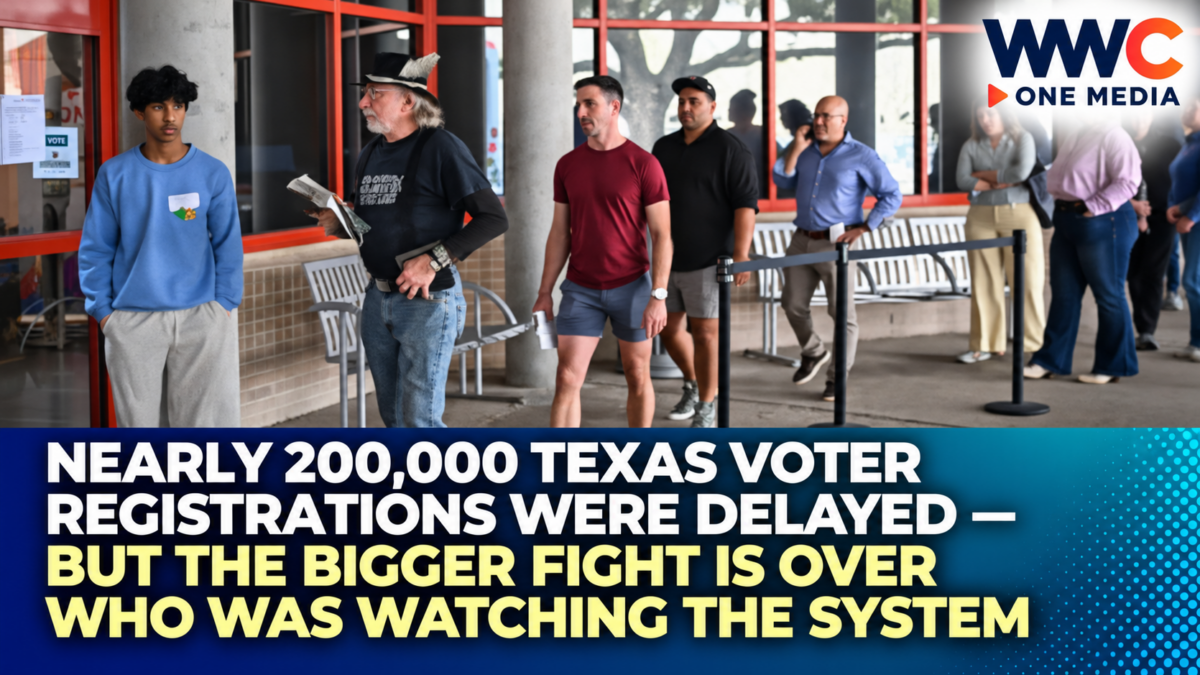
AUSTIN, Texas — A software failure that left roughly 178,000 to 200,000 Texas voter-registration records unprocessed for months is turning into a major political and technology controversy just weeks before the November midterm elections, with Deloitte and state officials now facing questions over how such a critical system failure went undetected for so long.
Texas state Sen. Nathan Johnson, the Democratic nominee for attorney general, said he would investigate Deloitte and review the state’s broader reliance on private contractors if elected, arguing that the registration breakdown exposes the risks of outsourcing essential government functions.
Johnson’s announcement comes after state officials said an October 2025 software update involving Deloitte disrupted the transmission of voter-registration information from the Texas Department of Public Safety, or DPS, to election officials.
The problem was not fully identified until late August 2026.
By then, tens of thousands of Texans who believed they had registered or updated their voter information through DPS had records that had never properly reached county election offices.
And with the state’s October 5 registration deadline approaching, election administrators suddenly found themselves processing a massive backlog ahead of the November 3 election.
What Actually Went Wrong?
Texas allows residents to register or update their voter information while completing certain driver’s license or state-ID transactions through DPS.
According to the Texas Tribune and Votebeat, an October 2025 software update caused three key pieces of data to be omitted from daily files sent from DPS to the Secretary of State’s office.
The consequences were serious.
Voters could select “yes” when asked whether they wanted to register.
They could even receive a receipt showing they had made that choice.
But because of the programming error, the information needed to complete the registration process was not properly transmitted.
In other words, some Texans had every reason to believe they were registered.
The system had not actually completed the process.
The Problem May Have Been Visible Months Earlier
One of the biggest questions is why the error remained unresolved for so long.
Public records obtained by Votebeat and the Texas Tribune show that lawmakers had raised concerns about missing voter-registration records as early as March 2026, roughly six months before the current backlog became widely known.
Officials said the earlier problem had been addressed.
But complaints continued.
By August, DPS and the Secretary of State’s office realized they were dealing with a much larger data-transfer failure.
DPS says it identified the missing-data issue in late August and worked with the Secretary of State and another vendor, Civix, to fix it.
The problem was resolved by September 13, according to state officials.
But resolving the software error created another problem:
the backlog still had to be processed.
Counties Were Suddenly Hit With Hundreds of Thousands of Records
Initial reports focused on roughly 178,000 to 200,000 affected registrations.
But the scale of records counties suddenly had to review was significantly larger.
The Texas Tribune reported that county election administrators had received at least 500,000 backlogged registration records by October 1.
That does not necessarily mean 500,000 individual people were improperly denied registration.
The backlog included applications, updates and other records that counties had to examine and reconcile.
But the volume created a huge administrative burden only days before the registration deadline.
Large counties were particularly affected.
Bexar County received about 45,000 delayed applications, while other major counties also received tens of thousands of records requiring review.
Collin County alone received more than 51,000 backlogged records, though election officials there said they had cleared most of them by late September.
Deloitte Is Now at the Center of the Political Fight
Johnson says the incident warrants a broader examination of Texas’ relationship with large private contractors.
CNBC reported that Deloitte currently has six active contracts with DPS worth about $84.46 million.
Across Texas state government, Deloitte has roughly 30 active contracts with 16 agencies worth a combined $2.02 billion.
Those numbers give Johnson’s argument a wider target.
He is not simply saying one software update failed.
He is questioning whether Texas has become too dependent on outside vendors for services that can directly affect citizens’ legal rights.
Johnson argues that outsourcing can create a dangerous accountability gap.
When a government system fails, responsibility may become divided among:
the agency,
the contractor,
another technology vendor,
and state oversight officials.
That can make it difficult to determine who was supposed to detect the problem first.
But Deloitte Is Not the Only One Facing Questions
Republican lawmakers have also criticized the failure.
State Sen. Paul Bettencourt, a Republican, has blamed the Deloitte-linked software update but also said the Secretary of State’s office should have noticed that expected voter-registration files were missing.
That is an important point.
Even if the software update triggered the failure, election-security experts say government agencies should have monitoring and testing procedures capable of detecting missing or abnormal data flows.
The Texas Tribune quoted technology and election-administration specialists saying system updates should be tested not only individually but also across the entire chain of connected state systems.
That turns the issue from a simple “vendor mistake” into a broader oversight question.
A software bug can happen.
The harder question is why nobody caught it quickly.
Another Vendor Is Already Under Fire
Texas election officials are also dealing with separate concerns involving TEAM, the state’s voter-registration management system.
That platform is operated with technology support from Civix, another private contractor.
County election officials have complained that TEAM has its own technical problems and inefficiencies, complicating efforts to process the Deloitte-related backlog.
The Texas Association of County Election Officials has asked the state to:
improve technical-support tools,
provide clearer monitoring,
and potentially hold vendors financially accountable when failures disrupt elections.
That broadens the issue considerably.
The controversy is no longer only about one Deloitte software update.
It is about how Texas builds, monitors and manages its entire election-technology infrastructure.
Could Affected Texans Still Vote?
State officials say yes.
The Texas Secretary of State says voters whose registration was submitted on time should still be eligible even if administrative processing is delayed.
Texas voters who believe their registration was affected can verify their status through the state’s voter-registration system.
If a voter arrives at the polls and is not listed as registered, they may be able to cast a provisional ballot.
Election officials can later verify whether that person submitted a qualifying registration by the deadline.
That safeguard is important.
But it does not eliminate concerns.
A voter who believes they are registered may be confused or discouraged if their name is missing on Election Day.
Election officials therefore want as much of the backlog resolved as possible before early voting starts on October 19.
October 5 Is the Critical Deadline
Texas’ deadline to register for the November 3 election is Monday, October 5, 2026.
Applications sent by mail must be postmarked by that date.
Texas does not offer universal online voter registration.
Eligible residents can register using paper forms or through certain DPS transactions when handling driver’s licenses or state IDs.
That makes the DPS system particularly important.
For many Texans, it is one of the few government interactions where registration can be completed digitally as part of another transaction.
The fact that this pathway failed for months therefore carries outsized significance.
The Timing Could Hardly Be More Sensitive
The breakdown comes ahead of a politically important November election.
Texas will vote on statewide offices, congressional seats and a closely watched U.S. Senate contest.
Republicans have dominated statewide Texas politics for decades, but 2026 polling has suggested a more competitive environment than usual.
That means any problem involving voter access is likely to become intensely political.
Johnson is himself running for attorney general.
He is competing to succeed Ken Paxton, who is now running for the U.S. Senate.
So Johnson’s promise to investigate Deloitte is simultaneously:
an election-administration proposal,
a government-contracting argument,
and a campaign issue.
That makes neutral fact-checking especially important.
Johnson Has Not Opened an Investigation
This distinction deserves emphasis.
Johnson currently does not control the Texas Attorney General’s Office.
His proposal is conditional:
if elected, he says he will investigate.
There is therefore no Johnson-led attorney-general investigation into Deloitte underway right now.
Similarly, public reporting establishes that state officials attribute the software failure to an October 2025 update involving Deloitte.
But a full independent technical investigation assigning legal responsibility has not yet been made public.
That means it is more accurate to say Deloitte’s role is under scrutiny than to say Deloitte has legally been found responsible for disenfranchising voters.
Deloitte Had Not Immediately Responded
CNBC reported that Deloitte had not immediately responded to its request for comment on the Friday announcement.
That leaves important technical questions unanswered publicly.
For example:
What exactly changed in the October software update?
Who tested the update before deployment?
What monitoring alerts existed?
Why were missing data fields not detected?
Who had responsibility for verifying successful transfers between DPS and election systems?
And why did warnings earlier in the year not trigger a broader system audit?
Those questions will likely determine whether this ultimately becomes a contractor-liability case, a government-oversight failure or both.
Outsourcing Is Becoming the Bigger Political Issue
Johnson is using the Deloitte episode to attack a much broader model of government.
His argument is that Republican state leaders claim to shrink government while actually shifting important work to private companies through large contracts.
That criticism is politically charged, but the underlying policy question is legitimate:
When governments outsource critical infrastructure, who remains accountable when the contractor fails?
Outsourcing can offer advantages.
Private technology firms may provide expertise and scale government agencies lack internally.
But election systems create unusually high stakes.
A broken retail application inconveniences customers.
A broken voter-registration application can affect constitutional participation.
That means reliability standards must be significantly higher.
Election Technology Is Becoming Critical Infrastructure
Modern elections depend heavily on software.
Systems manage:
voter registration,
ballot design,
electronic poll books,
mail-ballot tracking,
results reporting,
and voter databases.
That makes election administration increasingly similar to cybersecurity or banking infrastructure.
Failures do not have to involve malicious hacking to cause serious damage.
Ordinary programming mistakes can be enough.
The Texas incident demonstrates that clearly.
There is currently no public evidence that the registration backlog resulted from a cyberattack or intentional manipulation.
The available evidence points instead to a software and data-management failure.
But to an affected voter, the result can look the same:
their registration is missing.
A Receipt That Didn’t Equal Registration Is the Most Troubling Detail
Perhaps the most serious usability failure is that voters received documentation suggesting their request had succeeded.
According to DPS’s explanation, users could select voter registration during eligible transactions and receive a receipt acknowledging that choice.
Yet the missing data meant the application was not actually transmitted correctly.
That creates a false sense of security.
A user who sees an obvious error can try again.
A user who receives confirmation has no reason to suspect anything went wrong.
That is why monitoring systems inside government agencies matter so much.
Citizens cannot be expected to detect invisible failures happening between databases.
Counties Are Now Cleaning Up the Failure
Much of the immediate burden has fallen on county election offices.
Local officials must review huge batches of delayed records while preparing for:
early voting,
poll worker staffing,
mail ballots,
provisional-ballot procedures,
and Election Day itself.
The state has announced financial assistance for some counties dealing with the sudden workload.
But money does not create additional time.
The registration deadline is October 5.
Early voting begins October 19.
Election Day is November 3.
That leaves a narrow window.
The Bigger Issue Is Trust
Election systems depend on public confidence.
That does not mean every technical error proves an election is unreliable.
Nor does the Texas backlog demonstrate fraud.
But long-running administrative failures can still damage confidence if voters believe systems are poorly monitored.
Republican Sen. Bettencourt made essentially that argument when he said the failure threatens trust and integrity even though he expects affected voters ultimately to be able to cast ballots.
That may be where Democrats and Republicans have some common ground.
They disagree over who should be blamed.
They disagree over outsourcing.
They disagree over broader election policy.
But both sides have reasons to want a registration system that reliably records every eligible voter who follows the rules.
Deloitte’s $2 Billion Texas Relationship Raises the Stakes
That is why Johnson’s threat to review contracts matters beyond the 2026 election.
Deloitte’s approximately $2.02 billion in active Texas state contracts spans far more than one DPS system.
If elected, Johnson says he wants to examine not only the voter-registration incident but also the broader process by which Texas:
chooses vendors,
structures contracts,
monitors performance,
and holds contractors accountable.
That could have implications for one of the world’s largest professional-services firms — and for other major technology vendors doing business with Texas.
One Software Error Has Become a Much Bigger Governance Test
The immediate problem is straightforward.
Texas needs to process delayed voter-registration records before the election.
State officials say affected voters will remain eligible if they submitted their registrations on time.
But once the election passes, the deeper questions will remain.
Why did an error dating to October 2025 remain unresolved for months?
Why did warnings not trigger faster intervention?
Why was there no automated mechanism immediately flagging missing registration data?
And when a private contractor runs essential government infrastructure, who ultimately owns the failure?
Nathan Johnson has promised to make those questions part of the attorney-general race.
But regardless of who wins in November, Texas may already be facing a much larger lesson:
outsourcing technology does not outsource government responsibility.