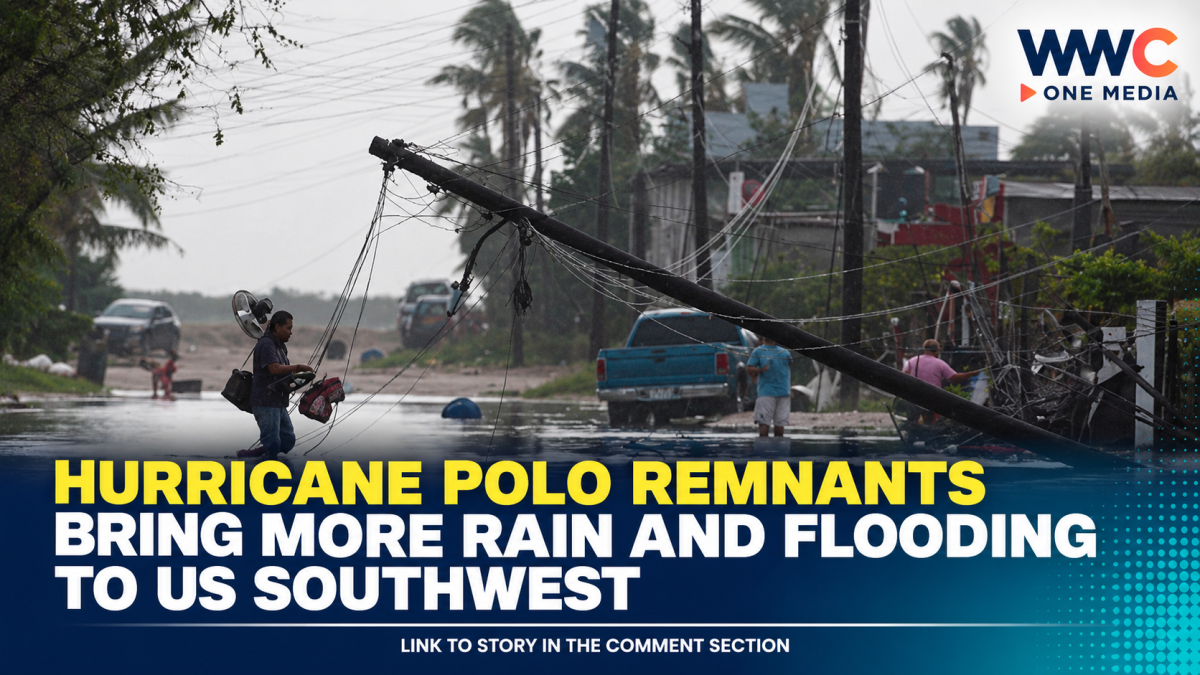
The remnants of Hurricane Polo are bringing additional heavy rain and flooding to parts of the US Southwest after the storm weakened over Mexico, with authorities issuing evacuation orders in several New Mexico communities amid concerns over rising water and a possible dam failure.
Polo made landfall in Mexico’s Baja California Sur with maximum sustained winds of about 110 mph before crossing the Gulf of California and weakening into a tropical storm as it moved northeast across mainland Mexico. Its remnants then pushed toward the United States, carrying substantial tropical moisture into an already saturated Southwest.
Heavy rain caused flooding across parts of New Mexico and Arizona, sending water through normally dry desert channels and forcing emergency crews to respond to stranded motorists and other flood-related incidents. A helicopter also rescued people caught by flash flooding in Utah’s Zion National Park.
In southern New Mexico, concerns over the condition of a dam along the Rio Grande prompted evacuation orders for residents in Rincon, Salem and Garfield. Nearby Hatch and Placitas were also included in evacuation warnings as officials monitored worsening conditions and urged people to move to higher ground.
The flooding threat is particularly significant in the Southwest because desert terrain typically receives relatively little rainfall and has limited vegetation to absorb sudden downpours. Rapid rainfall can quickly overwhelm washes, arroyos and drainage systems, creating dangerous flash-flood conditions.
Forecasters warned that the weather threat would not end with Polo’s remnants. Moisture associated with the storm was expected to spread eastward into the central United States, with parts of Colorado, Texas, Oklahoma and other states facing additional heavy rain and flooding risks.
North-central New Mexico, including Albuquerque and Santa Fe, could receive several inches of rain through Wednesday, while some areas farther east were also expected to experience significant rainfall as Polo’s moisture interacted with another weather system.
Emergency officials have warned residents to avoid flooded roads and stay away from normally dry waterways, which can become dangerous within minutes during intense rainfall.
The situation comes as the eastern Pacific remains unusually active, with other tropical systems also contributing moisture to the broader weather pattern across parts of the United States.