SEOUL — Smartphones are entering the lives of South Korean children remarkably early.
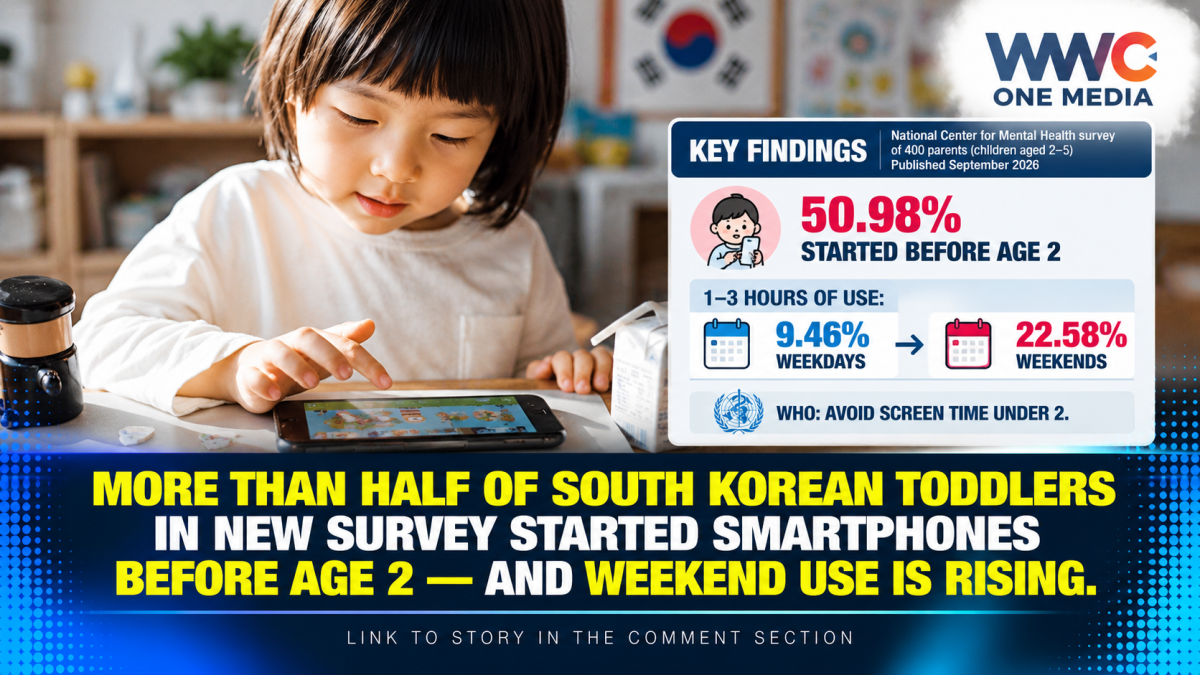
A government-backed survey found that 50.98% of children surveyed had started using smartphones before turning 2, highlighting the increasingly early exposure of young children to digital devices.
The findings came from the National Center for Mental Health’s Mental Health Research Institute, which surveyed the parents of 400 children between ages 2 and 5. The results were published in the institute’s MIND research publication.
The figures do not represent every child in South Korea, but they offer a snapshot of smartphone exposure among the children covered by the survey.
The First Smartphone Experience Is Coming Earlier
Among the parents surveyed, 37.18% said their children first used smartphones between 12 and 23 months old.
Another 13.80% reported that their children began using smartphones before their first birthday.
Combined, those groups account for 50.98% of the children surveyed — meaning roughly half had encountered smartphones before age 2.
The next-largest group, at 26.66%, began between 24 and 35 months.
Overall, 77.64% had started using smartphones before age 3, according to the survey.
Weekends Bring a Noticeable Jump
The survey also found differences between weekday and weekend use.
On weekdays, 56.78% of parents said their children used smartphones for less than an hour a day, while 32.74% reported no smartphone use.
Only 9.46% reported one to three hours of daily use on weekdays.
The pattern changed during weekends.
The share of children using smartphones for one to three hours rose to 22.58%, more than twice the weekday figure. Meanwhile, the proportion reporting no smartphone use fell to 21.28%.
That suggests weekends may provide more opportunities for young children to spend time with smartphones, although the survey does not establish why usage increases.
Mothers’ Smartphone Habits Also Showed a Link
The research found an association between mothers’ smartphone-use patterns and when their children began using smartphones.
Children whose mothers were classified in the survey’s high-risk smartphone-use group tended to start using smartphones earlier and reportedly faced fewer restrictions on device use.
The finding shows an association, however, rather than proving that a mother’s smartphone habits directly cause earlier smartphone use among children.
How the Findings Compare With WHO Guidance
The early starting ages stand in contrast with guidance from the World Health Organization.
WHO’s 2019 recommendations call for sedentary screen time to be avoided for children under 2, while children aged 2 to 4 should have no more than one hour of sedentary screen time per day.
The guidance is intended to support young children’s sleep, physical activity and development.
The survey therefore highlights a significant gap between recommended screen-time practices and the age at which many children in the sample first encounter smartphones.
A Digital Childhood Is Starting Earlier
The findings point to a broader change in childhood: smartphones are becoming familiar objects much earlier in life.
For parents, the challenge is not simply whether a child has access to a device, but when that access begins, how frequently it occurs and what role the device plays in everyday family life.
With half of the surveyed children starting smartphone use before age 2 and weekend use climbing sharply, South Korea’s latest data is raising a bigger question about how families navigate technology during the earliest years of childhood.
And as smartphones become part of childhood earlier than ever, the debate over where — and how — to draw the line is only getting started.
WWC ONE MEDIA G,A