TAIPEI — The artificial intelligence boom is creating demand for a different kind of semiconductor — and one Taiwan-linked chipmaker says its existing Singapore facility is already struggling to keep up.
Vanguard International Semiconductor Corp. (VIS) is accelerating its evaluation of a potential second semiconductor fabrication plant in Singapore after receiving more customer requests than its first facility can handle, according to reporting cited by Taiwan News.
The possible expansion comes as demand rises for power-management and analog chips used in data centers, automobiles and industrial equipment. VIS Chairman Fang Leuh said the company is still assessing the second plant based on funding requirements, customer demand and technology nodes.
For now, no final investment decision has been announced.
TSMC Connection Adds to the Significance
VIS is closely connected to Taiwan Semiconductor Manufacturing Co. (TSMC), which holds about 19% of VIS and is its largest shareholder.
The two companies also maintain a strategic partnership. VIS has licensed TSMC’s gallium nitride technology, which can improve power efficiency in semiconductor applications.
That relationship puts the Singapore expansion in a broader Taiwan semiconductor context as companies build capacity to meet the rapidly growing requirements of AI infrastructure.
First Singapore Fab Is Only Beginning Production
VIS operates its Singapore manufacturing facility through VisionPower Semiconductor Manufacturing Company (VSMC), a joint venture with Dutch semiconductor company NXP.
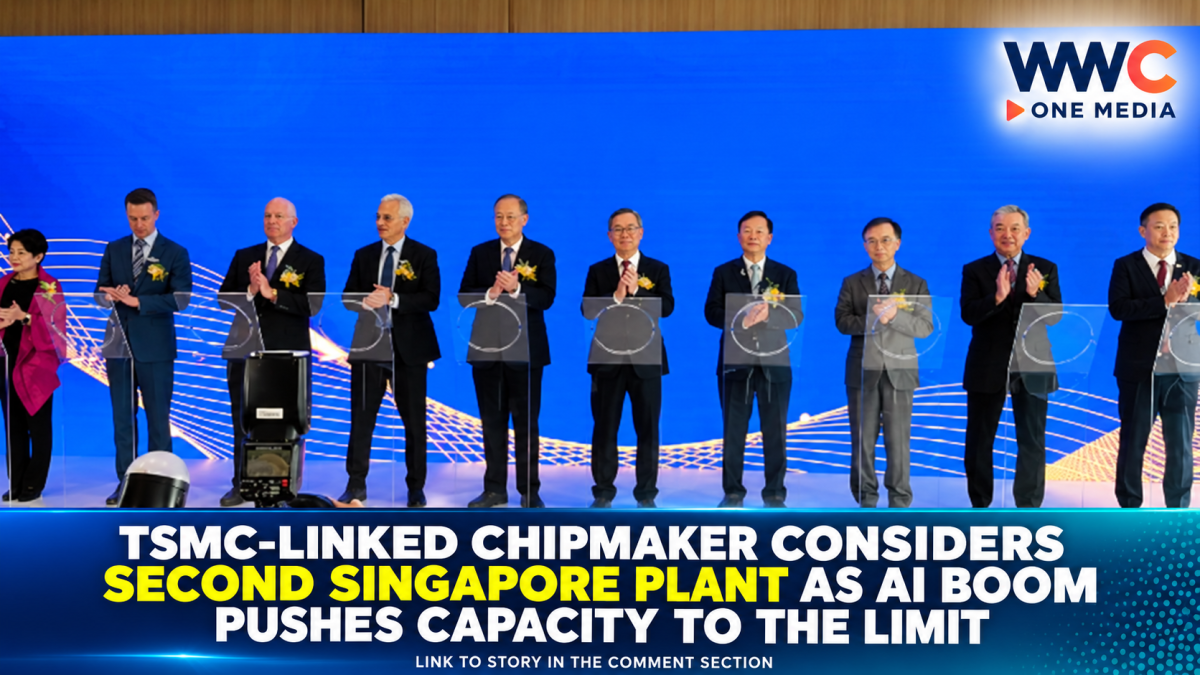
The facility was inaugurated Monday after construction began only about 18 months earlier. Test production started in June, while mass production is scheduled for early 2027.
VIS said the first batch of chips achieved a yield of at least 99%, an early production milestone for the new facility.
The plant is designed to manufacture power-management and analog semiconductors for automotive and industrial applications. It will also support TSMC by producing interposers used in advanced packaging for AI processors.
AI Is Driving Demand Beyond AI Processors
The semiconductor shortage created by the AI boom is no longer limited to high-performance computing chips.
As data centers expand, they require a much wider range of components to manage electricity, power conversion, connectivity and other functions.
VIS said demand for power-related and analog chips — particularly those used in data centers — continues to exceed available supply. Its existing capacity has therefore come under increasing pressure.
The company has already hired about 1,000 workers for its Singapore operations and expects its workforce to grow to roughly 1,600 as production ramps up.
A Major Investment Is Already on the Books
VIS and NXP initially announced a NT$248.13 billion (US$7.8 billion) investment in the Singapore facility in 2024.
That figure was later reduced to approximately NT$213.18 billion following changes to equipment procurement plans.
A second plant would require another substantial financial commitment, which is why VIS says it is carefully evaluating demand and funding before moving forward.
Singapore Could Become an Even Bigger Chip Hub
The potential second fab would add another layer to Singapore’s growing role in the global semiconductor supply chain.
For VIS, the immediate challenge is clear: customer demand is already stretching existing capacity, while the AI industry’s expansion continues to create demand for chips that sit behind the most powerful processors.
Whether VIS ultimately commits to a second Singapore facility remains undecided.
But with its first plant only beginning the transition toward mass production and customer requests already exceeding available capacity, the next major expansion decision could reveal just how much semiconductor demand the AI boom is generating beyond the headline AI chips themselves.
WWC ONE MEDIA G,A