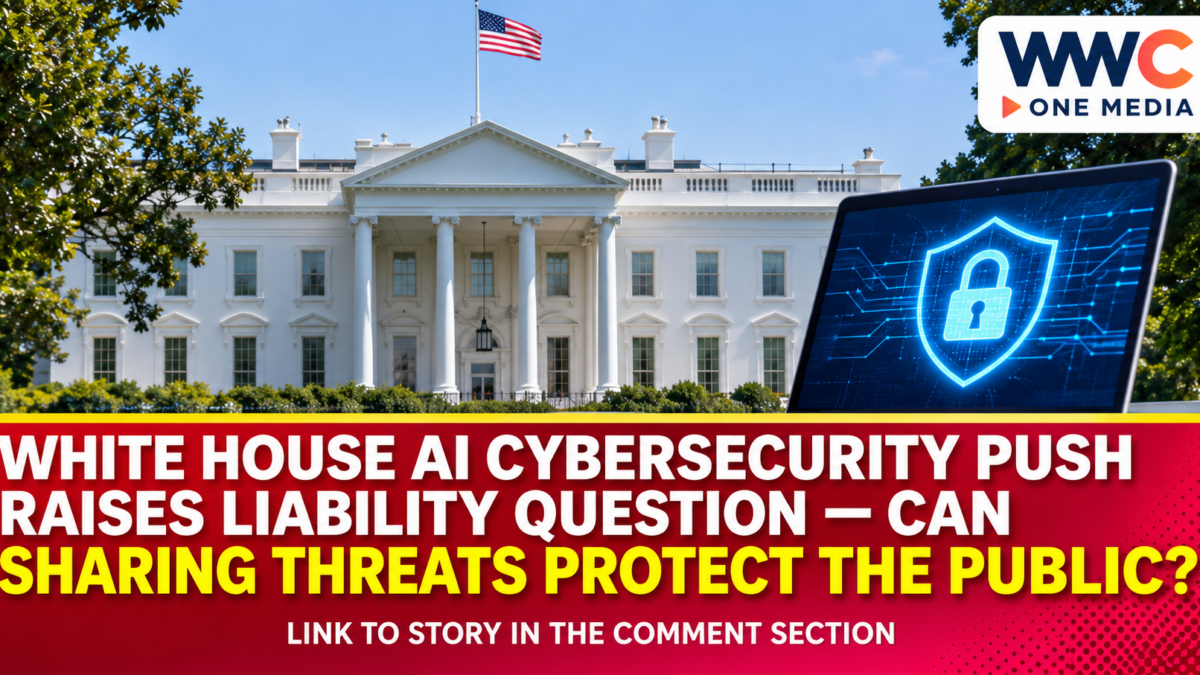
UNITED STATES — Nov. 14, 2026. The White House has established a government-industry effort to identify and address cyber vulnerabilities as increasingly powerful artificial intelligence systems enter critical infrastructure. Its published orders encourage cooperation with AI developers, while existing US law offers conditional protections for sharing certain cybersecurity information, leaving an important distinction between reporting a threat and escaping responsibility for harm.
For companies, regulators and customers, the central question is not simply whether more information will be shared. It is who can report a dangerous weakness, what protection that report receives and how quickly the affected organisation must respond.
White House AI Cybersecurity Policy Already Has a Formal Foundation
President Donald Trump’s June 2, 2026 executive order, titled Promoting Advanced Artificial Intelligence Innovation and Security, directs federal agencies to strengthen cyber defence and work with operators of critical infrastructure. The order calls for an AI cybersecurity clearinghouse involving the Treasury Department, national security agencies, the Cybersecurity and Infrastructure Security Agency and private participants.
The clearinghouse’s assigned work includes coordinating vulnerability scans, validating findings, prioritising fixes and supporting distribution of patches. In plain language, the policy aims to stop multiple organisations from discovering the same weakness in isolation while attackers continue to exploit it.
On July 14, the White House announced an initiative called GOLD EAGLE to coordinate the discovery and remediation of cybersecurity vulnerabilities. Its announcement describes cooperation between federal agencies, software partners and operators of critical infrastructure. That announcement establishes a programme and its purpose, but does not independently establish how many vulnerabilities it has eliminated or how much loss it has prevented.
Existing Law Protects Some Cyber Threat Sharing, Not Every AI Mistake
The Cybersecurity Information Sharing Act of 2015 supplies a legal framework for exchanging defined cyber threat indicators and defensive measures. Federal guidance explains that the protections are conditional: the information and the method of sharing must meet statutory requirements.
The law provides liability protections for qualifying monitoring and information sharing. It does not create a general exemption for an organisation’s defective AI product, negligent operations or unrelated harmful conduct. Nor does a voluntary submission necessarily replace incident reports required by a sector regulator.
That distinction is central to any discussion about encouraging companies to disclose AI-related vulnerabilities. An organisation may need confidence that describing a vulnerability will not itself create unnecessary litigation exposure, but customers still need meaningful remedies when a service provider fails an applicable duty.
The official documents reviewed do not establish a newly enacted, blanket November 2026 liability shield for AI developers or infrastructure operators. The existing protection is tied to qualifying cybersecurity information sharing, not a universal permission to develop or deploy unsafe systems.
AI Developers Face a Separate Frontier-Model Framework
The June order also directs agencies to design a voluntary process for working with developers of highly capable AI systems. Under that framework, developers may engage government reviewers about whether a model falls within a covered frontier category and may give authorised parties early access subject to confidentiality and security safeguards.
The order contemplates access for up to 30 days before release to other trusted partners. It expressly rejects interpreting that process as authority for a mandatory licence or pre-release approval requirement for all AI development.
A separate September 29 White House accord on superintelligence sets out commitments for frontier companies to establish internal controls, monitor their systems, use independent assessments and identify problems. A commitment is an important statement of intended conduct, yet it should not be confused with proof of compliance or an enacted statutory obligation.
WWC ONE MEDIA has previously examined questions around security controls inside an AI developer. The wider lesson is that internal testing, external scrutiny and transparent remediation serve different purposes, and none should be used as a substitute for the others.
Why Banks, Utilities and Essential Services Have Higher Stakes
The White House order specifically discusses extending AI-enabled defensive capabilities to operators such as community banks, local utilities and rural hospitals. These sectors depend on continuous service, secure records and systems that cannot always be taken offline for prolonged investigation.
AI can help specialists examine logs and discover software weaknesses, but the same automation can introduce failure modes involving permissions, data access and unexpected actions. A report of suspicious activity is useful only when the receiving team can verify it and decide how to contain the risk.
For Philippine businesses, the underlying management issue is familiar even though US law does not govern local companies automatically. WWC’s earlier discussion of AI infrastructure and cybersecurity challenges in Philippine enterprises examined why technology deployment requires supporting controls and trained staff.
In another report, WWC explored consumer risks when AI agents gain access to private accounts. These concerns show why information sharing must be paired with restricted access, audit trails and clear accountability when software can act on behalf of users.
What This Could Mean for the Balance Between Disclosure and Accountability
Analysis: A narrowly written reporting protection can make sense if it gives an operator confidence to alert others about a genuine vulnerability. A broad immunity that covers the underlying unsafe conduct would raise a different question: whether the public is losing a remedy in exchange for information that may never lead to a fix.
Good policy would define who is eligible, the type of information covered, the deadlines for reporting, the handling of personal data and the limits of legal protection. It would also identify who reviews incidents and what evidence demonstrates that a reported defect was corrected.
The present public record supports a US strategy of voluntary AI cooperation, coordinated cyber defence and conditional protections under existing law. It does not justify claiming that an entirely new legal immunity has already taken effect following recent policy discussions.
What Happens Next
The practical milestones are documented results from the federal vulnerability-coordination effort, the development of frontier-model assessment arrangements and any formal legislative or regulatory changes to information-sharing protections. Each should be assessed on its actual text, not on the assumption that a policy conversation has already changed the law.
The larger question is whether more candid reporting can produce faster repairs while preserving responsibility when people or essential services suffer harm. The answer will depend on measurable outcomes and enforceable boundaries, not assurances alone.
Frequently Asked Questions
Has the White House removed liability for AI companies?
No broad new exemption is established by the primary records reviewed. Existing US law provides conditional protections for certain qualifying cybersecurity monitoring and information sharing.
What is GOLD EAGLE?
It is a White House-announced initiative for coordinating the discovery, validation and remediation of software vulnerabilities with government and industry participants.
Must AI developers obtain government approval before releasing models?
The June 2026 executive order says its voluntary frontier-model framework must not be construed as creating a mandatory licensing or pre-release approval requirement.
Why does this matter outside the United States?
Businesses globally face similar trade-offs involving information sharing, cybersecurity response and accountability. US initiatives can provide lessons, but their protections do not automatically apply under Philippine law.