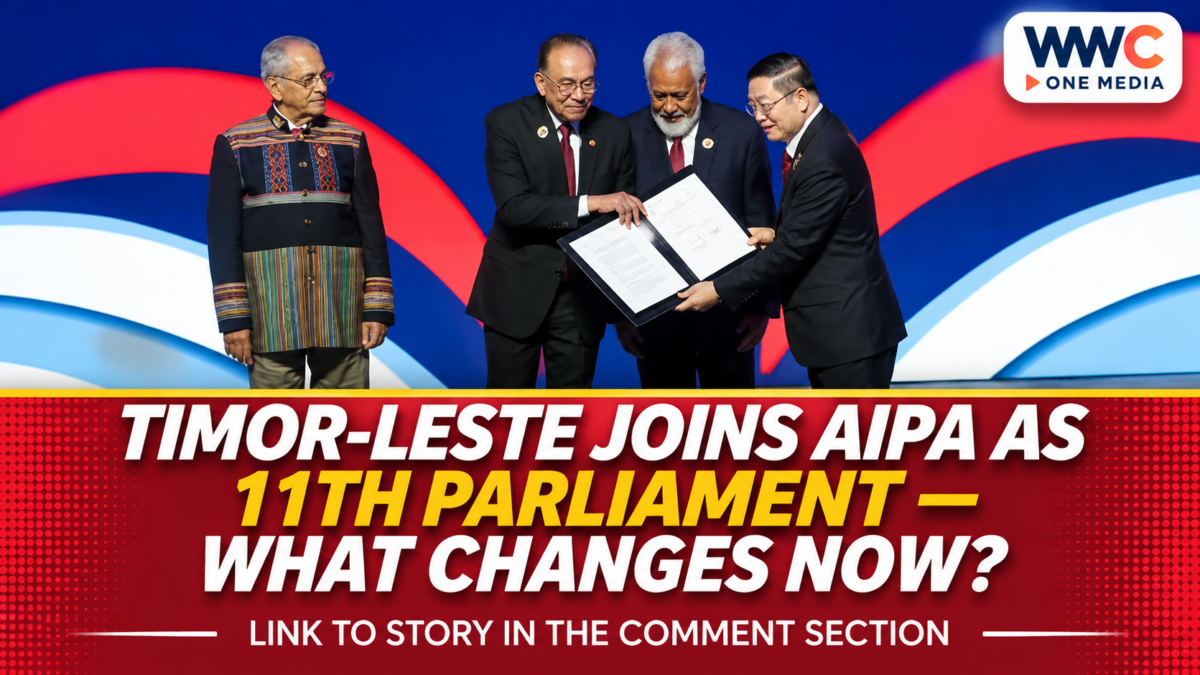
MANILA, Philippines — Nov. 21, 2026. Timor-Leste’s National Parliament became the 11th full member of the ASEAN Inter-Parliamentary Assembly (AIPA) on Nov. 18 during the organisation’s 47th General Assembly in Manila. Parliamentary president Maria Fernanda Lay signed the instrument of accession, formalising a step that followed Timor-Leste’s entry into ASEAN in October 2025.
The admission gives the country full standing within AIPA’s parliamentary cooperation framework. It does not automatically produce new laws, budgets or regional agreements. The practical test will be whether participation improves legislative exchanges and gives Timorese lawmakers a sustained voice in issues affecting their country and Southeast Asia.
Timor-Leste AIPA Membership: What Was Formally Completed?
The admission took place at the first plenary session on Nov. 18. AIPA’s announcement confirms that the National Parliament became its 11th member parliament, while Timor-Leste’s own parliamentary statement identifies Lay as the leader of the delegation and the signatory of the accession instrument.
The ceremony ended a 13-year period of observer participation, as described by Timor-Leste’s Parliament. Maria Gorumali Barreto, identified in the parliamentary announcement as president of the country’s AIPA national group, also joined the delegation’s engagements with regional counterparts.
This is a specific institutional transition, not the creation of a new country-level ASEAN membership. Timor-Leste had already joined ASEAN the previous year; AIPA admission established its full place in a separate forum for national legislatures.
The distinction is especially relevant after the Philippines’ wider diplomatic engagements with Timor-Leste, including the historical relationship explored in WWC’s report on Timorese independence advocacy and Filipino civil society. That earlier history is separate from the parliamentary accession now documented in Manila.
Why ASEAN Membership and AIPA Membership Are Different
ASEAN brings member governments together for regional cooperation. AIPA brings national parliaments together to exchange legislative perspectives and work on shared issues. Membership of one is closely connected to the other, but the procedures and institutional responsibilities are not identical.
AIPA’s published membership rules state that national parliaments of ASEAN member states are eligible to join and that its Executive Committee sets the application and admission procedure. An eligible parliament therefore still has to complete the relevant membership process.
The organisation also prepared Timor-Leste’s legislators for the transition. Its May 25, 2026 executive briefing in Dili explained AIPA’s institutional framework, meetings, projects and initiatives, and supported the country’s application for permanent membership.
That preparatory work matters because joining a regional assembly is not simply receiving a new title. Delegations must understand meeting procedures, committee work, reporting obligations and the difference between parliamentary recommendations and domestic lawmaking.
What Full Participation Could Mean for Timorese Lawmakers
Timor-Leste’s Parliament said its delegation held meetings with other parliamentary leaders at the Manila assembly. Those engagements provide a channel for presenting the country’s priorities in direct discussions with lawmakers from neighbouring states.
Analysis: A full seat can make participation more systematic. It gives a parliament a stronger basis for joining recurring discussions rather than depending on occasional observer invitations. The precise influence of that participation, however, will depend on how representatives prepare, follow up and engage their own national institutions.
Timorese lawmakers can use parliamentary exchanges to compare approaches to economic development, public administration and social policy. That does not imply that AIPA can impose a common law on its members or guarantee any particular development outcome.
The country’s parliament framed admission in terms of practical benefits for its people, including regional stability and economic development. Those are objectives, not outcomes that can already be measured from the accession ceremony.
The Philippine Assembly Provides a Regional Setting
The Philippines hosted the 47th AIPA General Assembly in Manila from Nov. 16 to 22 under the theme “Parliaments Securing a Peaceful, Prosperous, and People-centred ASEAN.” The first plenary was chaired by Philippine House Speaker and AIPA President Faustino “Bojie” G. Dy III.
Delegations included member and observer parliaments, regional secretariats and other invited participants. The gathering offered a forum for conversations extending beyond the accession itself, without making every statement at the assembly a binding policy decision.
Regional discussions also operate through other channels. WWC’s coverage of ASEAN Plus Three cooperation on trade, energy and food security examines commitments made by government leaders and external partners. AIPA is distinct: its institutional contribution lies in parliamentary dialogue and legislative follow-through.
That distinction helps prevent readers from confusing a regional parliamentary admission with a trade deal, a new investment commitment or the immediate amendment of national legislation.
What This Could Mean for Regional Cooperation
Analysis: Adding Timor-Leste completes AIPA’s formal expansion to 11 member parliaments, aligning its membership count with ASEAN’s expanded membership. A fuller range of parliamentary voices may improve the breadth of discussion, but representation and implementation are different tests.
The most useful indicators will be regular Timorese participation in committees, documented legislative exchanges, public reporting on the delegation’s work and identifiable follow-up within the country’s Parliament. None of those can be assumed from the accession document alone.
The regional agenda will also continue under new leadership. WWC has examined Singapore’s preparations for its 2027 ASEAN chairmanship, a governmental role separate from AIPA’s own parliamentary presidency. Keeping the two institutions distinct is necessary when tracking which body is responsible for which commitments.
What Happens Next
Timor-Leste’s full membership is already effective following the Nov. 18 accession ceremony. The next question is how its National Parliament uses the new platform in subsequent committee meetings, parliamentary exchanges and reports back to constituents.
Further official records may show which initiatives its delegation advances and whether any parliamentary recommendations lead to domestic legislative consideration. Until then, the clear achievement is admission itself, not a guaranteed economic or political payoff.
Frequently Asked Questions
When did Timor-Leste join AIPA?
Timor-Leste’s National Parliament was admitted on Nov. 18, 2026, during the first plenary of AIPA’s 47th General Assembly in Manila.
Who signed Timor-Leste’s AIPA accession instrument?
Maria Fernanda Lay, president of Timor-Leste’s National Parliament, signed the instrument and delivered the acceptance address.
Is AIPA the same as ASEAN?
No. ASEAN is a regional organisation of member states; AIPA is an assembly for their national parliaments. Their memberships are connected but their functions are different.
Does AIPA membership automatically change Timor-Leste’s laws?
No. Membership enables parliamentary participation. Any domestic legislative changes require the appropriate national procedures.