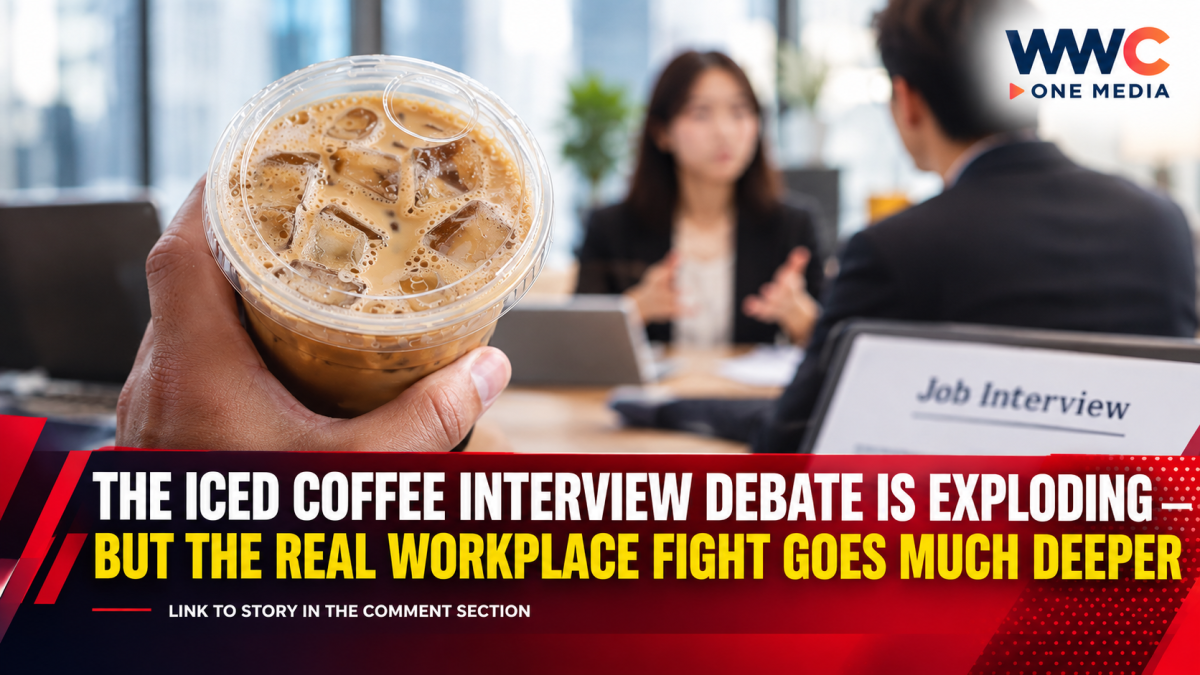
A simple iced coffee has become the unlikely symbol of a much bigger workplace battle.
A viral debate erupted after corporate recruiter Caitlin Wehniainen criticized younger job candidates for bringing iced coffee or iced lattes into interviews. Her argument was that the drink could make an interview appear too casual, suggesting that the candidate viewed it as merely another stop in a busy day.
The reaction was swift, with social media users divided over whether carrying a drink into an interview is genuinely unprofessional or simply an outdated workplace expectation.
But according to Bloomberg Opinion columnist Beth Kowitt, the argument is ultimately less about coffee than it is about who gets to define professionalism in a rapidly changing workplace.
Why One Coffee Became a Generational Flashpoint
For some older managers, Kowitt argues, an iced coffee can be interpreted as a sign that a job candidate does not understand—or does not intend to follow—traditional workplace etiquette.
For many younger workers, however, the reaction can look like another example of arbitrary rules being used to judge them before their skills and qualifications are even considered.
That tension has become more pronounced as Gen Z enters a labor market increasingly shaped by artificial intelligence, changing expectations around flexibility and continuing uncertainty over the future of many jobs.
The interview itself has also taken on a different role.
With applicants increasingly using AI to prepare resumes and cover letters—and employers using automated systems to screen candidates—the face-to-face interview can become one of the few remaining opportunities for employers to assess personality, communication and cultural fit.
AI Is Changing the Rules of Getting Hired
The coffee controversy arrives as employers and employees are already negotiating a broader transformation in workplace culture.
AI is changing how people apply for jobs, while companies are simultaneously reassessing office attendance, employee monitoring, benefits and expectations around workplace behavior.
Kowitt describes this as a struggle over workplace power: employers are seeking greater control and consistency, while many younger workers are pushing for clearer boundaries and questioning rules they consider arbitrary.
That makes the iced-coffee debate far more significant than the beverage itself.
The underlying question is whether professionalism should be defined by traditional signals of conformity—or increasingly by a person’s ability to perform, communicate and contribute.
Workplace Rules Have Changed Before
The controversy also highlights how quickly definitions of professionalism can evolve.
Kowitt points to earlier expectations surrounding tattoos and the disclosure of personal identity in resumes and interviews. Practices that were once treated as normal professional standards have changed as workplace culture evolved.
An iced coffee is obviously not comparable to those issues. But the broader lesson is that workplace norms are not permanent.
What one generation considers a basic sign of professionalism can look unnecessary or exclusionary to another.
And as AI continues to reshape hiring, the debate over something as ordinary as a coffee may be exposing a much larger question: What should professionalism actually mean in the modern workplace?
For now, the iced coffee remains the unlikely centerpiece of that conversation—but the conflict it represents is unlikely to disappear with the last sip.
WWC ONE MEDIA G,A