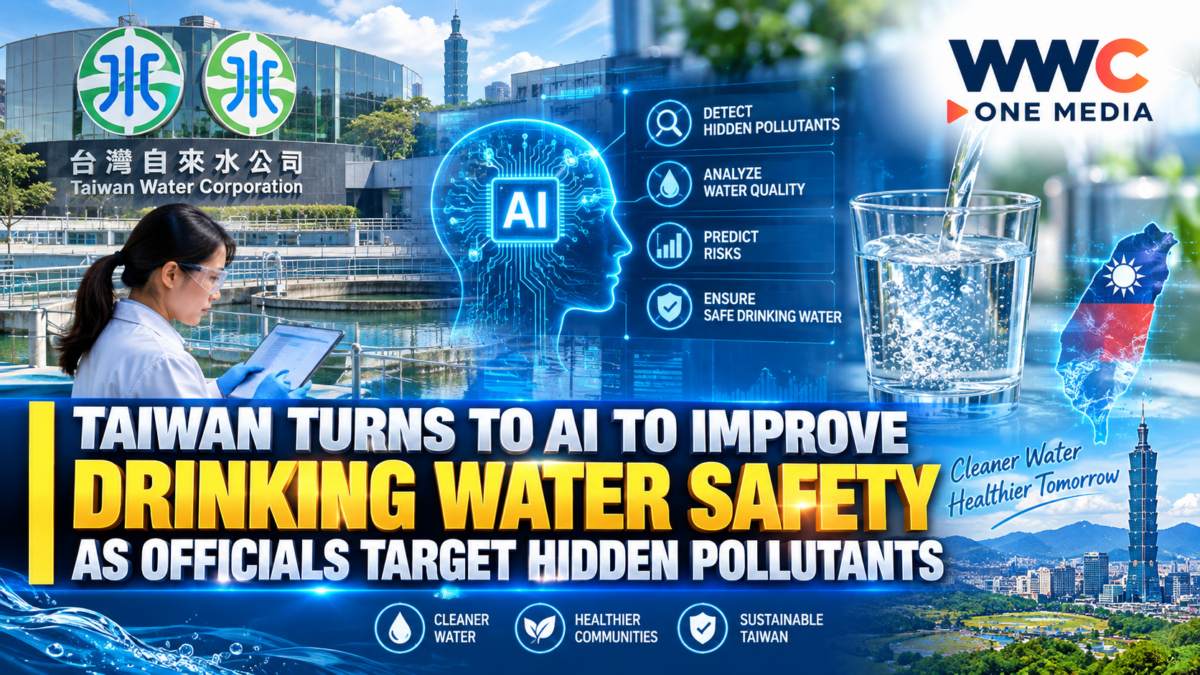
Taiwan is turning to artificial intelligence to strengthen drinking-water management, with the Taiwan Water Corporation entering a new partnership with the Ministry of Environment to improve testing, identify overlooked contaminants and respond to emerging water-quality threats.
The Taiwan Water Corporation signed a memorandum of understanding Wednesday with the ministry’s National Environmental Research Academy, creating a framework for cooperation on water management, testing techniques and professional training.
The move comes as Taiwan faces increasingly complicated challenges involving pollutants, algae, drought and changing environmental conditions.
AI Takes Aim at Water-Quality Problems
The National Environmental Research Academy has developed AI-assisted water-testing methods, including applications designed to address problems such as algal blooms in reservoirs.
Under the new cooperation agreement, Taiwan Water Corporation personnel will receive training in methods for identifying newly recognized contaminants and algae.
The water utility also plans to explore ways to incorporate AI into its own management and testing practices.
The goal is not simply to detect problems after they appear, but to improve the ability of water managers to identify and evaluate potential threats earlier.
Why Hidden Contaminants Matter
Officials said newer testing approaches are helping researchers identify, assess and address contaminants that may previously have received less attention.
Substances including nitrogen and phosphorus, along with algae, can accumulate in water systems. Under certain conditions, these materials can contribute to oxygen depletion and deteriorating water quality.
For a densely populated and highly industrialized island, maintaining reliable access to safe drinking water requires continuous monitoring as environmental conditions change.
Taiwan Water Corporation Chair Li Chia-jung emphasized the importance of maintaining the water supply and ensuring safe drinking water.
More Than 10,000 Water Samples Tested Each Year
The National Environmental Research Academy already operates a large-scale water-testing program.
According to the report, academy President Chang Shuenn-chin said the institute analyzes more than 10,000 water samples annually, with an acceptance rate exceeding 99.5 percent, citing the Commercial Times.
The academy’s existing AI capabilities could provide another layer of support as Taiwan Water Corporation works to upgrade its own testing and management practices.
Climate Change Adds Another Layer of Pressure
Water quality is only part of the challenge.
Chang also pointed to environmental changes associated with climate change, including droughts that have eliminated some water sources.
That makes water-supply monitoring and conservation increasingly important alongside pollution control.
The combination of AI-assisted testing, improved contaminant detection and closer cooperation between government research institutions and the national water utility reflects a broader effort to make Taiwan’s water system more responsive to changing environmental conditions.
What Happens Next?
The new agreement provides a framework for Taiwan Water Corporation staff to learn advanced testing methods while giving the utility access to research expertise in areas such as AI-assisted water analysis and algal-bloom management.
The bigger challenge will be turning those technologies into practical improvements across Taiwan’s water-supply network.
As climate pressures, drought and emerging contaminants continue to test water systems, AI may become an increasingly important tool in detecting problems before they become threats to the country’s drinking-water supply.
WWC ONE MEDIA G,A