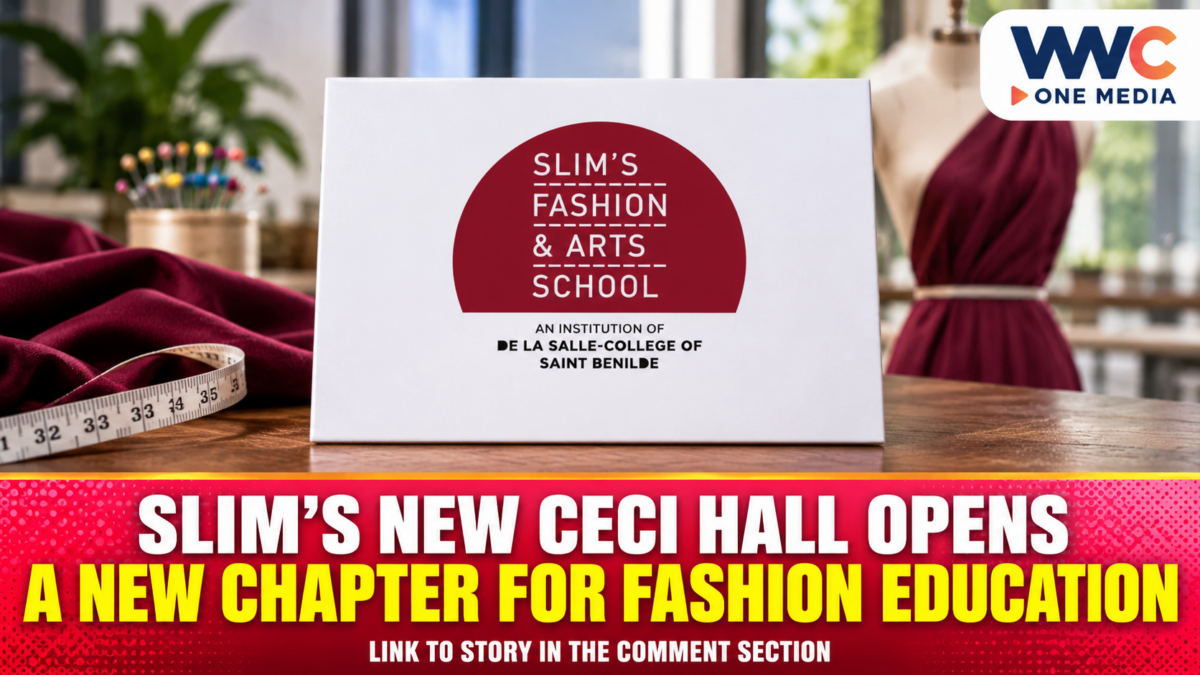
Slim’s Fashion & Arts School has established its new home at CECI Hall in Malate, Manila, marking a new phase for an institution with more than six decades of experience in fashion and dressmaking education.
The school is scheduled to welcome the public to an open house on Nov. 28, 2026, with activities that introduce visitors to fashion conceptualisation and ceramic accessory-making. The event offers a look at how creative education can extend beyond traditional classroom instruction and into practical, hands-on experiences.
The move is significant because fashion education depends on more than inspiration. Students and aspiring designers need opportunities to understand materials, develop technical skills and translate creative ideas into finished work.
A New Home for a Long-Established Fashion School
CECI Hall, located at 1053 Pablo Ocampo St. in Malate, Manila, was formally blessed on Sept. 30, 2026, as the new home of Slim’s Fashion & Arts School.
The announcement was included in De La Salle-College of Saint Benilde’s October 2026 institutional publication. The blessing brought together representatives from Benilde and the fashion and design community, including Slim’s School Director Christine Cheryl Benet and Fashion Design and Merchandising Program Chairperson Ionica Abrahan Lim.
The new location is intended to provide a dedicated environment for learning, collaboration and creative work.
The development also connects the school with Benilde’s wider efforts to support future professionals in fashion, design and the arts.
For an institution built around technical instruction, the importance of a learning space goes beyond its physical facilities. A dedicated environment can help bring together students, instructors and creative practitioners while giving practical activities a more visible place in the learning experience.
What the School’s Training Tradition Brings to the New Space
Slim’s Fashion & Arts School traces its origins to Salvacion Lim Higgins, known as Slim, and her sister Purificacion, who founded the institution in Manila.
The school’s official website says the sisters developed technical lessons that remain the foundation of its curriculum, a teaching approach known as the Slim’s Method.
The institution also identifies fashion design and dressmaking or patternmaking as its two foundation courses. Both are described as TESDA-certified.
Its fashion design programme covers freehand drawing, colour theory, anatomy and apparel design. The school says the course aims to build both sketching ability and an art-based foundation for developing design talent.
The dressmaking and patternmaking programme, meanwhile, covers measuring, fitting, pattern drafting, sewing and garment finishing.
These subjects demonstrate why fashion education involves several disciplines. A designer may begin with a visual concept, but turning that concept into a wearable garment requires knowledge of construction, fit, fabric behaviour and finishing.
The school’s official course information also describes workshops as supplementary learning opportunities, with specialised subjects offered on rotating schedules and limited slots.
The Open House Puts Practical Creative Activities in Focus
The Nov. 28 open house is expected to introduce visitors to two workshop options: Fashion Conceptualization: Mood Board Creation and Ceramic Fashion Accessories Making.
The first activity centres on building a visual direction through images, colours, textures and other references. Mood boards are commonly used in creative work to organise ideas before a design moves into development.
For fashion students, this process can help establish a clearer visual identity for a collection, garment or brand concept. It also provides a way to communicate an idea before committing to materials and construction.
The second workshop introduces ceramic techniques for making fashion accessories. The activity connects material exploration with wearable design, showing how clay can be shaped into decorative objects.
The school’s public announcement describes the sessions as free workshop options for the open house, with limited slots and registration details to be released through its official page.
The activities are particularly relevant to people who want to explore creative work without immediately enrolling in a full programme. They also give prospective learners a chance to experience different approaches to design and making.
Why Hands-On Learning Matters in the Creative Industries
The new space and planned activities raise a broader question about the role of practical education in the Philippine creative sector.
Fashion is not simply about producing attractive clothing. It involves technical processes, material knowledge, problem-solving and the ability to turn concepts into products that can be worn, presented or sold.
The importance of these skills can also be seen in other areas of Philippine design. WWC previously examined how the Philippine terno’s history is being documented for a wider audience, highlighting the craftsmanship and construction knowledge behind traditional garments.
Other design disciplines are also creating opportunities for students to translate ideas into physical work. The Philippine School of Interior Design’s student exhibition showed how concepts drawn from everyday Filipino experiences can become full-scale design environments.
Meanwhile, the connection between technical skills and livelihood is evident in initiatives such as Quezon City’s effort to turn discarded textiles into training and employment opportunities.
These examples involve different parts of the creative economy, but they point to a shared requirement: creative ideas need practical skills and opportunities to be developed.
The Opportunity Beyond a One-Day Event
An open house can serve as an introduction, but its longer-term value depends on what participants can pursue afterwards.
For visitors who discover an interest in fashion design, garment construction or accessory-making, the next step may involve structured training. The school’s existing foundation courses and specialised workshops provide different learning paths, depending on a participant’s goals and experience.
The distinction matters. A short activity can introduce a technique, while professional development requires sustained practice, feedback and a deeper understanding of the craft.
For aspiring entrepreneurs, technical knowledge can also help turn creative interests into products. However, running a fashion or accessories business requires more than design ability. Production costs, sourcing, quality control, pricing and customer demand all affect whether a creative idea can become a viable enterprise.
The new facility therefore has the potential to serve as more than a venue for introductory activities. Its significance will depend on how effectively it supports continuing instruction and engagement with the wider design community.
What Happens Next
The next scheduled public milestone is the Nov. 28, 2026, open house at CECI Hall.
Interested participants should monitor Slim’s Fashion & Arts School’s official social media page for registration instructions, workshop availability and any additional event details. The school’s announcement indicates that slots are limited.
The event will give visitors an opportunity to explore the new location and experience selected creative activities. Further information about regular classes and workshop schedules is available through the institution’s official website.
For Slim’s, the move to CECI Hall places its long-running technical education tradition in a new setting. Whether the new home becomes a stronger platform for emerging designers will ultimately depend on the learning opportunities and creative work that follow the opening.
Frequently Asked Questions
1. Where is Slim’s Fashion & Arts School’s new home?
The school’s new home is CECI Hall at 1053 Pablo Ocampo St., Malate, Manila.
2. When is the Slim’s Fashion & Arts School open house?
The open house is scheduled for Nov. 28, 2026.
3. What workshops are planned for the open house?
The announced activities are Fashion Conceptualization: Mood Board Creation and Ceramic Fashion Accessories Making.
4. Are the open house workshops free?
The school’s public announcement describes the two workshop options as free. Slots are limited, and visitors should check the official school page for registration details.
5. What courses does Slim’s Fashion & Arts School offer?
Its official website identifies Fashion Design and Dressmaking or Patternmaking as its two foundation courses. It also lists specialised workshops, including tailoring and draping.