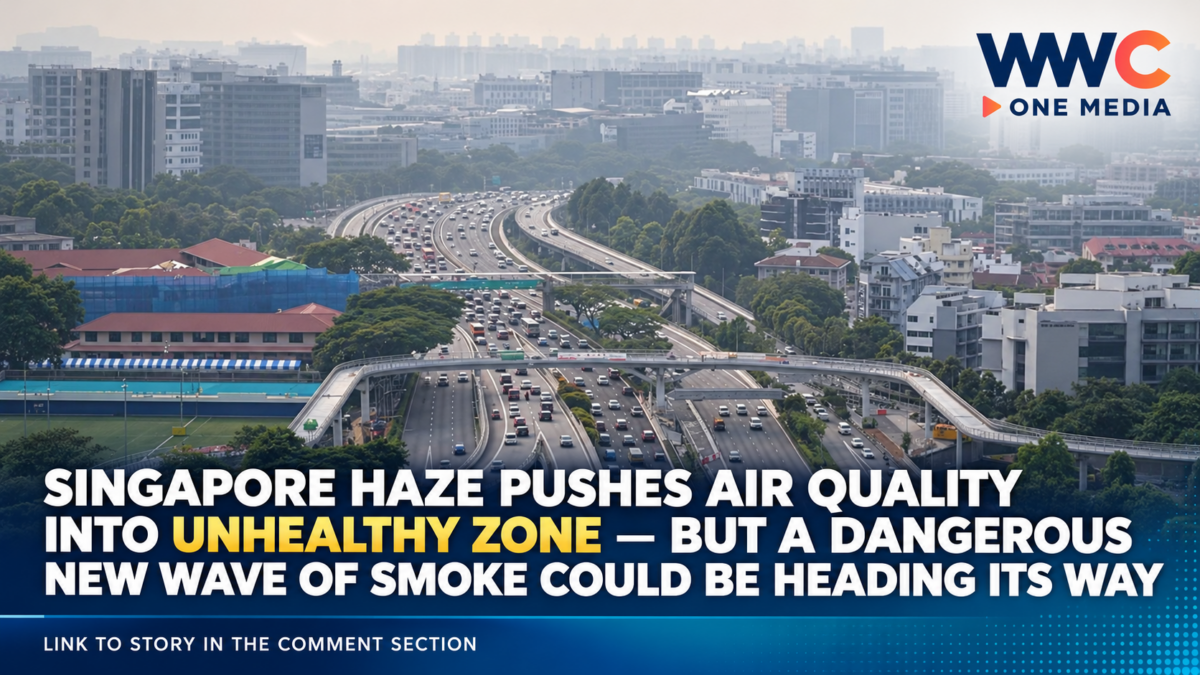
SINGAPORE, October 20, 2026 — Singapore is facing another troubling episode of air pollution as haze linked to widespread forest and peatland fires in Indonesia continues to affect the city-state, pushing air quality into the unhealthy range in parts of the island and raising concerns that a fresh wave of smoke could arrive in the coming days.
Latest readings from Singapore’s National Environment Agency (NEA), reported by Channel NewsAsia, showed elevated concentrations of fine particulate matter across four of the country’s five monitoring regions at 9 a.m. Tuesday, October 20.
One-hour PM2.5 concentrations ranged from 44 to 84 micrograms per cubic metre across Singapore, with the northern region the only area remaining within the normal band.
Meanwhile, the 24-hour Pollutant Standards Index (PSI) reached 125 in western Singapore and 114 in central Singapore, placing both regions in the unhealthy category. The remaining regions recorded moderate air quality.
While forecasts of rainfall offer some hope of temporary relief, shifting wind patterns threaten to bring more smoke from Indonesia’s fire-stricken territories toward Singapore.
Temporary Relief Could Give Way to Another Haze Surge
Singapore’s NEA said showers expected over the country and surrounding areas on Tuesday could help reduce the haze.
However, smoke from Indonesia’s Sumatra island could still drift toward Singapore, depending on atmospheric conditions.
The greater concern lies in the weather outlook from Tuesday night through Thursday, October 22.
According to NEA, winds are expected to shift toward an east-southeasterly direction while dry weather persists in parts of Kalimantan. Such conditions could carry additional smoke haze from Indonesian fires into Singapore.
The agency has warned that the possibility of severe transboundary haze remains despite recent improvements in local air quality.
The outlook highlights Singapore’s vulnerability to fires occurring hundreds of kilometres beyond its borders, where seasonal winds can transport microscopic smoke particles across Southeast Asia.
Indonesia’s Wildfires Are Becoming a Regional Emergency
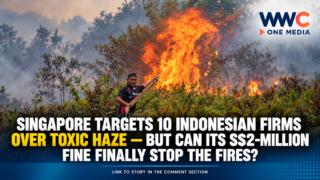
The worsening haze is part of a much larger environmental crisis affecting Indonesia and neighbouring countries.
Reuters reported on October 15 that prolonged forest and peatland fires across Sumatra and Borneo have been intensified by exceptionally dry El Niño conditions.
According to the report, Indonesia has recorded more than 283,000 respiratory illness cases across seven provinces affected by the fires.
The crisis has also disrupted transportation, forced school closures and affected communities throughout the region.
Authorities in Indonesia have deployed tens of thousands of personnel and aircraft to battle the fires. However, peatland blazes are particularly difficult to extinguish because they can continue burning underground even when flames on the surface appear to have disappeared.
This makes prolonged rainfall and sustained firefighting operations crucial to stopping the pollution at its source.
The situation has also renewed questions about land-clearing practices, environmental enforcement and whether governments across Southeast Asia have done enough to prevent recurring haze disasters.
Singapore’s Pollution Crisis Is Already Disrupting Daily Life
The impact of the haze goes far beyond reduced visibility.
Earlier reports indicated that worsening air quality had disrupted outdoor sports and recreational activities in Singapore, with some events cancelled and outdoor facilities temporarily closed.
Singapore also experienced a significant pollution spike on October 14, when Reuters reported PM2.5 levels reaching 284 micrograms per cubic metre, reflecting the severity of the smoke episode.
For residents, the most immediate concern is exposure to fine particulate matter.
PM2.5 refers to airborne particles measuring 2.5 micrometres or less in diameter. These particles are small enough to penetrate deep into the lungs, and exposure can aggravate respiratory and cardiovascular conditions.
Health authorities have advised vulnerable residents, including older adults, pregnant women, children and people with chronic heart or lung diseases, to reduce prolonged or strenuous outdoor activities when air quality deteriorates.
Individuals undertaking extended outdoor activities during severe pollution episodes may also benefit from properly fitted N95 or equivalent protective masks.
Singapore Steps Up Pressure on Companies Linked to the Fires
The crisis has also become a major environmental and diplomatic issue.
Associated Press reported on October 20 that Singapore had issued preventive notices to three additional Indonesian companies linked to areas affected by land and forest fires in Kalimantan.
The action increased the number of companies targeted under Singapore’s Transboundary Haze Pollution Act to ten.
The notices call for action to prevent or stop fires and require companies to provide information about their fire-prevention measures.
Such notices do not automatically establish legal liability, but non-compliance can trigger enforcement consequences.
The tougher approach reflects mounting pressure to hold businesses accountable for pollution that crosses national borders and affects millions of residents.
Environmental groups and regional observers have repeatedly argued that firefighting alone will not permanently resolve Southeast Asia’s haze problem without stronger land-use controls, protection of peatlands and credible enforcement against illegal burning.
Could Southeast Asia Face Another Prolonged Haze Emergency?
The latest developments suggest that Singapore’s air quality may remain unpredictable over the coming days.
Rainfall and favourable wind conditions could bring temporary improvements, but renewed smoke transport from Indonesia may quickly reverse those gains.
The broader regional outlook remains concerning because persistent dry conditions, extensive fire activity and vulnerable peatland ecosystems can sustain pollution episodes for weeks.
For Singapore, Malaysia and other Southeast Asian countries affected by transboundary smoke, the challenge is no longer simply dealing with one bad day of air pollution.
It is preventing another prolonged environmental emergency that threatens public health, disrupts businesses and exposes gaps in regional cooperation.
The bottom line: Singapore may see temporary relief from the haze on October 20, but shifting winds and continuing Indonesian wildfires mean another pollution surge remains possible. Whether conditions improve sustainably will depend largely on rainfall, fire suppression and the scale of smoke emissions across the region.