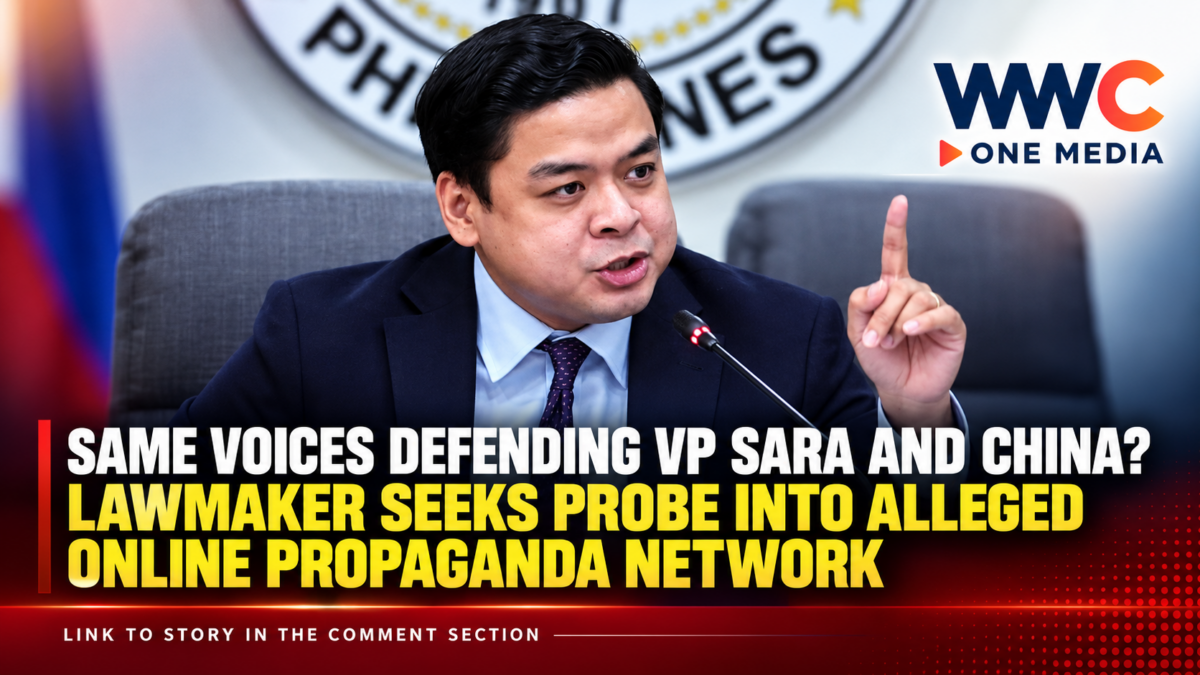
MANILA, Philippines — A proposed congressional investigation into possible links between online personalities defending Vice President Sara Duterte and accounts promoting China’s position on the West Philippine Sea is raising fresh questions about foreign influence, political messaging, and the role of social media in Philippine politics.
Bicol Saro party-list Representative Terry Ridon is preparing a House resolution seeking to examine what he described as an apparent overlap between online networks supporting the Duterte political family and those amplifying pro-China narratives, according to a report published by BusinessMirror on October 19.
The proposed inquiry would look into social media activities, messaging patterns, possible common organizers, and potential sources of funding behind the campaigns. The objective is to determine whether the apparent similarities reflect coordinated activity or another explanation.
Ridon said some online personalities who previously defended Duterte during her impeachment proceedings appeared to be promoting arguments favorable to Chinese Ambassador Jing Quan and Beijing’s position in the maritime dispute.
However, the alleged overlap does not, by itself, establish that the accounts are centrally coordinated, financed by the same source, or acting on behalf of the Chinese government.
Why the proposed investigation matters
The issue comes amid heightened tensions between Manila and Beijing over the West Philippine Sea, as well as growing concerns about online influence operations targeting Philippine political debates.
Ridon pointed to earlier cases involving networks that promoted favorable narratives about China while amplifying content supporting former president Rodrigo Duterte. He also cited research into foreign and domestic influence operations targeting overlapping audiences in the Philippines.
A congressional inquiry could examine whether the current online activity involves coordinated messaging, shared resources, or other evidence of organized influence. Any findings would need to be supported by verifiable records and a fair assessment of the accounts and individuals concerned.
The distinction is important: expressing support for a political leader, criticizing the government, or sharing views that align with Beijing does not automatically establish foreign direction or unlawful conduct.
China’s position and the West Philippine Sea controversy
The renewed scrutiny follows remarks by Chinese Ambassador Jing Quan that drew strong objections from Philippine officials. On October 16, the Associated Press reported that President Ferdinand Marcos Jr.’s administration protested the ambassador’s comments, which included the statement that China could easily win if it chose to use force but preferred peace.
The dispute has added to longstanding tensions over China’s maritime claims and the Philippines’ efforts to defend its rights in the West Philippine Sea.
The online propaganda question is therefore part of a wider debate about how foreign-policy disputes are discussed and influenced on Philippine social media.
In an August 29 report, Inquirer.net also covered warnings from the House prosecution team and the Armed Forces of the Philippines about fake news and foreign malign influence operations taking advantage of domestic controversies, including Vice President Duterte’s impeachment proceedings.
These reports provide context for the proposed investigation, but they do not independently prove that the particular online personalities mentioned in the current controversy are working together or receiving foreign support.
What investigators would need to establish
If the resolution is filed and an inquiry proceeds, investigators could examine several key questions:
- Are the accounts independently expressing similar opinions, or is there evidence of coordinated activity?
- Do public records or other verifiable evidence establish shared organizers, financial backers, or operational links?
- Is there credible evidence connecting any activity to a foreign government or organization?
- Were any laws violated, or does the activity fall within lawful political expression?
Digital investigations may consider posting patterns, account relationships, funding records, and other relevant evidence. Similar wording or synchronized posts may warrant closer examination, but neither alone proves foreign control.
As of the October 19 report, Ridon’s initiative was still being drafted. The proposal should not be confused with an approved congressional investigation or a final finding of wrongdoing.
The bigger question: Who is shaping the online political conversation?
The controversy highlights the challenge facing Philippine institutions as social media increasingly shapes public understanding of political disputes and national security issues.
A credible investigation would need to distinguish legitimate political advocacy from demonstrable coordination or unlawful foreign interference. It would also need to protect due process and avoid labeling individuals as foreign agents without sufficient evidence.
For now, the central question remains unresolved: Will investigators find evidence of an organized network connecting Duterte-aligned online campaigns with pro-China messaging, or will the apparent overlap prove insufficient to establish coordination?
The answer will depend on evidence, not simply on the political positions expressed by the accounts involved.










