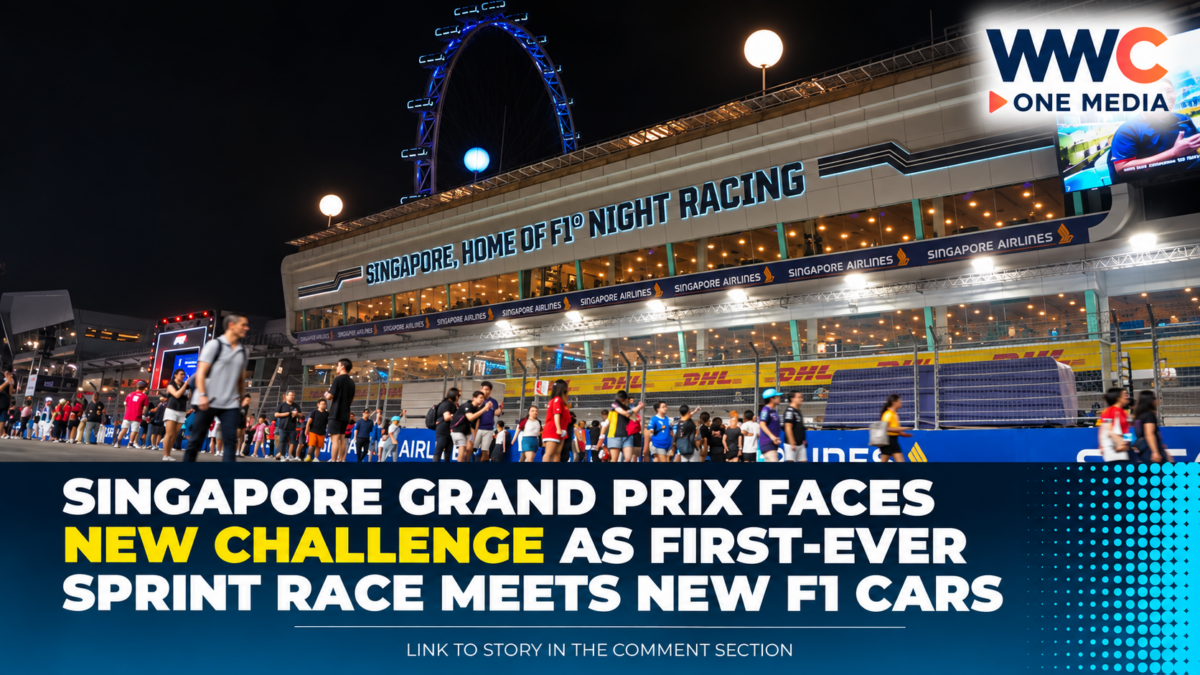
SINGAPORE — The Singapore Grand Prix is set for one of its most challenging weekends yet, with Formula One introducing its first-ever Sprint race at Marina Bay, a new generation of cars and just one practice session before competitive action begins.
The 2026 race weekend, running from Oct. 9 to 11, brings significant changes to the familiar night-race spectacle. For the first time, drivers will compete in a Sprint race on Saturday afternoon, adding another competitive session to a circuit already known for its narrow streets, demanding corners and punishing heat.
The changes come during the first season of sweeping technical regulations that have reshaped Formula One cars and their power units. With limited time to understand the new machinery at Marina Bay, teams face a tight window to find the right setup before qualifying and the races begin.
First Singapore Sprint brings more racing to the weekend
The Marina Bay Street Circuit will host its first Formula One Sprint on Saturday, Oct. 10, giving fans an additional race before Sunday’s main Grand Prix.
The Sprint covers approximately 100km, or about one-third of a conventional Grand Prix distance. Points are awarded to the top eight finishers, with the winner receiving eight points.
Unlike a traditional Grand Prix weekend, the Sprint format compresses preparation and competitive sessions into a shorter period. Sprint qualifying takes place on Friday night, while a separate qualifying session on Saturday night determines the starting grid for Sunday’s race.
The 2026 Singapore event is the sixth and final Sprint weekend on this season’s calendar. The format is intended to provide more competitive action across the three-day event, but it also leaves drivers with less time to learn the circuit and adjust their cars.
For teams, that creates a difficult balance between finding speed quickly and avoiding mistakes that could compromise the rest of the weekend.
New-generation cars add to the challenge
Drivers will also be tackling Marina Bay with Formula One’s redesigned 2026 cars for the first time.
The new technical rules have brought major changes to the cars’ power units, with a substantially greater contribution from electrical power. The regulations also introduce active aerodynamics, allowing elements of the front and rear wings to move to improve efficiency and performance.
These changes mean drivers must adapt not only to the physical demands of the Singapore circuit but also to the behaviour of the new cars.
Marina Bay is particularly demanding because it is a street circuit lined by barriers, leaving little room for mistakes. The combination of tight corners, heavy braking and limited opportunities to overtake makes preparation especially important.
Under the Sprint format, however, teams will have only one 60-minute practice session on Friday afternoon before Sprint qualifying begins that evening. That is a significant reduction from the three practice sessions available during a conventional race weekend.
The limited preparation time leaves engineers with fewer opportunities to assess tyre behaviour, adjust car balance and refine power-unit settings before competitive sessions begin.
Lando Norris sees opportunity in limited practice
McLaren’s Lando Norris, the reigning world champion, acknowledged that the compressed schedule would make the weekend particularly demanding.
Speaking on Thursday, Oct. 8, Norris appeared surprised when a reporter reminded him that Saturday’s Sprint would take place in daylight rather than under Singapore’s familiar night-time conditions.
He said he had not previously considered that detail.
Norris, who won the Singapore Grand Prix in 2024, said the limited practice time could suit drivers who are able to find their limits quickly.
He explained that drivers can often be separated by only hundredths or tenths of a second after three practice sessions. With only one session available this weekend, getting comfortable with a new car on a challenging street circuit becomes a much bigger task.
Norris also acknowledged that he enjoys racing at Marina Bay despite its physical demands.
His record at the Singapore circuit and his experience in Sprint events could prove useful, although the new regulations and shortened preparation leave no guarantee that previous performance will translate directly into success this weekend.
Championship battle adds pressure
The Singapore weekend also arrives at a significant point in the drivers’ championship.
Mercedes’ Kimi Antonelli entered the event with an 84-point lead over teammate George Russell, according to the standings reported by AsiaOne. Ferrari’s Lewis Hamilton was a further 22 points behind Russell in third.
Antonelli’s lead has placed him in contention to become Formula One’s youngest world champion, while Russell faces an additional challenge after a power-unit failure in Malaysia forced Mercedes to change his engine and left him facing a grid penalty.
Red Bull’s Max Verstappen also arrives with renewed momentum after claiming his first win of the season in Malaysia.
The Sprint adds another opportunity for championship contenders to score points before Sunday’s main event. However, the compressed schedule could make it more difficult for teams to recover from a poor setup or an incident during practice or Sprint qualifying.
With eight points available for a Sprint victory and 25 for winning the Grand Prix, the weekend offers substantial opportunities for drivers seeking to improve their championship positions.
Heat hazard declared for Sprint and Grand Prix
The tropical conditions in Singapore present another challenge.
The Fédération Internationale de l’Automobile (FIA) declared a heat hazard for both Saturday’s Sprint and Sunday’s Grand Prix on Oct. 8, with the heat index forecast to exceed 31 degrees Celsius.
Under the relevant procedures, cars must be fitted with functioning driver-cooling systems for both races.
The heat has long been one of the defining features of the Singapore Grand Prix. Drivers spend hours inside cockpits while navigating a demanding street circuit, and the combination of high temperatures, humidity and physical exertion can make the race particularly strenuous.
Drivers can lose significant amounts of fluid during a Grand Prix, making preparation, hydration and cooling important parts of race strategy.
Fernando Alonso, a two-time world champion who won the inaugural Singapore Grand Prix in 2008, has previously spoken about the need to prepare for the event well in advance.
The heat warning adds to the challenge of a weekend already complicated by the new cars, limited practice and the additional Sprint race.
Saturday afternoon race changes the familiar night-time spectacle
Singapore’s Grand Prix remains a night race, with Sunday’s main event scheduled to begin at 8pm local time.
Saturday’s Sprint, however, is scheduled for 5pm, making it the first competitive Formula One race at Marina Bay to take place before nightfall.
The change introduces different track conditions and lighting to a circuit normally associated with racing under floodlights. Drivers and engineers will need to account for the changing conditions as the evening progresses, particularly when comparing performance during practice, the Sprint and qualifying.
The weekend’s official schedule places the first practice session at 4.30pm on Friday, followed by Sprint qualifying at 8.30pm. Saturday’s Sprint begins at 5pm, with Grand Prix qualifying at 9pm. Sunday’s 62-lap race starts at 8pm.
A demanding test for drivers and teams
The 2026 Singapore Grand Prix combines several major changes in a single weekend: a new race format, substantially revised cars, a shortened practice schedule and challenging tropical conditions.
For fans, the Sprint promises more competitive action before Sunday’s main event. For teams and drivers, it leaves less time to make adjustments and increases the importance of getting the setup right from the beginning.
The results will depend on how quickly drivers adapt to the circuit and new machinery, how effectively teams interpret the limited practice data and how well they manage the heat.
At a track where small errors can have significant consequences, the first Singapore Sprint could provide an especially revealing test of Formula One’s new era.
:::