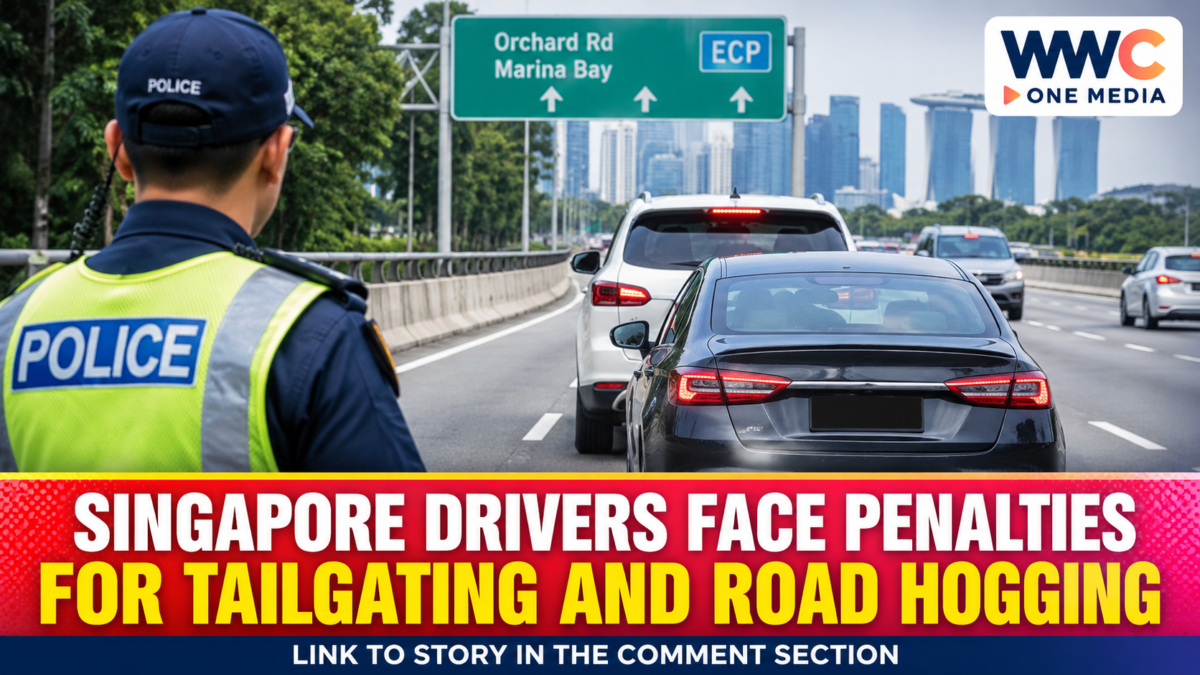
Singapore motorists may be surprised to learn that two behaviours commonly associated with aggressive driving are treated differently under the country’s traffic laws. Tailgating is not an offence in itself, but road hogging is punishable, with motorists potentially facing demerit points and financial penalties.
The distinction matters on busy expressways such as the Central Expressway (CTE), where drivers must balance speed, lane discipline and safe following distances.
The rules also raise an important question: does travelling at the speed limit give a driver the right to remain in the rightmost lane indefinitely? Singapore’s official traffic guidance makes clear that the answer depends on more than the speedometer.
Singapore road rules: Why tailgating and road hogging are different
The Ministry of Home Affairs (MHA) clarified the legal distinction in a parliamentary reply dated April 4, 2022.
It stated that the Traffic Police does not track tailgating incidents because tailgating is not an offence in and of itself.
However, this does not mean motorists can follow another vehicle dangerously without consequences.
A driver who fails to maintain a safe distance and subsequently becomes involved in an accident may face a charge of driving without due care or reasonable consideration.
The distinction is important: the act of following too closely is not automatically a standalone criminal offence, but the circumstances and consequences of the driving behaviour can lead to prosecution.
By comparison, road hogging is an established traffic offence. It involves driving unreasonably slowly, particularly in the right-hand or centre lanes, in a way that obstructs traffic.
The Singapore Traffic Police’s driving handbook instructs motorists to use the rightmost lane primarily for overtaking or when preparing to turn right or make a U-turn.
What penalties can road hogging attract?
Road hogging is not simply a matter of irritating drivers behind you.
In a parliamentary response dated Feb. 28, 2025, MHA confirmed that motorists committing lane-hogging offences can receive up to four demerit points.
The composition sums can reach:
- Light vehicles: Up to S$150.
- Heavy vehicles: Up to S$200.
These penalties underline the importance of keeping left when appropriate, particularly when driving slower than surrounding traffic.
The government has also disclosed the scale of enforcement.
In a separate parliamentary reply published on Feb. 4, 2026, Home Affairs Minister K. Shanmugam stated that the Traffic Police issued approximately 1,930 summonses annually on average between 2021 and 2025 for failing to keep left.
That figure shows that lane discipline is an established enforcement concern rather than merely a matter of driving etiquette.
For motorists, the practical lesson is that travelling below the appropriate speed for a particular lane can create problems even without a collision.
Does driving at the speed limit mean you can stay in the right lane?
This is one of the most misunderstood aspects of expressway driving.
A driver travelling at the posted speed limit may assume that remaining in the rightmost lane is automatically acceptable.
However, speed compliance and lane discipline are separate responsibilities.
Singapore’s Traffic Police guidance states that motorists should use the rightmost lane for overtaking and return to an inner lane when it is safe to do so.
In its Aug. 4, 2026 parliamentary speech, Second Minister for Foreign Affairs and Second Minister for Home Affairs Sim Ann addressed road hogging directly.
She explained that the issue includes drivers occupying the rightmost expressway lane without overtaking despite having a clear opportunity to move elsewhere.
The speech also confirmed that road hogging is already covered by the Road Traffic Rules and is enforced by the Traffic Police.
MHA and the Traffic Police said they would consider additional measures to tackle the behaviour.
This means drivers should not treat the speed limit as permission to occupy an overtaking lane unnecessarily.
At the same time, motorists approaching a slower vehicle must not use aggressive driving or unsafe manoeuvres to force it to move.
Why tailgating remains a road-safety concern
Although tailgating is not a standalone offence, Singapore’s official driving guidance strongly discourages the practice.
The Traffic Police’s online learning portal includes a dedicated road-safety video addressing following too closely.
It reminds motorists to maintain a safe following distance, watch the brake lights of vehicles ahead and account for the distance required to stop safely.
This is particularly relevant on expressways, where vehicles can travel at high speeds and sudden braking can leave little time for drivers behind to react.
The Ministry of Home Affairs has also explained that a motorist who causes an accident after failing to maintain a safe following distance may face prosecution for driving without due care or reasonable consideration.
Under the penalties confirmed in official police releases in 2026, a first-time offender convicted of this offence can face a fine of up to S$1,500, imprisonment of up to six months, or both.
For a second or subsequent conviction, the maximum penalties increase to a fine of S$3,000 or imprisonment of up to 12 months, or both.
The consequences demonstrate why maintaining distance is a legal and practical road-safety responsibility.
Singapore’s broader traffic enforcement efforts have also covered other violations, including those highlighted in WWC’s report on expressway enforcement and motorists driving without valid licences.
Traffic Police enforcement and the responsibility of every driver
Road safety depends on consistent compliance from everyone using public roads.
In its Aug. 4, 2026 parliamentary speech, MHA also explained that the Traffic Police follows up on reports submitted through its online reporting portal.
The ministry stated that action is taken on approximately four out of 10 public reports, while the remaining submissions typically do not provide sufficient grounds to warrant investigations.
Members of the public submitting reports are encouraged to provide relevant information, including the date, time, location, vehicle registration number and supporting photographs or video evidence.
This is important because a video circulating online does not automatically establish that an offence has occurred.
Traffic Police must assess the available evidence and circumstances before determining whether enforcement action is justified.
Accountability also applies to enforcement personnel. In September 2026, WWC reported on three Singapore Traffic Police officers investigated over alleged unsafe riding. That separate case illustrates the importance of applying road-safety expectations consistently, without assuming wrongdoing before investigations are completed.
The wider consequences of unsafe road behaviour are also relevant to vulnerable road users, including cyclists. Recent coverage of road safety concerns following a fatal cyclist collision in Katong highlights why predictable and responsible driving matters beyond the occupants of cars.
What happens next
The Traffic Police will continue enforcing existing road rules and educating motorists about safe driving and lane discipline.
MHA has also indicated that it is considering additional measures to address road hogging.
For motorists, the immediate responsibilities remain straightforward: maintain a safe following distance, avoid unnecessary occupation of overtaking lanes, observe speed limits and change lanes only when it is safe.
The key distinction is that a driver cannot justify dangerous following behaviour simply because another motorist is travelling slowly, while a driver travelling at the speed limit cannot automatically disregard lane discipline.
Both responsibilities exist to keep traffic moving safely.
Frequently asked questions
1. Is tailgating illegal in Singapore?
Tailgating is not an offence in and of itself. However, a motorist who fails to maintain a safe following distance and causes an accident may be charged with driving without due care or reasonable consideration.
2. What is the penalty for road hogging in Singapore?
Motorists can receive up to four demerit points. The composition sum can reach S$150 for light vehicles and S$200 for heavy vehicles.
3. Can you drive at 90km/h in the rightmost lane in Singapore?
Motorists must observe the applicable speed limit, but they must also follow lane-discipline rules. The rightmost lane is intended primarily for overtaking, and drivers should return to an inner lane when safe.
4. How many motorists are booked for failing to keep left in Singapore?
The Traffic Police issued approximately 1,930 summonses annually on average between 2021 and 2025 for failing to keep left.
5. Can motorists report road hogging or dangerous driving?
Yes. Members of the public can submit reports through the Traffic Police’s official feedback channels, providing the relevant date, time, location, vehicle registration number and available video or photographic evidence. Each report is assessed based on its circumstances and supporting information.