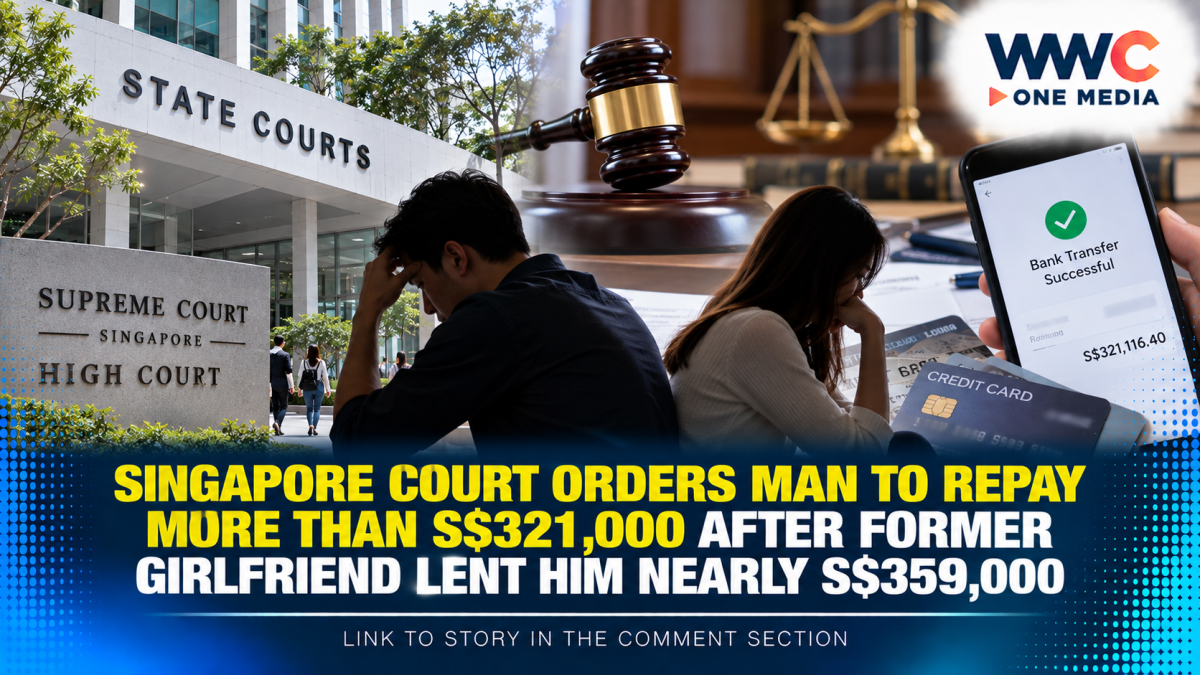
SINGAPORE — A relationship that began through an online dating platform has ended in a High Court judgment ordering a man to repay more than S$321,000 to his former girlfriend after she successfully proved that hundreds of thousands of dollars transferred during their relationship were loans, not gifts.
The case involved finance manager Teow Seok Phen, a Singapore permanent resident from Malaysia, and Chee Wei Jun, a Singaporean who worked as a tutor and café worker.
Between June 2023 and February 2024, Teow transferred substantial sums to Chee and allowed him to use her credit cards. The total value of the disputed transactions was about S$358,739, according to the High Court judgment.
After accounting for repayments already made, Justice Alex Wong ordered Chee to pay S$321,116.40 outstanding.
How Nearly S$359,000 Changed Hands
The pair met through the dating platform Coffee Meets Bagel in June 2023 and entered into a relationship shortly afterward.
Teow told the court that Chee had presented himself as financially well-off. According to her evidence, he said he was a commercial airline pilot, had several hundred thousand dollars in his bank account and came from a wealthy family.
Chee allegedly told her that his bank account had been frozen after he clicked on a fraudulent link and that he needed financial help for his daily expenses.
Teow subsequently provided him with money, including almost all of her savings as well as funds obtained through credit-card cash advances and balance transfers. She also allowed him to use her credit cards.
Chee disputed her account, arguing that the money was given to him as gifts motivated by love and affection, rather than loans that he was legally required to repay.
The Messages That Became Key Evidence
One of the central issues was whether both parties understood that the money was supposed to be repaid.
The court examined numerous WhatsApp exchanges between the couple in which Chee discussed repaying money he had received.
The messages continued as the amounts involved increased. The judgment noted that Chee repeatedly acknowledged obligations to repay Teow.
In August 2023, for example, he expressed appreciation for her financial help and promised to repay her. Later messages again referred to returning the money.
The court also noted that Chee had made partial repayments totaling S$23,241 between June 2023 and February 2024, as well as a separate S$35,000 repayment relating to his use of Teow’s credit cards.
Those transactions became important in assessing whether the money had actually been intended as gifts.
The Relationship Eventually Broke Down
By December 2023, Teow had begun receiving letters from banks demanding payment of outstanding credit-card bills.
In February and March 2024, she told her family that Chee had been borrowing money from her. Family members subsequently demanded that he repay what was owed.
Chee then signed several documents acknowledging the debt.
One document dated June 10, 2024, identified him as the debtor and Teow as the creditor and stated that S$323,739.16 was to be repaid by July 31, 2024, including applicable bank interest until full payment.
Chee later argued that certain repayment documents were invalid because they had been signed under duress or undue influence.
The court rejected those arguments.
Judge Rejects ‘Grey Area’ Explanation
Justice Wong found Chee’s explanations about the nature of the transactions unconvincing.
The judgment said Chee appeared to maintain what the judge described as a “grey area of deniability”, allowing him to avoid his repayment obligations when it suited him.
The judge also found that Teow consistently expected repayment and accepted her evidence that she had been persuaded to provide the money partly because of Chee’s representations about his financial circumstances.
The court ultimately concluded that the disputed sums were loans rather than gifts.
Court Rejects Duress Claims
Chee also alleged that Teow’s brother had connections to the underworld in Penang and had threatened him, forming part of his argument that the repayment documents were signed under pressure.
But during cross-examination, Chee conceded that Teow’s brother had made no direct threats against him.
The judge therefore rejected the allegations as a basis for invalidating the repayment acknowledgements.
A Legal Lesson From a Relationship Dispute
The judgment highlights an important distinction in disputes involving money transferred between romantic partners.
Money changing hands during a relationship does not automatically establish a loan. What matters is the evidence surrounding the transaction and whether the parties intended the money to be repaid.
In this case, the court considered the parties’ communications, repayment history, written acknowledgements and surrounding circumstances before determining that the transactions were loans.
The case ultimately turned a private relationship dispute into a substantial civil judgment.
What began with a request for financial help during a new relationship ended with a Singapore High Court order for more than S$321,000 in repayment — showing how messages, repayment promises and written acknowledgements can become decisive evidence when a relationship and a financial dispute collide.
WWC ONE MEDIA G,A