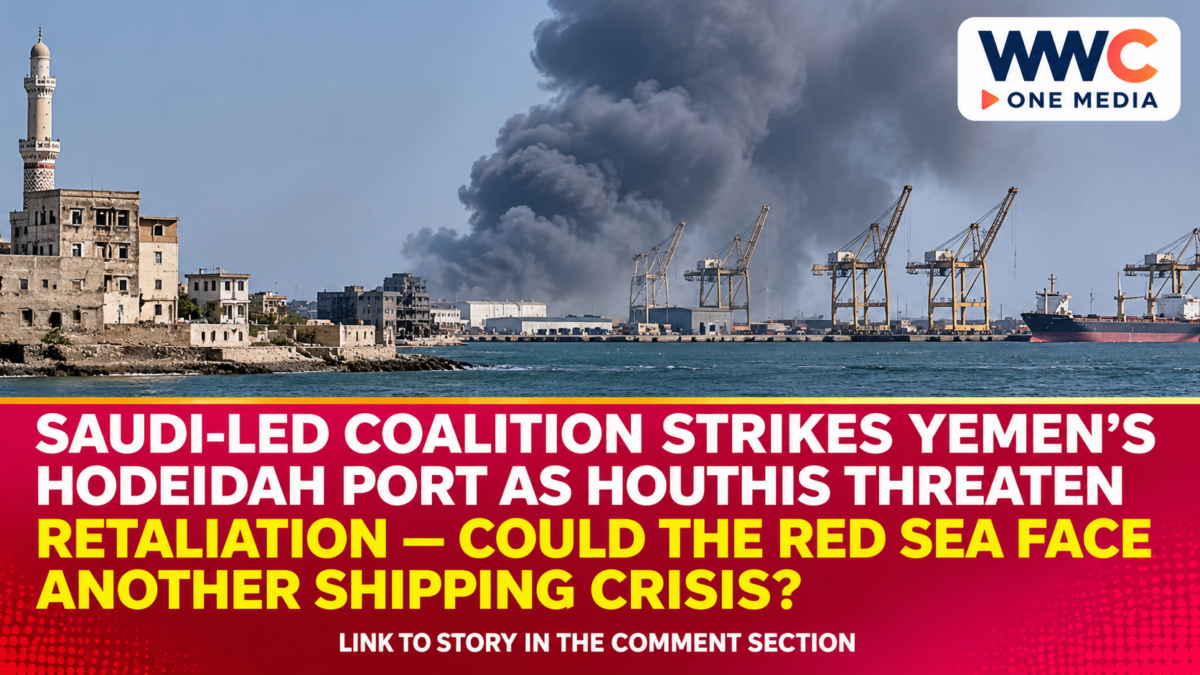
RIYADH/SANAA — The Saudi-led military coalition carried out renewed strikes on Yemen’s Hodeidah port on Nov. 25, 2026, following a second evacuation warning to civilians, as Houthi forces threatened retaliation against Saudi Arabia’s Red Sea ports.
The Hodeidah port attack has intensified concerns over regional maritime security, humanitarian access and the stability of international supply chains connecting the Middle East, Europe and Asia-Pacific economies.
The confrontation places renewed pressure on a country already struggling with widespread hunger while introducing additional uncertainty for international shipping companies.
Hodeidah port attack intensifies Saudi-Houthi confrontation
The latest military operation followed an earlier evacuation warning and strike against Hodeidah port facilities on Nov. 20.
Five days later, the Saudi-led coalition conducted another operation against the port.
The Houthis responded with threats against Saudi maritime infrastructure, raising concerns that the confrontation could extend beyond Yemen’s borders and affect commercial operations elsewhere in the Red Sea.
The developments come amid an already volatile maritime security environment in the Middle East.
However, threats against ports must be distinguished from confirmed attacks on commercial vessels. The available maritime security assessments do not establish that every threatened facility has been attacked or that the entire Red Sea has become inaccessible.
Red Sea shipping remains open despite growing security risks
The Bab el-Mandeb Strait, which connects the Red Sea with the Gulf of Aden, remains open to commercial navigation despite heightened security concerns.
Maritime security assessments dated Nov. 26 continued to classify the southern Red Sea and Bab el-Mandeb area as facing a substantial threat.
Meanwhile, the historical average for daily vessel transits through the strait stood at approximately 61 in 2023, compared with around 24 daily transits between Nov. 22 and 25, 2026.
The figures illustrate the extent to which commercial traffic remains below historical levels.
For international shipping companies, the challenge is not simply whether a maritime passage remains technically open. It is whether vessels can operate with acceptable levels of security, predictable delivery schedules and manageable transportation costs.
These concerns extend to the wider Middle East, where recent Hormuz tanker incidents have raised questions about the security of Asia’s oil supply.
Yemen’s dependence on imported food raises humanitarian concerns
The military confrontation presents an especially serious challenge for Yemen’s civilian population.
Yemen imports approximately 90 percent of its food, making the country particularly vulnerable to interruptions affecting international trade and domestic distribution networks.
More than 18 million people were already experiencing acute food insecurity in the country, based on humanitarian assessments released before the latest November escalation.
Approximately 2.2 million children under the age of five were experiencing acute malnutrition, including around 500,000 suffering from its most severe form.
These figures represent an existing humanitarian emergency rather than a newly established consequence of the Nov. 25 attack.
Any prolonged disruption to food imports, transportation or humanitarian access could place additional pressure on vulnerable communities.
The immediate humanitarian priorities include protecting civilians, maintaining access to essential commodities and ensuring that relief organisations can continue operating safely.
An evacuation warning alone does not establish that these needs have been met or that civilian harm has been prevented.
Why Asia-Pacific economies are watching the Red Sea
The renewed confrontation has implications beyond Saudi Arabia and Yemen.
Asia-Pacific manufacturers, energy importers, shipping companies and logistics operators have a commercial interest in maintaining reliable maritime connections between Asia, the Middle East and Europe.
Potential disruptions could introduce additional expenses through longer transportation routes, insurance premiums, delayed deliveries and operational adjustments.
WWC ONE MEDIA previously examined Saudi Arabia’s efforts to maintain oil deliveries to Asian markets through alternative export arrangements, highlighting the importance of resilient energy transportation networks.
The latest escalation reinforces a broader concern: producing sufficient energy and manufactured goods does not necessarily guarantee their timely delivery to international customers.
Nevertheless, the Hodeidah strikes do not automatically mean that petroleum prices, consumer goods prices or shipping rates will increase across Asia-Pacific economies.
Such outcomes depend on the duration of the conflict, actual damage to infrastructure, commercial decisions and developments in international commodity markets.
Maritime workers remain exposed to regional instability
Beyond the movement of oil, food and manufactured products, maritime insecurity also raises concerns about the welfare of civilian workers.
Commercial shipping depends on multinational crews whose safety can be affected when regional conflicts expand towards ports and international waterways.
The potential consequences of these risks were explored in WWC ONE MEDIA’s earlier coverage of the repatriation of seafarers following the Saudi tanker Sidr incident.
The latest confrontation underscores the importance of distinguishing civilian maritime operations from military activity.
For shipping companies, crew welfare and continuity of operations must remain central considerations when evaluating developments in conflict-affected regions.
What happens next?
The immediate questions concern the extent of damage at Hodeidah port, the continuity of humanitarian and commercial deliveries, and whether the confrontation will result in further regional escalation.
The maritime assessment issued on Nov. 26 did not identify a corroborated attack on commercial shipping in the Red Sea since Aug. 24, 2026.
That distinction remains important: an elevated security threat is not equivalent to a confirmed closure of international shipping routes.
For Yemen, the principal concern remains maintaining access to food and humanitarian assistance.
For Asia-Pacific businesses, the economic implications will depend on whether the confrontation produces sustained transportation disruptions or remains geographically contained.
The coming developments will help determine whether the latest Hodeidah port attack becomes another prolonged source of instability for international trade or remains a more limited regional security crisis.