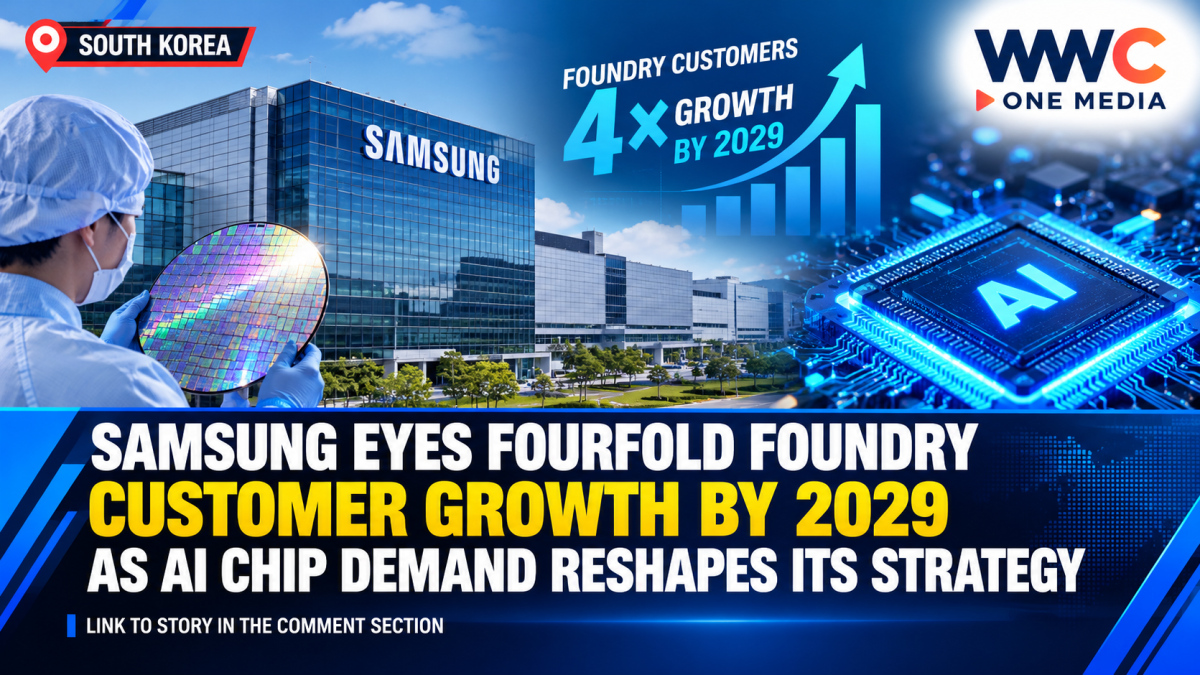
Samsung Electronics is preparing for a major expansion of its foundry business, saying its customer base could grow roughly fourfold by 2029 compared with 2017 as the company shifts its focus toward artificial intelligence and high-performance computing.
Noh Mi-jung, a senior vice president at Samsung’s foundry business, said Sept. 29 that the number of customers has already increased about threefold since the foundry operation became an independent unit in 2017.
Samsung now expects that figure to grow to roughly four times its 2017 level by 2029.
The company is also targeting a significant change in the makeup of its foundry business. High-performance computing, or HPC, accounted for only 5 percent of the business in 2017 but has grown to 28 percent.
Samsung expects HPC to represent about 66 percent of its foundry business by 2029, with HPC customers projected to make up more than half of its customer base and HPC generating well over half of sales.
That shift reflects the growing importance of AI and advanced computing applications in the semiconductor industry. Samsung said its foundry portfolio, which has historically had a strong mobile focus, is being diversified toward AI and HPC customers.
Samsung’s Next-Generation Chip Road Map
Samsung is also preparing to advance its manufacturing technology.
The company plans to begin mass production of its third-generation 2-nanometer process in 2028, followed by mass production of its 1.4-nanometer process in 2029.
The timeline comes as chipmakers compete to secure customers seeking increasingly advanced processors for AI, high-performance computing and other demanding applications.
Samsung is simultaneously expanding its manufacturing footprint in the United States.
The company plans to begin initial operations at the first fab of its Taylor, Texas, semiconductor complex by the end of 2026. Construction of a second fab is also planned to begin this year, with mass production targeted for 2030.
Together, the customer-growth target, AI and HPC expansion, advanced process roadmap and Texas manufacturing plans point to a broader transformation of Samsung’s foundry strategy.
The challenge will be converting those targets into sustained customer growth and production as competition intensifies across the global advanced-chip market.
For Samsung, 2029 is shaping up as a key test of whether its foundry ambitions can translate into a much larger role in the AI semiconductor supply chain.
WWC ONE MEDIA G,A