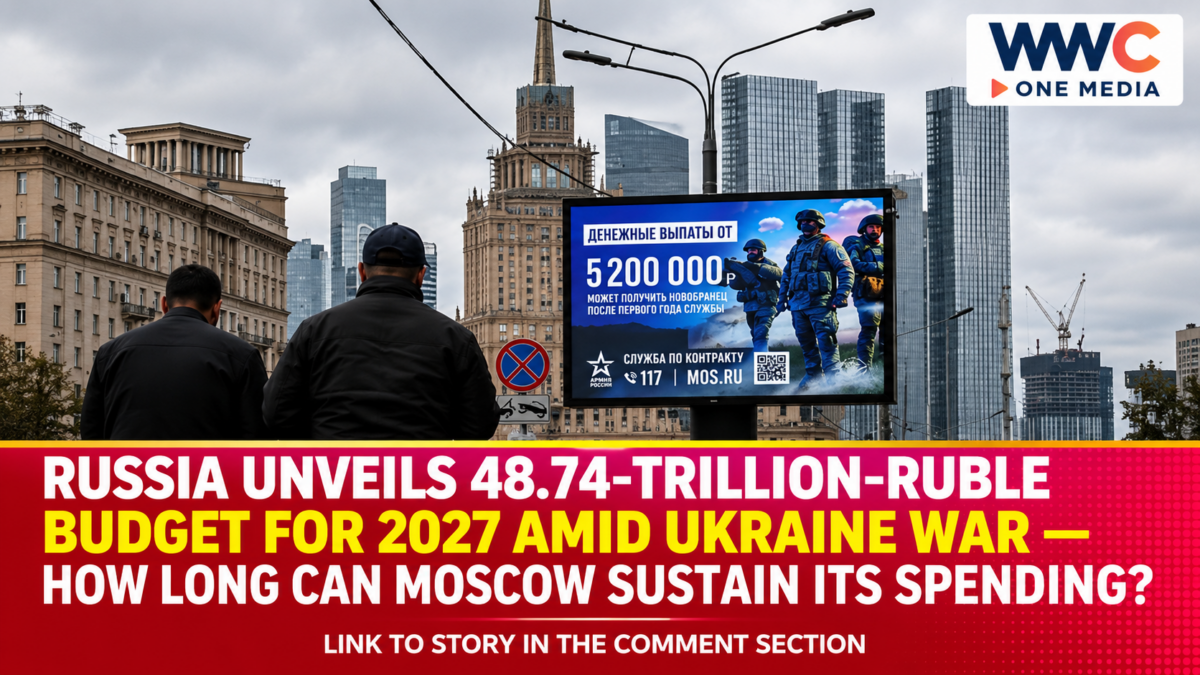
MOSCOW, Russia — Russia’s proposed federal budget for 2027 outlines 48.74 trillion rubles in government expenditure as Moscow confronts mounting economic pressures, international sanctions and the continuing financial demands of its war against Ukraine.
The three-year fiscal programme covering 2027 to 2029 projects persistent government deficits, highlighting the challenges of maintaining public expenditure while managing inflation and restricted access to international financial markets.
With Russia’s central bank maintaining elevated interest rates and European authorities expanding economic restrictions, the country’s financial strategy faces another demanding period.
The central question is whether Moscow can sustain its spending commitments without imposing additional pressure on households, civilian industries and long-term economic development.
Russia 2027 Budget Reveals Persistent Financial Pressure
Russia’s federal budget proposal, identified as Bill No. 615-9, outlines government revenue and expenditure projections extending through 2029.
For 2027, the government expects approximately 43.30 trillion rubles in revenue against 48.74 trillion rubles in expenditure.
The difference represents a projected deficit of 5.44 trillion rubles, equivalent to 2.2% of Russia’s gross domestic product.
The following two years also feature substantial projected budget deficits.
Government expenditure is expected to reach 50.95 trillion rubles in 2028 before increasing to 53.87 trillion rubles in 2029.
Revenue is forecast to reach 45.83 trillion rubles and 48.62 trillion rubles during those respective years.
These projections indicate that government expenditure will continue exceeding revenue throughout the three-year planning period.
A budget deficit does not automatically establish that a government is approaching financial collapse. However, persistent deficits require sustainable financing arrangements and can increase borrowing requirements.
Wartime Spending Creates Difficult Economic Choices
Russia’s continuing war against Ukraine remains central to the international debate surrounding Moscow’s fiscal priorities.
Government spending must accommodate national security requirements while maintaining public services, infrastructure and existing social commitments.
When financial resources are limited, expanding expenditure in one sector can reduce the flexibility available for other programmes.
The proposed fiscal framework assumes that existing geopolitical conditions and external restrictions on Russia’s economy will persist.
This is an important distinction because the budget’s economic projections do not depend on an immediate removal of international sanctions.
The government’s ability to maintain its planned expenditure will therefore depend partly on domestic revenue collection and the resilience of its export industries.
International diplomatic developments could eventually alter those conditions, but a fiscal programme alone cannot establish when the war will end or whether a comprehensive peace agreement will be reached.
Russia’s Oil Revenue Faces Expanding International Restrictions
Russia’s energy industry remains an important component of its economic relationship with international markets.
However, European governments continue expanding restrictions involving Russian oil companies, financial institutions and petroleum transportation networks.
On Nov. 16, 2026, the European Union imposed additional sanctions on 12 individuals and 101 entities.
The measures covered banks, energy companies and commercial networks that European authorities identified as supporting Russian government revenues or the transportation of Russian-origin petroleum.
Businesses based in China, Oman, the United Arab Emirates and Seychelles were also included in the latest listings.
The development demonstrates how sanctions targeting Russian energy exports can extend beyond Russia’s own domestic companies.
WWC ONE MEDIA previously examined these pressures in its coverage of Russia’s shadow fleet and the international crackdown on its oil export network.
Restrictions on shipping, insurance and financial transactions could increase the commercial costs associated with maintaining international trade.
However, the introduction of additional sanctions does not automatically establish how much revenue Russia will lose. Their financial consequences depend on implementation, enforcement and wider market conditions.
Russia Maintains a 14% Interest Rate as Inflation Risks Persist
Russia’s economic challenges also extend to domestic monetary policy.
On Oct. 23, 2026, the Bank of Russia maintained its benchmark interest rate at 14%.
Its updated economic outlook projects annual inflation of between 7.1% and 7.6% in 2026, alongside economic growth of between 0.5% and 1%.
For 2027, the central bank expects economic growth of between 1% and 2%.
The projected average benchmark interest rate for 2027 stands between 12.5% and 13.5%.
Elevated borrowing costs can create difficulties for civilian businesses seeking financing for investment, expansion and everyday operations.
The central bank also recognises that substantial government demand and constraints on production capacity can contribute to persistent inflationary pressure.
These conditions create a complicated economic balancing act.
While government expenditure can support economic activity, maintaining price stability may require tighter monetary conditions that limit private-sector borrowing and consumer demand.
European Sanctions Increase Pressure on Russia’s Financial System
On Nov. 23, the European Commission presented its proposed 22nd package of sanctions against Russia.
The proposed measures include additional transaction restrictions involving approximately 60 Russian banks, further action against cryptocurrency payment networks and expanded limitations on services associated with Russian energy infrastructure.
The Commission also proposed removing the targeted banks from the SWIFT financial messaging system.
These proposals are intended to restrict financial channels that European authorities believe help sustain Russia’s war effort.
Further details are examined in WWC ONE MEDIA’s coverage of the European Union’s proposed sanctions targeting Russian banks, cryptocurrency and other industries.
The distinction between proposed and legally adopted sanctions remains essential.
The announcement of a sanctions package does not necessarily mean that every proposed restriction has already entered into force.
For international businesses, particularly financial institutions and commodity traders across the Asia-Pacific, evolving sanctions requirements can create additional compliance obligations when dealing with designated counterparties.
What Russia’s Budget Means for Asia-Pacific Economies
Russia’s fiscal strategy has implications extending beyond Europe because of the international nature of energy markets and financial transactions.
Asia-Pacific businesses with exposure to Russian commodities, shipping operations or financial institutions may need to monitor changes in trade restrictions and regulatory requirements.
Potential disruptions involving Russian energy exports could also affect commercial decisions concerning procurement, transportation and insurance.
Meanwhile, diplomatic negotiations remain another variable influencing the international economic environment.
WWC ONE MEDIA has previously examined the relationship between US sanctions waivers and Ukraine peace negotiations, highlighting why selective changes to economic restrictions should not be confused with a comprehensive removal of sanctions.
For governments and businesses across APEC economies, the continuing uncertainty reinforces the importance of distinguishing formal policy changes from speculative geopolitical developments.
What Happens Next for Russia’s Wartime Economy?
Russia’s three-year fiscal programme provides a framework for government spending through 2029.
However, planned allocations are not equivalent to actual expenditure, and projected revenue is not guaranteed.
Future economic performance will depend on inflation, export earnings, domestic demand, government financing and developments surrounding the war against Ukraine.
The government’s budget assumptions anticipate continued external restrictions, while the central bank expects economic growth to remain moderate.
Whether these projections prove sustainable will become clearer as actual government revenue and expenditure figures emerge.
Russia’s financial challenge extends beyond maintaining its immediate spending commitments. It must also manage the longer-term economic consequences of persistent deficits, elevated borrowing costs and international restrictions.
Frequently Asked Questions
How large is Russia’s proposed 2027 federal budget?
Russia’s proposed federal budget includes approximately 48.74 trillion rubles in expenditure and 43.30 trillion rubles in revenue.
How much is Russia’s projected 2027 budget deficit?
The projected deficit is approximately 5.44 trillion rubles, equivalent to 2.2% of GDP.
Does the budget establish when the Ukraine war will end?
No. Government expenditure plans indicate fiscal priorities but do not independently establish the duration or outcome of the conflict.
What is Russia’s benchmark interest rate?
The Bank of Russia maintained its benchmark interest rate at 14% on Oct. 23, 2026.
Why are international sanctions relevant to Russia’s budget?
Sanctions affecting energy exports, financial transactions and commercial services can influence government revenue, business costs and access to international markets.