MANILA, Philippines — November 4, 2026 | WWC ONE MEDIA | Business, Energy & Global Markets
The Philippines’ largest oil company is facing an increasingly difficult financial reality: selling more fuel and generating significantly higher revenue no longer guarantees stronger profits.
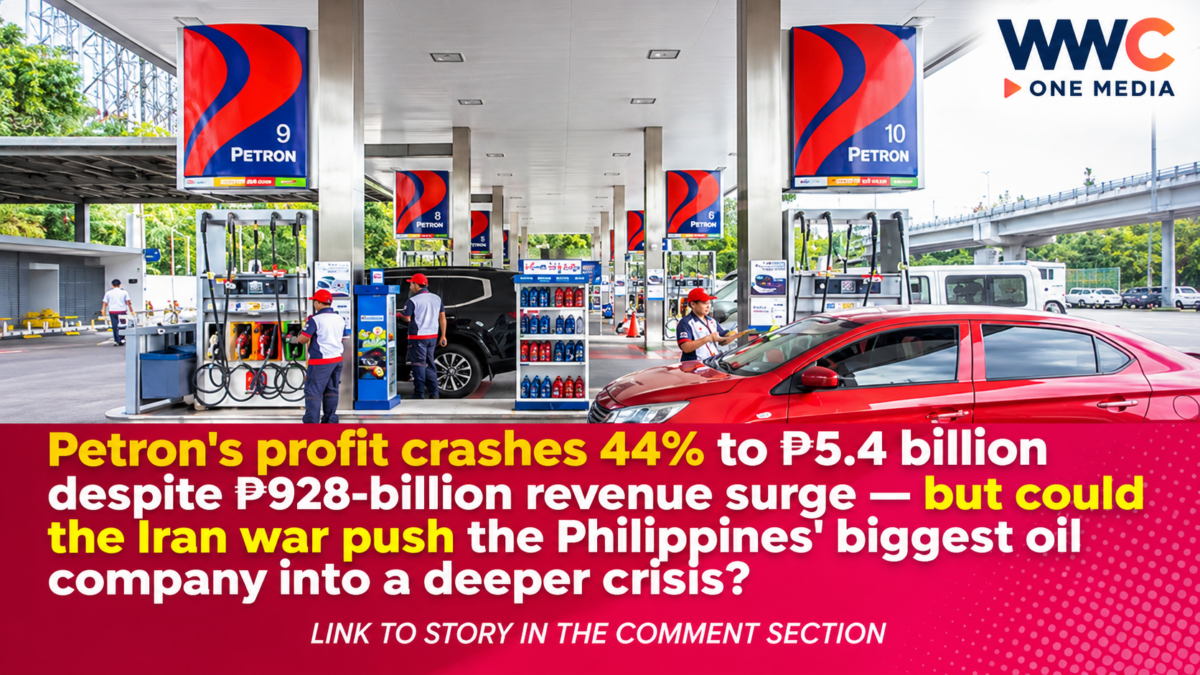
Petron Corporation, led by San Miguel Corporation President and Chief Executive Officer Ramon S. Ang, reported a 44% decline in net income to ₱5.4 billion for the first nine months of 2026, as soaring crude prices, rising shipping costs and disruptions linked to the US-Iran war squeezed its refining and marketing margins.
The earnings decline came despite a remarkable 56% increase in revenue to ₱928.2 billion, driven by higher petroleum prices and increased consolidated sales volume.
Petron earned approximately ₱9.7 billion during the same nine-month period in 2025.
That means the company generated roughly ₱4.3 billion less in net income this year, even as its revenue expanded dramatically.
The company’s operating income also dropped 28% to ₱19.1 billion, underscoring how higher petroleum costs can erode profitability even when sales remain strong.
The results were disclosed on November 3, 2026, and confirmed through the company’s regulatory announcement.
But behind the earnings decline lies an even bigger question: if one of the Philippines’ most important fuel suppliers is already struggling with higher oil costs, what happens if another Middle East supply disruption pushes crude prices even higher?
Petron’s ₱928.2-Billion Revenue Surge Hides a Profitability Problem
At first glance, Petron’s financial performance appears impressive.
Revenue climbed 56% during the nine months ended September 30, reaching ₱928.2 billion.
Consolidated sales volume also increased 3% to 103.5 million barrels.
However, higher revenue does not necessarily indicate that the company retained more money from its sales.
When international crude prices increase, petroleum companies often generate higher sales revenue because the products they sell become more expensive.
But they may also face higher costs for crude oil, imported refined products, freight, insurance and other operating requirements.
The difference between selling prices and costs is crucial to profitability.
For Petron, those cost pressures proved substantial.
Its net profit fell sharply even though the company reported stronger sales.
The divergence highlights the difference between growing sales and achieving profitable growth.
Petron’s nine-month net profit margin fell to roughly 0.6%, based on reported net income and revenue.
That indicates that less than one peso of net income was retained for every ₱100 in consolidated revenue.
Iran War Pushes Dubai Crude to $114 Per Barrel
A major source of pressure has been the prolonged conflict involving the United States and Iran.
According to Petron’s November 3 disclosure, the war disrupted regional oil trade and contributed to higher petroleum prices, shipping costs and import premiums.
The benchmark Dubai crude price averaged $92 per barrel during the first nine months of 2026.
That represented a 29% increase from the comparable period in 2025.
The third quarter was particularly volatile.
Dubai crude averaged approximately $77 per barrel in July before climbing to $114 in September.
The sharp increase reflected concerns over critical shipping routes, threatened energy infrastructure and disruptions to Middle Eastern oil supplies.
For a company operating refineries and distributing petroleum products across several markets, such volatility creates significant financial challenges.
Petron must manage the costs of acquiring crude oil and refined products while responding to changing market prices and customer demand.
WWC ONE MEDIA previously examined these pressures in Oil Prices Hit Six-Week High as Middle East Conflict Deepens Supply Shock Fears.
That report explored how military escalation and threats to energy infrastructure could affect global crude supplies and petroleum markets.
Petron’s latest results show how those risks can directly affect the earnings of a major Philippine fuel company.
Fuel Sales Grow in the Philippines Despite Higher Prices
Not everything in Petron’s financial report was negative.
The company continued to record demand growth in important parts of its business.
Retail sales volume increased 16% in the Philippines and 2% in Malaysia during the first nine months of 2026.
These figures suggest continued activity across the company’s service station network.
Meanwhile, Petron’s Singapore-based regional trading operations reported a 33% increase in volume.
That contributed to the 3% rise in consolidated sales to 103.5 million barrels.
However, the combined sales volume in the Philippines and Malaysia declined 3% to 82 million barrels.
Petron attributed that decrease primarily to lower refinery production.
This distinction is important.
The company experienced stronger retail sales in its two core consumer markets, but total volume across those markets declined because of other operational factors.
The results demonstrate how different parts of an integrated petroleum business can perform differently during the same reporting period.
Malaysia Refinery Disruption Adds Another Financial Burden
Beyond the oil-price shock, Petron is also dealing with operational restrictions in Malaysia.
Its Port Dickson refinery has faced difficulties because of damage to its product jetty.
The facility, damaged during Tropical Storm Senyar, plays an important role in handling petroleum shipments.
Its continued unavailability has constrained refinery operations and contributed to weaker refining margins.
Petron Malaysia is constructing a replacement jetty, which the company expects to commission during the first quarter of 2027.
The project is intended to help restore operational flexibility and reduce constraints affecting fuel shipments.
However, the commissioning date remains a target rather than a completed milestone.
Construction, testing and operational readiness could influence the final timetable.
Restoring the jetty may improve refinery efficiency, but it will not eliminate exposure to global oil prices or geopolitical risk.
Ramon Ang Stresses Financial Discipline and Fuel Security
Despite the earnings decline, Petron’s management maintains that the company has the resources and operating strategy needed to navigate the difficult environment.
Chairman and CEO Ramon Ang emphasized the company’s diversified operations, financial discipline and risk management.
Petron also reiterated its commitment to maintaining fuel supply reliability and meeting customer requirements.
That commitment is particularly significant for the Philippines.
Petron operates the country’s only remaining petroleum refinery, located in Limay, Bataan.
The facility is a major component of domestic petroleum supply infrastructure.
The company also maintains a substantial network of service stations, storage facilities and distribution assets.
These operations give Petron an important role in the Philippine energy market.
However, operating critical fuel infrastructure does not make the company immune to financial pressures.
Its refining and distribution businesses remain exposed to international crude prices, foreign exchange movements, shipping disruptions and domestic market conditions.
Philippine Fuel Prices Show Consumers Are Also Feeling the Pressure
The same international petroleum volatility affecting Petron’s earnings is also creating pressure for Filipino motorists and businesses.
Effective November 3, 2026, major oil companies implemented another round of fuel price adjustments.
Gasoline prices increased by up to ₱3.50 per liter, while diesel prices declined by ₱1.00 per liter and kerosene prices fell by ₱1.90 per liter.
WWC ONE MEDIA reported the adjustments in Gasoline Jumps Up to ₱3.50 a Liter on November 3 as Diesel and Kerosene Roll Back.
Petron was among the companies implementing the announced changes.
The mixed adjustments illustrate why it is misleading to assume that every petroleum product rises or falls by the same amount.
Gasoline, diesel and kerosene prices can respond differently to international supply conditions, refining demand and regional trading markets.
For consumers, the impact is immediate.
Changes in pump prices affect household transportation budgets and operating costs for delivery firms, public transport operators and businesses that depend heavily on fuel.
For Petron, fuel pricing must also account for commercial competition, product costs and the economics of its supply chain.
Global Oil Market Swings Could Change Petron’s Outlook
Another challenge is that international oil prices can reverse direction rapidly.
On November 2, Brent crude futures fell to approximately $104.77 per barrel as renewed hopes for negotiations involving Washington and Tehran encouraged traders to reassess supply risks.
WWC ONE MEDIA examined the development in Oil Prices Crash Nearly 8% as Iran Peace Talks Send Brent to $104 — But Could One Failed Deal Trigger a $140-a-Barrel Shock?.
The sharp decline illustrates how geopolitical developments can rapidly change expectations in petroleum markets.
Lower crude prices could eventually reduce some of Petron’s acquisition and freight pressures.
However, falling oil prices do not automatically guarantee higher profits.
Refinery margins depend on the difference between crude input costs and the prices of refined products.
Changes in inventory values, product demand and operating expenses can also influence earnings.
For Petron, a more stable and predictable petroleum market may be just as important as the direction of oil prices.
The Philippines Is Looking for Ways to Protect Its Fuel Supply
Petron’s results are emerging as the Philippine government works to strengthen its energy security.
The Department of Energy has been exploring arrangements that could provide access to petroleum reserves stored overseas while developing domestic storage capabilities.
WWC ONE MEDIA reported these efforts in Philippines Moves to Secure Oil Reserves Abroad as Middle East Conflict Threatens Fuel Supply — But Will It Prevent Another Price Shock?.
The report cited government estimates that existing petroleum inventories could meet approximately 53 to 55 days of demand.
For an economy dependent on imported petroleum, inventory management and reliable shipping arrangements are essential.
But there is an important distinction between securing fuel supplies and making petroleum affordable.
A country can have sufficient fuel available while still facing high international prices.
The challenge is therefore twofold: preventing physical shortages while limiting the economic damage from price volatility.
Petron’s domestic refinery, distribution network and import operations play a role in the broader fuel supply system.
Nevertheless, national energy security requires coordination among government agencies, petroleum companies, shipping operators and other industry participants.
What Happens if Oil Prices Stay Above $100?
Financial institutions have warned that elevated crude prices could persist if Middle Eastern supply disruptions remain unresolved.
Australia and New Zealand Banking Group raised its year-end Brent oil forecast to $105 per barrel, citing continued supply and shipping risks.
WWC ONE MEDIA discussed the forecast in ANZ Raises Oil Forecast to $105 as Iran War Tightens Supply — But Could Brent Surge Beyond $120 and Trigger Another Fuel Shock?.
The forecast represents an analyst expectation, not a guaranteed future price.
Nevertheless, it highlights the uncertainty surrounding petroleum markets.
If crude prices remain elevated, Petron could continue facing high working capital requirements, acquisition costs and logistical expenses.
If prices decline and supply routes stabilize, some of those pressures could ease.
The company’s actual financial results will also depend on product spreads, operating efficiency, sales volume and conditions in its Philippine and Malaysian businesses.
Petron Expands Retail and Non-Fuel Businesses
While confronting higher costs, Petron is continuing to develop its retail operations.
The company recently opened its fourth Treats convenience store at Ninoy Aquino International Airport.
The expansion reflects its effort to develop additional revenue opportunities beyond fuel sales.
Convenience stores, food services and other retail offerings can complement traditional gasoline station operations.
Such businesses may help diversify revenue sources and increase customer engagement.
However, Petron has not disclosed enough information in its latest earnings announcement to determine how much these newer activities contribute to consolidated net income.
They should therefore be viewed as part of the company’s broader expansion strategy rather than a confirmed solution to the current profit decline.
Petron is also working to optimize refining, storage and distribution facilities while improving efficiency.
These efforts may become increasingly important if international oil markets remain volatile.
Why Higher Revenue Can Still Mean Lower Profit
Petron’s earnings report offers a useful lesson about how oil companies operate.
Revenue measures the total value of goods and services sold.
Net income measures what remains after accounting for applicable costs, expenses, financing and taxes.
For petroleum companies, revenue can rise dramatically when oil prices increase.
But higher crude costs, expensive freight and weaker refining margins can absorb much of that additional revenue.
Petron’s results provide a clear example.
Revenue increased 56%, but operating income declined 28% and net income fell 44%.
Investors and consumers should therefore avoid interpreting higher sales as automatic evidence of improved financial health.
The company’s profitability depends on how effectively it converts those sales into earnings.
What Other News Outlets Confirm
InsiderPH reported on November 3 that Petron earned ₱5.4 billion during the first nine months of 2026 despite higher crude costs and international supply disruptions.
BusinessMirror confirmed the 44% earnings decline, 56% revenue increase and weaker operating income.
Context.ph provided additional coverage of the company’s retail sales performance, Singapore trading operations and operational challenges in Malaysia.
Bilyonaryo reported that Petron’s net income declined from approximately ₱9.7 billion during the first nine months of 2025 to ₱5.4 billion in 2026.
The findings are consistent with Petron’s official November 3 corporate announcement.
However, these reports largely rely on the company’s disclosed financial information.
They do not establish that the earnings decline will continue indefinitely or that Petron is experiencing a liquidity crisis.
The Bigger Question: Can Petron Protect Its Profitability in a Prolonged Oil Crisis?
Petron remains profitable despite difficult conditions.
Its retail sales are growing, its Singapore trading operations are expanding and management continues to invest in distribution and non-fuel businesses.
But the latest figures expose significant financial vulnerabilities.
The company’s nine-month profit has fallen by approximately ₱4.3 billion.
Its operating income is under pressure.
Its Malaysian refinery continues to face logistical constraints.
And global crude prices remain vulnerable to developments in the Middle East.
For Ramon Ang and Petron’s management, the priority is to maintain fuel supply reliability while protecting margins and controlling costs.
For Philippine consumers, the bigger concern is whether continued petroleum volatility will translate into higher transportation expenses and broader inflation.
The Bottom Line
Petron generated ₱928.2 billion in revenue and remained profitable during the first nine months of 2026.
But the 44% decline in net income shows that higher fuel prices and rising sales have not translated into stronger earnings.
With Middle Eastern oil supplies still facing uncertainty and the Port Dickson jetty replacement not expected until 2027, the company’s next financial results will be closely watched.
Petron has managed to stay profitable through one of the most volatile periods in global energy markets—but if another oil-price shock strikes before costs stabilize, could the Philippines’ biggest oil company face an even more difficult financial year?