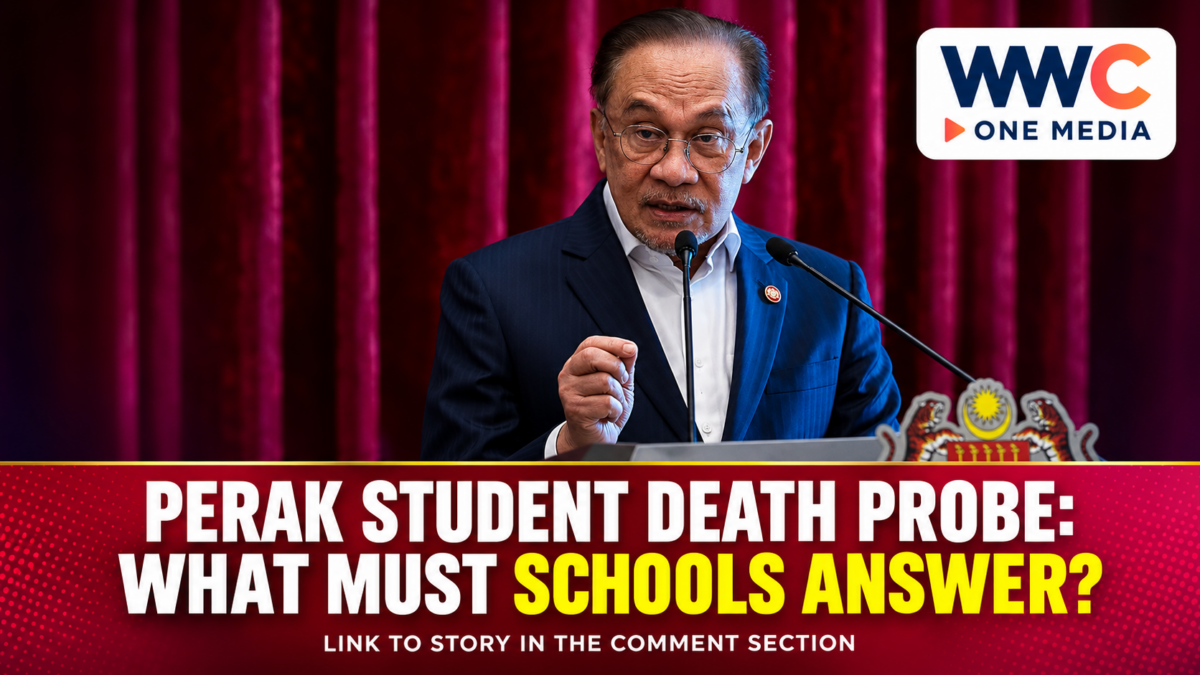
KUALA LUMPUR, Malaysia — Nov. 22, 2026. Malaysian Prime Minister Anwar Ibrahim called for a thorough, transparent and prompt investigation on Nov. 18 following the death of a Form Three student at a school in Perak. His public statement urged authorities to establish the circumstances and ensure that no relevant aspect was overlooked.
The Perak student death has brought renewed attention to how schools protect pupils, document safety incidents and account for their supervision procedures.
Malaysia already has an extensive school-safety framework. The crucial question is how that framework is implemented, reviewed and explained when an incident demands public accountability.
Anwar’s Perak Student Death Investigation Demand
In his official public statement, Anwar expressed condolences to the student’s family and called for an investigation that would establish the circumstances of the death.
His intervention created a clear expectation of investigative transparency. It did not, however, amount to a finding of misconduct or establish why the student died.
That distinction is essential.
An investigation can examine potential procedural weaknesses without assuming that any individual committed wrongdoing. Equally, the existence of written safety rules does not prove that those rules were followed in a particular case.
The Prime Minister’s statement did not provide a medical conclusion, identify anyone responsible or announce a completed investigative finding.
Any subsequent conclusion must be assessed against its own official record, rather than inferred from the initial call for an investigation.
What Malaysia’s 2026 School Safety Rules Require
Malaysia’s Education Ministry issued its Safe School Management Guidelines through Circular No. 3 of 2026.
The document establishes procedures covering school environments, student safety, residential facilities, emergency preparedness and administrative accountability.
Its boarding-school provisions place particular emphasis on the responsibilities of hostel wardens and school management.
Wardens are instructed to prioritise students’ welfare and safety, supervise hostel activities, inspect rooms and shared facilities, and complete daily duty reports for school management.
The guidelines also address emergency arrangements, the condition of school facilities and the need to maintain a safe residential environment.
These requirements provide a documented framework for examining school administration.
They do not, by themselves, establish whether a lapse occurred in Perak.
Analysis: A meaningful review should distinguish between policies that exist on paper and evidence showing how staff implemented those policies at the relevant time.
Why Supervision Records Could Matter
Malaysia’s official guidelines describe daily reporting duties and routine checks as part of residential-school management.
For an investigator reviewing an incident, these records can help establish whether prescribed processes were carried out.
Relevant questions could include whether applicable inspection records were completed, whether supervision arrangements were documented and whether emergency reporting procedures were available to staff.
These are lines of inquiry, not accusations.
A missing document, an administrative discrepancy or an incomplete account would require proper examination before anyone could determine its significance.
The broader issue resembles questions raised in WWC ONE MEDIA’s coverage of school safety and child-protection responsibilities in Malaysia.
School management has duties relating to pupil welfare, but administrative procedures and criminal investigations serve different purposes.
A school’s internal review examines whether institutional requirements were satisfied. Law enforcement determines matters within its investigative authority.
Neither process should be substituted for the other.
How School Safety Audits Are Supposed to Work
The Education Ministry’s 2026 guidelines also outline mechanisms for monitoring and auditing schools.
These include the School Safety Rating System, known as SPKS, education-management information systems and inspections involving the Education Inspectorate.
The guidelines describe assessments covering infrastructure, student activities, crisis management and safety arrangements.
They also assign roles to district and state education offices in verifying information and pursuing corrective measures.
This framework matters because accountability should extend beyond the immediate response to an incident.
Analysis: If an inspection identifies an actual weakness, the public-interest question becomes whether the responsible institution corrects it and verifies that the correction works.
A safety audit is most valuable when findings inform practical improvements.
Previous WWC reporting on the Negeri Sembilan sports-school death proceedings illustrates why different incidents must be assessed separately.
That case involved criminal charges and its own legal process. Those proceedings do not establish anything about the circumstances of the Perak student’s death.
Why Student Privacy Must Remain Protected
The Malaysian Social Welfare Department issued a public advisory on July 8, 2026, warning against disclosure of identifying information about children involved in covered investigations and proceedings.
The advisory refers to Section 15 of the Child Act 2001, which restricts publication of children’s names, educational institutions, photographs and other details that could reveal their identities in applicable cases.
A violation can carry a fine of up to RM10,000, imprisonment of up to five years, or both.
Those protections also serve a broader ethical purpose.
A public investigation should not become an invitation to circulate private photographs, identify classmates or speculate about a family’s circumstances.
WWC’s separate report on La Salle Green Hills’ precautionary school-safety response examined another important distinction: a school’s protective action does not automatically establish the nature or cause of an incident.
That principle also applies when the public demands immediate answers following a tragedy.
Information should be released responsibly, with the rights of affected individuals respected.
What Happens Next?
The immediate accountability test is whether the Perak investigation produces an appropriately authorised, verifiable account of its findings.
Any school-management review should also distinguish confirmed procedural compliance from corrective measures that may be recommended.
As of this editorial review, the original case-specific police findings have not been independently authenticated for this update. This is a reporting-verification limitation, not a claim that police have issued no findings.
A responsible follow-up should establish the official investigative status, identify any formally confirmed administrative findings and explain whether corrective measures have been announced.
Anwar’s call for transparency is clear from his original statement.
What remains for this report is to establish, through directly verifiable records, how that commitment has been carried through.
Frequently Asked Questions
What did Anwar Ibrahim say about the Perak student’s death?
On Nov. 18, 2026, Anwar called for a thorough, transparent and prompt investigation to determine the circumstances of the student’s death.
Has WWC verified the official cause of death?
No. This update does not present a cause of death because the relevant original police or authorised medical finding has not been directly authenticated for this review.
What responsibilities do Malaysian boarding-school wardens have?
The Education Ministry’s 2026 guidelines describe responsibilities including student welfare, hostel supervision, routine inspections and daily duty reporting.
How does Malaysia monitor school safety?
The Education Ministry’s guidelines provide for school safety ratings, administrative data systems, inspections and follow-up through education authorities.
Can information identifying a child involved in an investigation be published?
Section 15 of Malaysia’s Child Act 2001 restricts publication of identifying information in cases covered by the law. The restrictions can extend to photographs, school details and other identifying information.