
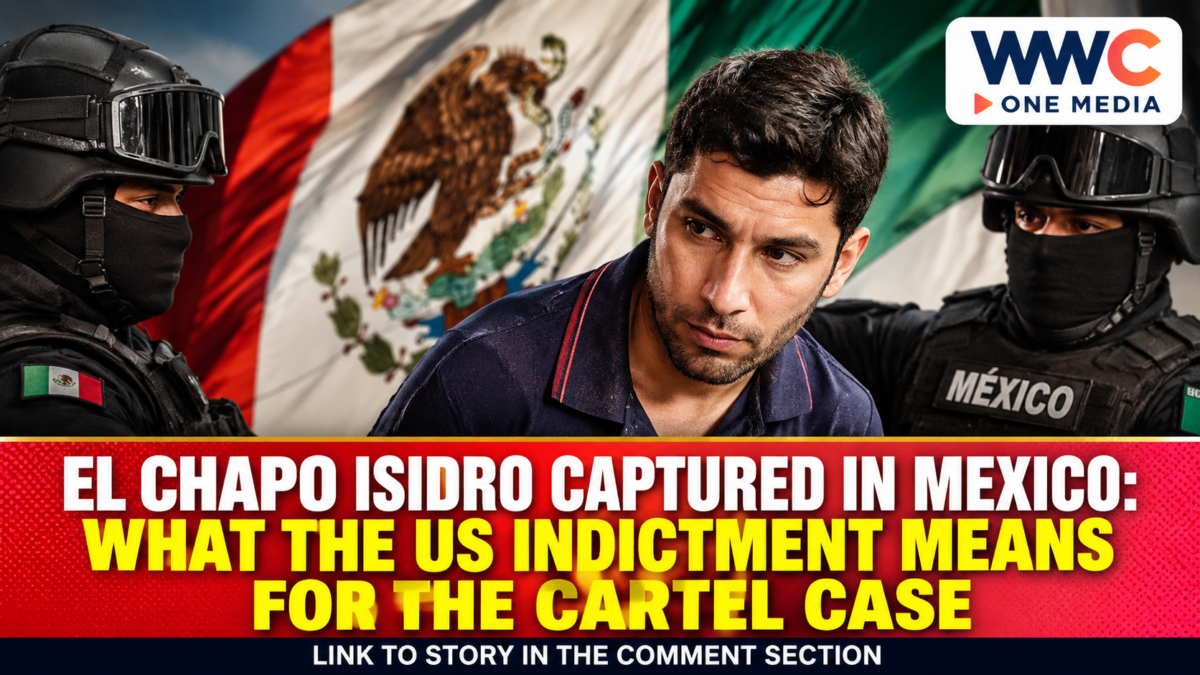
Fausto Isidro Meza Flores, known as “El Chapo Isidro,” was captured by Mexican military forces in Guasave, Sinaloa, on Nov. 20, 2026, according to a US Department of Justice announcement published the following day. The arrest places a high-profile alleged Sinaloa Cartel leader in custody as he faces a six-count federal indictment in the United States.
The development matters beyond the arrest itself. It brings a long-running US criminal case into a new phase and highlights the extent to which American and Mexican authorities have worked together to pursue a fugitive accused of directing a major drug-trafficking organisation.
The official record confirms the capture and the US charges. It does not, by itself, establish that Meza Flores is guilty of those allegations or that his detention has dismantled the criminal network attributed to him.
Chapo Isidro capture confirmed by the US Justice Department
The US Department of Justice said Meza Flores was captured in Guasave on Nov. 20 during a Mexican military operation supported by the Homeland Security Task Force.
The operation also resulted in the arrest of German Rolando Galvez Meza, identified in the announcement by the alias “El Serafin.” The US statement described him as an alleged cartel leader.
The Justice Department credited cooperation between US and Mexican agencies. It said the Homeland Security Task Force supported the Mexican operation, while FBI Director Kash Patel described the capture as having taken place with US assistance. United States Department of Justice+1
The FBI had added Meza Flores to its Ten Most Wanted Fugitives list on Feb. 4, 2025. Its public notice was updated on Nov. 21, 2026, to record his capture the previous day.
The arrest therefore closes his status as an active fugitive on that list. It does not resolve the criminal charges that remain pending in the United States. FBI
Six federal counts define the US case
The Justice Department said a federal grand jury in the District of Columbia returned a second superseding indictment on Sept. 25, 2026.
The six-count indictment charges Meza Flores with leading a continuing criminal enterprise, conspiring to manufacture and distribute controlled substances for importation into the United States, international money-laundering conspiracy, conspiracy to provide material support to a terrorist organisation, narcoterrorism and firearms-related offences.
The listed drug allegations include cocaine, methamphetamine, heroin, marijuana and fentanyl. The firearms allegations include the use of a machine gun and a destructive device.
These are charges, not findings of guilt. The distinction is important because the indictment sets out what prosecutors must prove through the legal process. Meza Flores remains entitled to the presumption of innocence unless and until a court determines otherwise.
The Justice Department said the case is being prosecuted by the US Attorney’s Office for the Southern District of California and the department’s Money Laundering, Narcotics and Forfeiture Section. United States Department of Justice
Why Guasave appears repeatedly in the case record
The US announcement identifies Guasave, Sinaloa, as a significant area of the alleged organisation’s operations.
The Justice Department said court documents describe Meza Flores as having commanded a large contingent of gunmen controlling territory in Guasave, Los Mochis and remote parts of the Sinaloa mountains.
Prosecutors allege that the territory was used to manufacture and distribute illegal drugs before they were transported north into the United States. The same court-based allegations describe the organisation as using violence to protect its activities and control territory.
Those assertions remain allegations contained in the US case. They should not be treated as independently proven facts simply because they appear in a government announcement.
For readers following Mexico’s wider security situation, the location also matters because the state has been the subject of repeated federal operations. In an Oct. 28 joint statement, Mexico’s security authorities described a separate operation in Sinaloa involving an attack on naval personnel and the recovery of vehicles and weapons. That announcement referred to a suspected high-ranking operator whose identity was still awaiting forensic confirmation. gob.mx
The US-Mexico operation shows the role of intelligence cooperation
The Justice Department attributed the capture to a combined effort involving the Homeland Security Task Force and Mexican military forces.
The announcement also identified the FBI’s Washington and San Diego field offices and Homeland Security Investigations in San Diego as participants in the investigation. It said the Drug Enforcement Administration, Bureau of Alcohol, Tobacco, Firearms and Explosives, and US Marshals Service provided significant assistance.
That list illustrates the range of US agencies involved in a cross-border investigation. The case was not described as a single-agency arrest effort, but as a coordinated investigation involving several federal bodies and Mexican partners. United States Department of Justice
The wider policy question is whether cooperation that helps capture senior figures can also weaken the structures supporting criminal organisations.
A leadership arrest can remove an important target from an organisation. It does not automatically establish that the group’s finances, supply routes, armed personnel or other operating networks have been dismantled. That is a question for subsequent investigations and enforcement actions, not something the arrest announcement can settle.
WWC has examined the broader regional dimension of anti-cartel cooperation in its coverage of US security discussions with Ecuador and the limits of regional commitments. The same distinction applies here: cooperation is a documented process, while its long-term results require separate evidence.
The charges carry severe potential penalties
The Justice Department said Meza Flores could face the death penalty or a mandatory term of life imprisonment if convicted of the charges.
That statement describes the potential consequences under the US case as announced by prosecutors. It is not a sentence, a conviction or a determination that any particular penalty will be imposed.
The prosecution will have to proceed through the applicable court process. The indictment, evidence presented by prosecutors and any defence arguments will be central to determining the outcome.
The FBI’s earlier public notice also shows the scale of the US pursuit. When Meza Flores was added to its Ten Most Wanted list in February 2025, the FBI said the State Department was offering a reward of up to US$5 million for information leading to his arrest and conviction. The later capture announcement now records that he has been apprehended. FBI
What happens next
The next major step is the US judicial process following Meza Flores’ capture. The Justice Department has identified the federal charges and the offices responsible for prosecuting the case, but the announcement does not provide a court schedule or a date for his first appearance.
The public record reviewed for this report also does not establish the full legal arrangements for his transfer, extradition or any other proceedings between Mexico and the United States. Those details should not be assumed from the fact of his capture.
For now, the confirmed development is that Meza Flores is no longer listed as a fugitive by the FBI and that US prosecutors intend to pursue the six-count indictment.
The broader test will be whether authorities can use the arrest to advance the case and establish what happens to the organisation’s alleged operations after its capture of a senior figure.
WWC’s previous reporting on the investigation into a killing in Morelos also underlines why the distinction between detention, allegations and a court finding matters in Mexican criminal proceedings. The same standard should apply in a case involving an internationally wanted fugitive.
Frequently Asked Questions
Who is El Chapo Isidro?
El Chapo Isidro is the alias of Fausto Isidro Meza Flores, whom US authorities have described as an alleged senior leader of the Sinaloa Cartel.
When was El Chapo Isidro captured?
The US Department of Justice said Meza Flores was captured by Mexican military forces on Nov. 20, 2026, in Guasave, Sinaloa.
What charges does he face in the United States?
The Justice Department announced a six-count indictment involving alleged leadership of a continuing criminal enterprise, drug-trafficking conspiracies, money laundering, narcoterrorism, material support to a terrorist organisation and firearms offences.
Does the capture mean he has been convicted?
No. Capture and indictment are not convictions. The charges must be resolved through the US judicial process.
Could he face life imprisonment?
Yes. The Justice Department said he faces the death penalty or a mandatory term of life imprisonment if convicted of the charges.
The capture is a major development in a long-running international pursuit. But the legal outcome, the status of the alleged organisation and the longer-term security consequences will depend on what investigators and courts establish next.










