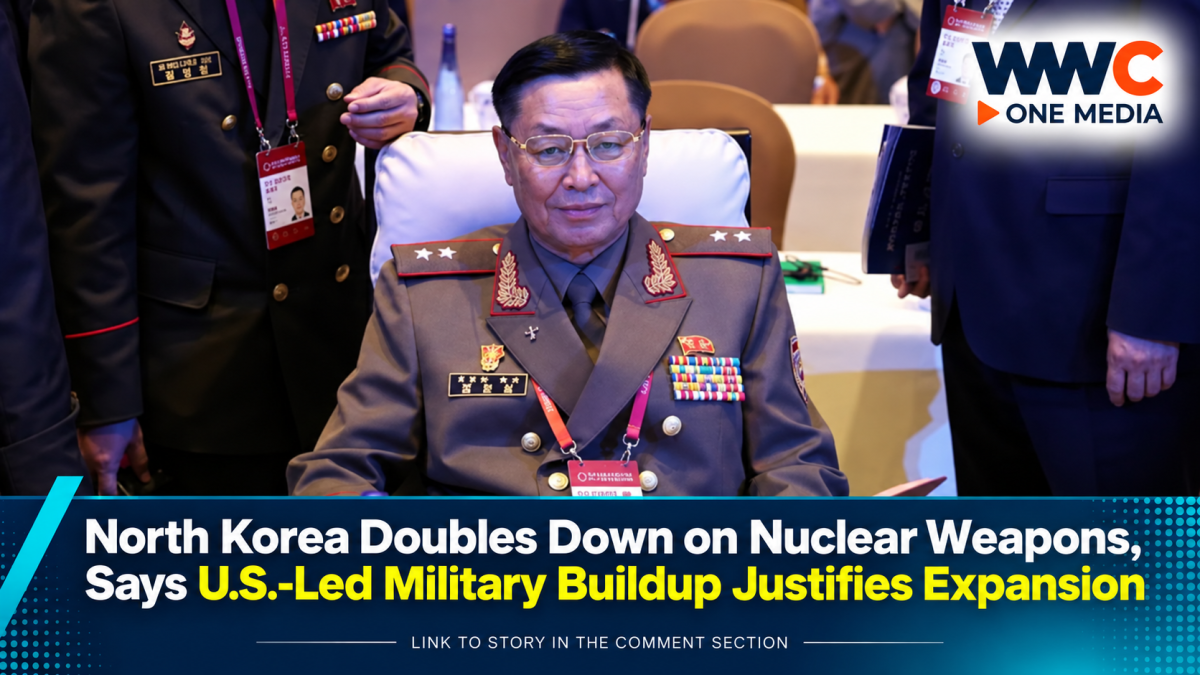
BEIJING — North Korea has renewed its commitment to expanding its nuclear capabilities, with Vice Defense Minister Kim Kang-il telling an international security forum in Beijing that Pyongyang considers its nuclear status irreversible.
Speaking Thursday at the 13th Beijing Xiangshan Forum, Kim blamed what he described as growing U.S.-led military pressure and closer security cooperation among the United States, South Korea and Japan for the need to strengthen North Korea’s nuclear deterrent.
His remarks reinforce Pyongyang’s long-standing position that its nuclear program is necessary for what it calls self-defense.
Pyongyang Says Denuclearization Is No Longer an Option
Kim argued that North Korea’s status as a nuclear-armed state has reached what he described as a “point of no return.”
He said Pyongyang would continue to expand and strengthen its nuclear deterrent, while calling on other countries to abandon demands for North Korea’s denuclearization.
The comments echoed a separate statement from Kim Yo-jong, the North Korean leader’s sister, who also rejected international calls for denuclearization earlier this week. She described North Korea’s nuclear status as permanently established.
North Korea’s government has increasingly formalized its nuclear policy through domestic law and official statements, making denuclearization a central point of disagreement between Pyongyang and countries seeking to limit its nuclear capabilities.
U.S., South Korea and Japan Security Cooperation Comes Under Fire
Kim specifically criticized military cooperation between Washington, Seoul and Tokyo, portraying it as an increasingly integrated nuclear alliance.
He argued that U.S.-led military exercises and what North Korea sees as expanded nuclear capabilities around the Korean Peninsula demonstrate a growing threat to Pyongyang.
Reuters reported that Kim said the buildup by what he called “enemy states” justified North Korea’s efforts to establish a stronger nuclear shield.
Those statements represent Pyongyang’s characterization of regional security developments. The United States, South Korea and Japan have consistently described their military cooperation as intended to deter threats and maintain regional security, rather than as preparation for an offensive nuclear campaign.
Rare North Korean Appearance at China’s Major Defense Forum
Kim’s appearance at the Xiangshan Forum is significant because North Korea has had a relatively limited presence at the event in recent years.
The forum, organized by China’s military research establishment, is one of Beijing’s major international defense gatherings and is often compared with the Shangri-La Dialogue in Singapore.
North Korea previously participated at a high level, but in the two most recent editions it was reportedly represented by military attaches from its embassy in China rather than a vice defense minister.
The return of a vice minister-level delegation comes after North Korean leader Kim Jong-un and Chinese President Xi Jinping held a summit in Pyongyang in June, where both sides pledged to strengthen high-level exchanges.
That makes the Beijing appearance another closely watched sign of renewed official contact between Pyongyang and Beijing.
Beijing Forum Focuses on a Changing Security Environment
North Korea’s nuclear message was delivered against a broader backdrop of concern over emerging military technologies and geopolitical rivalry.
The three-day Xiangshan Forum brought together roughly 2,000 military officials, diplomats and academics from around 100 countries, according to Reuters.
Artificial intelligence and autonomous military systems were among the issues discussed, with several participants warning that rapidly advancing technology could shorten decision-making times and create new risks in military conflicts.
The presence of North Korea’s delegation therefore placed Pyongyang’s nuclear policy alongside wider discussions about how major powers should manage an increasingly complex security environment.
China-North Korea Ties Add Another Layer
North Korea’s decision to send Kim Kang-il also comes as Pyongyang and Beijing seek to strengthen official exchanges.
Yonhap reported that the delegation’s participation followed the June summit between Kim Jong-un and Xi Jinping. The two governments have sought to rebuild high-level engagement after periods of strained relations.
At the forum, Kim also called for cooperation with friendly countries against what North Korea describes as “hegemony and unilateralism.”
However, his attendance does not by itself establish that China endorses every element of North Korea’s nuclear policy. The Xiangshan Forum brings together officials from a wide range of countries, and participation provides a venue for governments to present their own security positions.
What This Means for the Korean Peninsula
Kim’s remarks reinforce a difficult reality for efforts to restart discussions over North Korea’s nuclear program.
Pyongyang is publicly presenting its nuclear arsenal as a permanent part of its national security strategy, while the United States, South Korea and other countries continue to call for the reduction or elimination of North Korea’s nuclear weapons capabilities.
The latest statements also came as Washington, Seoul and Tokyo continue to strengthen security cooperation in response to North Korea’s missile and nuclear programs.
For now, Kim’s message from Beijing is clear: North Korea says it intends to keep strengthening its nuclear deterrent rather than return to a denuclearization framework.