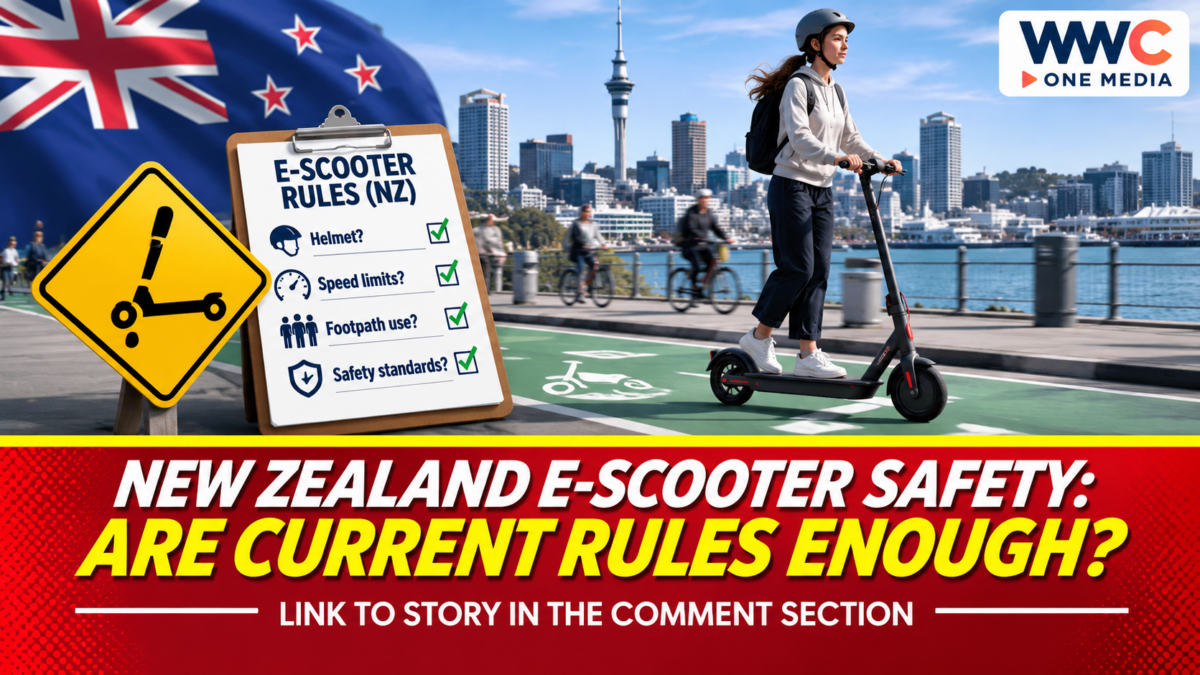
WELLINGTON, New Zealand — Nov. 22, 2026. New Zealand’s Accident Compensation Corporation (ACC) has recorded 3,865 new claims relating to e-scooter injuries between January and September 2026, while the country’s transport regulator continues to allow qualifying electric scooters on footpaths and roads without a compulsory helmet requirement. These official figures and regulations provide a basis for examining e-scooter safety, even as details of a reported serious crash involving a teenager in Paraparaumu remain unverified in accessible primary records.
The policy question is not whether a single incident proves the rules are ineffective. It is whether existing requirements, public information and injury monitoring are sufficient to manage the risks of a transport device that can share space with pedestrians and cars.
New Zealand E-Scooter Safety: What the Claims Show
ACC reports 3,865 new e-scooter injury claims for the nine months to Sept. 30, 2026. It also lists 4,314 active claims and NZ$14.2 million in active costs during that period. The measures are different: a new claim is counted when lodged, while an active claim involves at least one payment during the period and could relate to an earlier injury.
The figures should not be added to produce a total number of people injured. Nor can they establish a crash rate without a reliable measure of journeys taken, kilometres travelled or the size of the riding population.
ACC identifies claims using keywords in free-text accident descriptions. Its published caveats describe the statistics as indicative rather than a definitive count. They also note that acute public-hospital costs are bulk-funded and not attributed to individual claims in the displayed active-cost figure.
Analysis: Those qualifications matter. The claims demonstrate a meaningful ongoing injury burden, but they do not prove that incidents are increasing per trip, or that every reported injury involved an unlawful scooter or unsafe riding.
How New Zealand Classifies E-Scooters
The NZ Transport Agency Waka Kotahi (NZTA) distinguishes qualifying low-powered e-scooters from devices treated as motor vehicles. An e-scooter within the exemption must meet design requirements and have electric motors with combined maximum power output no greater than 300 watts.
Qualifying scooters do not require vehicle registration or a driver licence. NZTA renewed the declaration for five years, with an expiry date of Sept. 30, 2028. This is a regulatory classification, not a guarantee that every scooter sold or ridden complies.
NZTA also says some higher-powered devices fall outside the exemption. A buyer cannot assume a product is covered merely because an advertisement calls it an e-scooter. The particular vehicle’s technical characteristics determine which rules apply.
Where Riders May Travel and What They Must Do
NZTA says qualifying e-scooters may be used on footpaths, roads and designated cycle lanes. On footpaths, riders must be careful and considerate, travel at a speed that does not endanger others and give way to pedestrians and people using mobility devices.
On roads, the agency instructs e-scooter riders to remain as close as practicable to the edge. Its advice also stresses awareness of other users, leaving safe passing distances and adjusting speed in busy areas.
A helmet is recommended but is not legally required for a qualifying e-scooter. That distinction matters for both consumer understanding and responsible coverage: a safety recommendation should not be reported as a compulsory offence, nor should the absence of a mandate imply that head protection has no value.
These are national requirements. Specific local rules or conditions may also apply, so riders should check the rules governing the scooter and location they actually use.
What Earlier Safety Reviews Established
NZTA’s 2023 safety review examined the e-scooter exemption and injury information, as well as the balance between accessibility and public safety. The agency later renewed its declaration rather than moving every qualifying scooter into the ordinary motor-vehicle regime.
The decision recognised the role e-scooters can play in mobility while retaining obligations for careful operation. It did not eliminate the possibility of injuries or remove the need to monitor the consequences of wider use.
Analysis: A sensible assessment of regulation should ask whether riders understand their duties, whether vehicle classifications are enforceable and whether streets provide safe space for pedestrians, scooters and other traffic. The existence of injuries alone cannot tell policymakers which intervention would produce the greatest benefit.
Why Individual Crash Details Require Separate Verification
A publicly circulated account of a serious teenage e-scooter crash cannot be treated as a police finding or medical record without corroborating primary documentation. The accident’s cause, the equipment involved, the rider’s protective gear and the course of any hospital treatment are all case-specific matters.
Even where a family shares personal information publicly, it is important to distinguish its account from independently verified investigative findings. No inference about fault should be drawn from someone’s age, medical condition or the severity of an injury.
For readers, the broader safety guidance is actionable without needing private details. Consider a helmet, use a device that fits the rules, adjust speed around others and avoid riding in a way that puts pedestrians at risk. These recommendations align with official guidance; they are not conclusions about the reported Paraparaumu incident.
What Happens Next
New Zealand’s present e-scooter declaration runs until September 2028, leaving scope for continuing safety monitoring before another regulatory decision. More detailed official data on exposure, injury severity and device type could help establish which risks are most substantial.
For the individual reported crash, a dated official police notice or other authorised primary record would be needed before publishing a precise timeline or confirmed injury update. Until then, the evidence supports a national safety analysis, not an independently verified account of that person’s condition.
Frequently Asked Questions
Are e-scooter helmets compulsory in New Zealand?
NZTA recommends helmets, but says they are not legally required for qualifying e-scooters.
Can electric scooters use New Zealand footpaths?
Qualifying e-scooters can use footpaths. Riders must give way to pedestrians, operate considerately and avoid speeds that endanger others.
How many e-scooter injury claims were recorded in 2026?
ACC lists 3,865 new claims from January through September 2026. This is not a full-calendar-year total.
Does an e-scooter need a driver’s licence?
An e-scooter meeting the applicable low-powered device requirements does not require a driver’s licence or vehicle registration. Different rules can apply to more powerful equipment.
Does ACC’s injury data prove scooter crashes are becoming more frequent?
Not on its own. A claim count does not establish the risk per ride, and ACC cautions that its keyword-based claim figures are indicative rather than definitive.