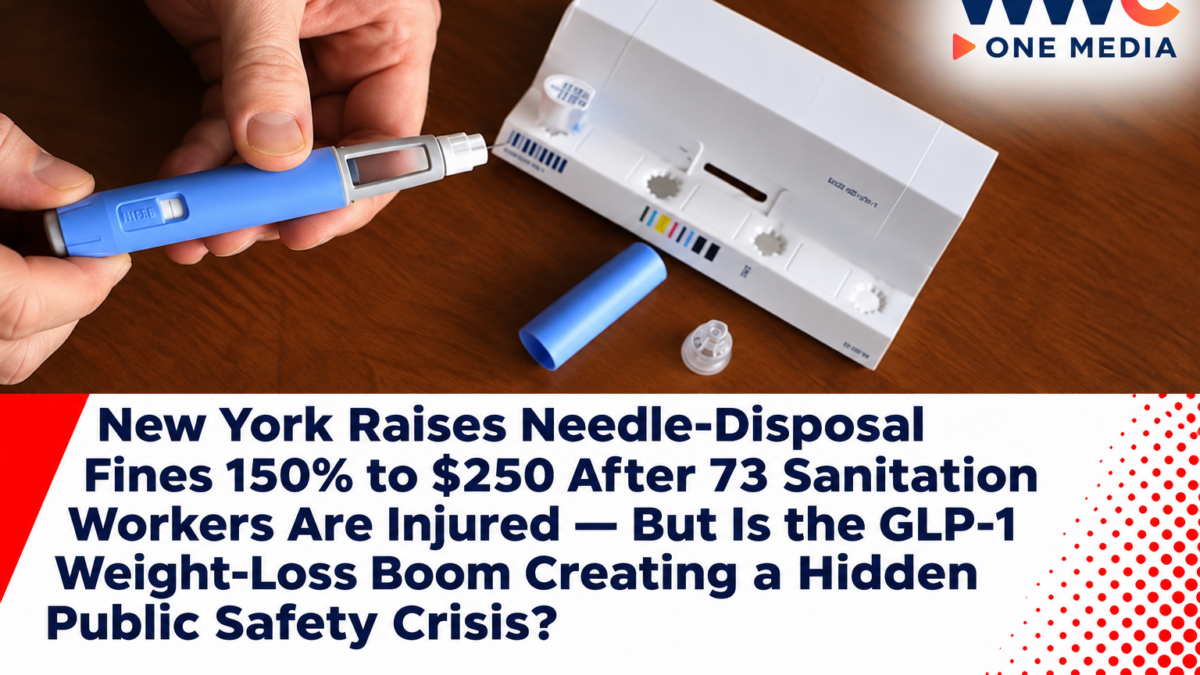
NEW YORK, UNITED STATES / MANILA, PHILIPPINES — November 11, 2026 — The explosive popularity of injectable weight-loss medications is bringing an unexpected public safety problem to America’s largest city: used medical needles are turning ordinary household garbage into a potentially dangerous workplace hazard.
New York City has increased the penalty for improperly discarding used needles and other medical sharps from US$100 to US$250, following a sharp rise in needlestick injuries among sanitation workers.
The new regulation took effect on November 9, 2026, according to the city’s official rulemaking records.
The Department of Sanitation reported 73 needlestick injuries among its employees during 2026, nearly double the 37 reported in 2024.
The increase comes as millions of Americans use injectable medicines for diabetes, obesity and other health conditions, including increasingly popular GLP-1 medications.
Officials believe the growing use of home injections may be contributing to the danger.
However, New York has not identified the precise source of every discarded needle responsible for the injuries.
The problem extends beyond weight-loss treatments. Needles used for insulin, fertility medicines and other legitimate medical purposes can create the same hazard when discarded improperly.
For sanitation workers, the risk is immediate.
A needle concealed inside an ordinary garbage bag can puncture protective gloves or skin, potentially requiring emergency medical evaluation and follow-up testing.
The question now is whether New York’s tougher fines will change disposal habits—or whether the rapid expansion of at-home injectable medicines is creating a medical-waste problem that cities are not yet prepared to handle.
New York City Raises Sharps-Disposal Penalties to $250
The New York City Department of Sanitation, known as DSNY, formally adopted the higher penalty under an amendment to its rules governing regulated household waste.
The change became effective on November 9.
The previous penalty was $100, an amount that had remained unchanged since 2002.
The new $250 fine represents a 150% increase and is the maximum permitted under the applicable city administrative provision.
The regulation concerns needles, syringes and other sharp objects used to administer medications that can puncture or cut someone handling residential waste.
The rule is not limited to GLP-1 prescriptions.
Residents using other injectable medications must also comply with safe-disposal requirements.
The objective is to discourage people from placing exposed needles directly inside ordinary trash bags, where sanitation workers may encounter them without warning.
DSNY says the increasing number of injuries makes stronger deterrence necessary.
But the effectiveness of the new penalty will depend partly on public awareness and compliance.
Sanitation Workers Report 73 Needlestick Injuries in 2026
The strongest evidence behind the rule is the rising injury count.
According to the figures reported by Bloomberg on November 10, DSNY had recorded 73 employee needlestick injuries during 2026.
The department recorded 37 such injuries in 2024.
That represents an increase of approximately 97% between the two reported totals.
Earlier figures show how the problem developed.
As of August 10, the department had reported 49 needlestick injuries for 2026.
By late August, other reporting cited 57 injuries.
The latest total of 73 reflects the continued increase later in the year.
These figures refer to different reporting dates.
They should not be treated as separate groups of injured workers or added together.
The official rulemaking notice also states that department employees experienced more than 140 needlestick incidents over the preceding three calendar years.
That historical figure provides context for the broader trend.
The department has not claimed that every injury was caused by a discarded weight-loss injection.
Sanitation Workers Describe the Danger Hidden in Trash Bags
A New York sanitation employee can encounter used needles during ordinary collection duties.
Workers regularly lift, move and load garbage bags whose contents are not visible.
If a syringe has been thrown away without a protective container, its needle can penetrate a bag or protective glove.
In an August interview with Spectrum News NY1, sanitation worker Nicholas Derenzi described being stuck by a discarded needle while working in the Bronx in 2020.
After the incident, coworkers discovered several needles inside the garbage.
Derenzi underwent emergency medical evaluation.
Other sanitation workers have described similar concerns.
The immediate injury can be painful, but uncertainty about possible exposure can add significant emotional stress.
A worker may not know what the needle was previously used for or whether it carries an infectious risk.
This makes proper disposal a worker-safety issue rather than simply a matter of keeping public streets clean.
Why Used Needles Can Be Dangerous
Used medical sharps can cause accidental puncture wounds.
Those injuries can introduce bacteria or create potential exposure to bloodborne infections.
Healthcare professionals have identified concerns involving hepatitis B, hepatitis C and HIV, depending on the nature of the exposure.
However, a needlestick does not automatically mean that a worker has contracted an infection.
The actual risk depends on factors including the source of the needle, the circumstances of the injury and whether infectious material is present.
A person who sustains a needlestick injury may require prompt medical assessment.
Clinicians can determine whether wound treatment, testing, vaccination review or post-exposure treatment is appropriate.
For sanitation workers, the problem is complicated because the source of a discarded needle is often unknown.
Prevention is therefore particularly important.
A puncture-resistant container can greatly reduce the chance that a needle will injure someone handling the waste.
Why GLP-1 Medicines Are Part of the Conversation
The issue has attracted attention because GLP-1 medications have become increasingly popular.
GLP-1 receptor agonists are medicines that act on biological pathways involved in blood-sugar regulation and appetite.
Several widely known medications in this broader treatment category are administered by injection.
These include semaglutide products such as Ozempic and Wegovy, as well as tirzepatide products such as Mounjaro and Zepbound, although their approved uses differ by product and country.
As more people receive treatment at home, the number of injection devices requiring safe disposal may also increase.
But the relationship with sanitation injuries has not been precisely measured.
New York officials have acknowledged that they cannot identify which categories of medication were associated with every discarded needle.
Some devices may be associated with diabetes treatment.
Others may have been used for fertility treatments, emergency medication or different medical needs.
Consequently, it would be inaccurate to portray all the injuries as directly caused by Ozempic or other GLP-1 drugs.
The safer conclusion is that growing home-injection use is increasing the importance of medical-sharps education.
Gallup Finds 11% of US Adults Currently Use GLP-1s for Weight Loss
The scale of America’s weight-loss medication boom helps explain why the issue is receiving national attention.
A Gallup survey released in July and updated in September 2026 found that 11% of American adults reported currently taking GLP-1 medications for weight loss.
That compares with 3% in 2024.
The proportion reporting that they had ever used the medicines for weight loss reached 15%.
The research was based on a survey of 5,065 American adults conducted between May 28 and June 5.
These figures show the rapid expansion of the market.
But they require an important qualification.
The survey measures self-reported medicine use among American adults.
It does not establish how many New York City residents use GLP-1 injections.
It also does not measure how many needles are improperly discarded.
Moreover, some GLP-1 treatments may be available in oral form, depending on the medicine and approved indication.
The Gallup results therefore provide background about the growing popularity of the treatments, not proof of the precise cause of DSNY’s injury increase.
The Weight-Loss Drug Industry Is Expanding Rapidly
The public safety discussion is unfolding alongside one of the pharmaceutical industry’s largest commercial expansions.
Novo Nordisk and Eli Lilly have become leading competitors in obesity and diabetes treatments.
Their products have generated substantial demand and encouraged other manufacturers to accelerate development of new therapies.
As WWC ONE MEDIA reported in its analysis of Eli Lilly’s revenue growth and the commercial success of Mounjaro and Zepbound, the market for diabetes and weight-management treatments is becoming an important driver of pharmaceutical revenue.
That success is also encouraging investment in injection devices, manufacturing equipment and medication-delivery systems.
However, the expanding supply of treatments creates responsibilities beyond pharmaceutical production.
Patients need clear information about medication administration, storage and the safe disposal of used devices.
Healthcare providers and drug manufacturers have roles in explaining those requirements.
Municipal governments must also establish practical waste-management arrangements.
The industry’s growth does not itself cause improper disposal.
The problem arises when used sharps are handled in ways that expose other people to injury.
New Weight-Loss Treatments Could Increase the Need for Safe Disposal
Drugmakers are continuing to develop more powerful and convenient obesity therapies.
Research is expanding beyond existing GLP-1 medicines into other hormonal pathways, including amylin.
As WWC ONE MEDIA examined in its report on Eli Lilly and Novo Nordisk’s next-generation obesity treatments, pharmaceutical companies are testing combinations that may improve weight-loss outcomes or offer patients new treatment options.
Some experimental therapies are administered through injections.
Others may eventually use different delivery methods.
Clinical trial results do not guarantee approval, and not every medicine will be delivered through a needle.
Nevertheless, the growth of at-home treatment makes patient education increasingly important.
A new medication is not only a pharmaceutical product.
Its safe use can also involve preparation, administration, device handling and disposal.
Those practical responsibilities should be considered alongside effectiveness, safety and affordability.
New York’s Rule Applies to More Than Weight-Loss Needles
One of the most important details about the city’s new rule is its broad coverage.
The $250 penalty applies to improper disposal of regulated household sharps.
These can include:
- Syringes and injection needles.
- Lancets used for blood testing.
- Sharp medical instruments used in home care.
- Other needle-bearing equipment associated with medication administration.
The exact handling requirements depend on the type of waste.
For ordinary household sharps, the city provides specific instructions for secure containment and disposal.
Residents should not assume that placing a loose needle into a garbage bag is acceptable simply because the medicine was legally prescribed.
A discarded needle can be dangerous regardless of why it was originally used.
The purpose of the regulation is to protect anyone who may handle residential trash, including building employees, sanitation personnel and waste-processing workers.
How New Yorkers Should Dispose of Used Needles
The city’s Department of Sanitation provides a straightforward disposal procedure.
Used needles, syringes, lancets and similar sharps should be carefully placed into an appropriate sharps container or another leak-proof, puncture-resistant container.
A heavy-duty laundry detergent bottle can be an acceptable household alternative under the city’s guidance.
The container must be securely sealed.
It should also be clearly labeled:
HOME SHARPS – NOT FOR RECYCLING
After sealing and labeling, residents may use an authorized collection or drop-off location.
New York City also allows properly contained household sharps to be discarded with regular trash.
This does not mean loose needles may be placed directly in a trash bag.
It means a properly prepared and secured sharps container can be placed in the permitted waste stream.
Sharps containers must not be placed in recycling.
Residents should follow the city’s current instructions rather than relying on general advice that may apply to other jurisdictions.
Hospitals and Nursing Homes Offer Another Disposal Option
New York State requires hospitals and nursing homes to accept used household sharps for disposal.
The Department of Sanitation advises residents to call ahead to confirm receiving hours and procedures.
Other collection facilities and designated drop-off events may also be available.
These options can be particularly helpful for households that generate sharps regularly.
Proper collection allows needles to be managed through systems intended to reduce accidental exposure.
Residents do not necessarily need to purchase expensive disposal equipment to meet New York City’s basic household containment requirements.
The city specifically recognizes certain strong, puncture-resistant containers.
However, weak plastic bottles, loosely closed bags or containers that can easily be punctured may not provide adequate protection.
The key principle is to prevent needles from becoming exposed during handling.
Landlords Challenge the Fairness of the New Fines
The new regulation has generated objections from property owners.
The Small Property Owners of New York submitted comments opposing aspects of the penalty increase.
The organization argued that building owners may have little direct control over what tenants or passersby put inside shared garbage containers.
It also warned that requiring landlords or building staff to examine trash for improperly discarded needles could expose them to the same hazards facing sanitation workers.
The group called for penalties to be directed at identifiable individuals responsible for violations.
It also advocated more public education and accessible disposal locations.
Those concerns reveal an enforcement challenge.
In a large apartment building, garbage may be collected from hundreds of households.
Determining which resident discarded a particular needle may be difficult.
DSNY maintains that property owners already have responsibilities concerning proper waste handling.
The debate concerns how those obligations should be enforced fairly and safely.
The adopted regulation establishes the higher penalty, but disputes over enforcement responsibility may continue.
Why Some Critics Say Education Could Be More Effective Than Fines
The city hopes that raising the penalty will discourage improper disposal.
However, penalties work best when people know the rules and understand the consequences of violating them.
A resident who has never received guidance on sharps disposal may not know that an exposed injection needle presents a risk to sanitation workers.
Similarly, someone using an injectable treatment for the first time may not understand which containers are acceptable.
Public health education can address that knowledge gap.
Doctors, pharmacists and manufacturers can remind patients of correct disposal procedures.
Residential buildings can provide accessible instructions.
Municipal agencies can promote collection locations.
The higher fine may create an additional reason to comply, but it does not replace the need for practical information.
At this stage, there is no verified evidence that the newly adopted $250 penalty has already reduced the number of needlestick injuries.
That will require further data.
Automated Garbage Collection Could Reduce Worker Exposure
New York is also changing how residential garbage is collected.
The city has been moving toward greater use of secure waste containers and mechanized collection equipment.
Automated systems can reduce the amount of direct contact workers have with loose garbage bags.
That may reduce exposure to sharp objects and other hazards.
But mechanical collection does not eliminate the need for correct disposal.
Needles can still create risks during sorting, processing or accidental contact with damaged waste containers.
Building maintenance employees and other personnel may also encounter medical waste before garbage reaches a collection vehicle.
Safe disposal must therefore begin at the household level.
The most effective approach may combine prevention, accessible disposal options, clear guidance and safer collection technology.
The Pharmaceutical Industry Is Also Benefiting From Injection Technology
The growth of injectable treatments has created opportunities for specialized manufacturers.
Companies producing pharmaceutical components, containers and delivery systems have benefited from increased demand.
As WWC ONE MEDIA reported on West Pharmaceutical Services’ earnings growth and strong demand for components associated with weight-loss medicines, the GLP-1 market affects companies beyond the original drug developers.
However, growth in pharmaceutical packaging and delivery technology does not automatically guarantee corresponding investment in waste collection.
The two activities involve different businesses, regulations and funding arrangements.
This creates an important policy question.
As at-home treatments become more common, should disposal information and collection access receive greater attention from the healthcare system?
The New York crackdown suggests that medical waste is becoming a more visible part of the discussion surrounding injectable medicines.
Weight-Loss Medication Advertising Faces Separate Scrutiny
The broader GLP-1 industry is also experiencing increased regulatory attention.
Authorities in several countries have examined how weight-loss medicines are promoted and prescribed.
In the United Kingdom, advertising regulators recently banned several promotional materials involving weight-loss pill services.
As WWC ONE MEDIA reported on the UK’s action against advertisements associated with Voy, Juniper and MedExpress, regulators are concerned about the accuracy and legality of marketing certain prescription treatments.
That dispute is separate from New York’s sharps-disposal regulation.
However, both developments show that the rapid growth of weight-management medicines involves more than clinical effectiveness or pharmaceutical revenue.
Healthcare providers, pharmacies, advertisers and patients face different responsibilities throughout the treatment process.
The safe handling of used devices is another part of that system.
What the New York Crackdown Means for the Philippines
The New York policy offers a broader lesson for healthcare systems in the Philippines and elsewhere.
At-home injections are used for diabetes and other medical conditions in many countries.
As additional injectable treatments become available, healthcare providers and waste-management authorities may need to strengthen public education.
However, New York City’s $250 rule does not apply in the Philippines.
Local medical-waste requirements are governed by Philippine laws, regulations and applicable local collection procedures.
Residents should not assume that New York’s household disposal instructions are automatically authorized in Philippine municipalities.
For Filipino patients using prescribed injectable medicines, appropriate disposal should be discussed with a healthcare professional, pharmacist or local waste-management authority.
The key public health concern is universal: exposed needles can injure people handling household refuse.
But the approved containers, collection points and disposal procedures may differ by location.
Will $250 Fines Actually Reduce Needlestick Injuries?
That is the central question surrounding the new regulation.
New York has established that needlestick injuries among sanitation workers have increased.
It has also adopted a higher penalty to discourage improper disposal.
But the effectiveness of the policy has not yet been measured over a meaningful period.
Future assessments could examine whether injury reports decline after the rule takes effect.
They could also evaluate whether more residents use sharps containers and authorized disposal services.
Other useful indicators might include public awareness, complaints, enforcement activity and the availability of collection locations.
A decline in injuries would be encouraging, but it would still be necessary to consider other factors, such as changes in collection equipment or workforce exposure.
Likewise, continued injuries would not automatically prove that fines have no effect.
The results will depend on how the rule is communicated and implemented.
The Bigger Picture: A Medical Breakthrough Creates a Waste-Management Challenge
The rise of GLP-1 medicines has changed the treatment landscape for obesity and diabetes.
These medicines can provide important clinical benefits to appropriately selected patients.
The problem highlighted by New York City is not the use of legitimate medical treatments.
It is the unsafe disposal of the needles and other sharps that may accompany those treatments.
The distinction matters.
Millions of Americans are using GLP-1 medications, while numerous other patients use injectable therapies for unrelated conditions.
All of these groups need access to clear, practical disposal information.
New York sanitation workers have reported a sharp increase in needlestick injuries.
The city has responded by raising the penalty for improper sharps disposal to $250.
But a higher fine alone may not solve the problem.
Workers also need safer collection conditions.
Residents need convenient disposal methods.
And healthcare providers need to ensure patients understand what happens to used medical devices after treatment.
New York City’s $250 penalty is now in force after 73 needlestick injuries were reported among sanitation workers in 2026. But as more Americans administer medications at home, will stronger enforcement and better education finally protect the people who collect the city’s garbage—or is the expanding market for injectable treatments creating a public safety challenge that extends far beyond New York?