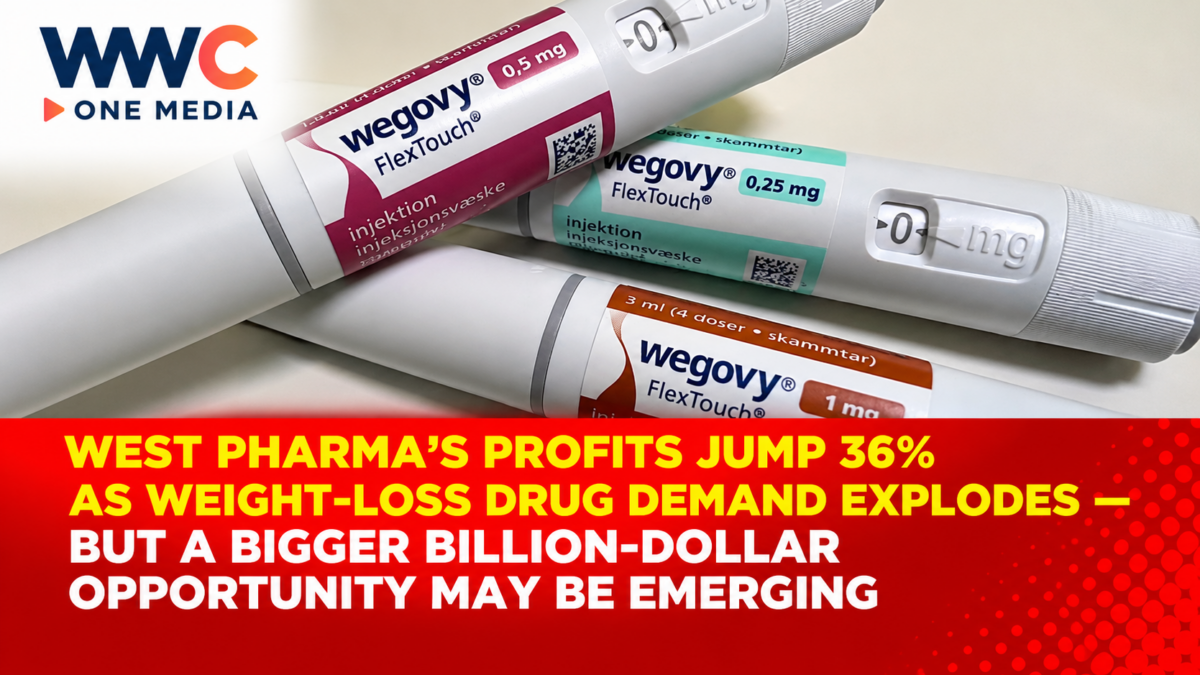
EXTON, PENNSYLVANIA — West Pharmaceutical Services (NYSE: WST), a major supplier of specialized pharmaceutical packaging and drug-delivery components, has delivered stronger-than-expected third-quarter 2026 earnings, highlighting its expanding role in the global injectable-medicine industry.
The company reported quarterly revenue of $874.5 million, up 8.7% year over year, while adjusted earnings per share surged approximately 36% to $2.66.
Its performance was supported by demand for high-value pharmaceutical components, including products used in GLP-1 weight-loss treatments and advanced biologic medicines.
But beneath the headline earnings figures lies a potentially bigger story: West’s future growth may depend less on the obesity-drug boom than many investors expect.
West Pharmaceutical Beats Earnings Expectations
West’s financial results for the quarter ended September 30, 2026, exceeded market expectations.
The company reported:
- Revenue: $874.5 million, up 8.7% year over year.
- Organic sales growth: 11.9%.
- GAAP earnings per share: $3.02, up approximately 57%.
- Adjusted earnings per share: $2.66, up approximately 36%.
- Gross profit margin: 39.7%.
- Adjusted operating margin: 25.3%.
According to financial reporting from Investing.com, Wall Street analysts had expected approximately $827.1 million in revenue and adjusted earnings of $2.20 per share.
West exceeded both estimates, demonstrating stronger sales growth and improved profitability.
GLP-1 Drugs Are Driving Demand — But They Are Not the Whole Story
The worldwide expansion of GLP-1 medicines has reshaped the pharmaceutical industry.
Treatments such as Eli Lilly’s Mounjaro and Zepbound, along with Novo Nordisk’s Ozempic and Wegovy, have generated significant demand for injectable-drug technologies.
West benefits by supplying specialized components used in pharmaceutical containment and delivery systems.
During its third-quarter earnings call, management reported that organic sales of high-value components associated with GLP-1 medicines increased by more than 30%.
However, GLP-1-related high-value components represented just under 12% of West’s total quarterly revenue.
That distinction is crucial.
Although obesity treatments are an important source of growth, most of West’s revenue comes from other pharmaceutical applications.
Management reported high-teens organic growth in high-value components outside GLP-1 medicines, highlighting the company’s broader exposure to pharmaceutical innovation.
For additional context, read WWC ONE MEDIA’s coverage of the emerging obesity-treatment market:
Related reading: Lilly and Novo Bet on Amylin as Next Obesity-Drug Battleground After GLP-1 Boom
High-Value Pharmaceutical Components Lead the Expansion
West’s High-Value Product Components business emerged as a particularly important growth driver.
Quarterly sales reached $466.7 million, representing an increase of approximately 20% from the previous year.
The division accounted for more than half of the company’s overall quarterly revenue.
These products are engineered to meet demanding pharmaceutical requirements, including compatibility, sealing performance and contamination control.
As manufacturers develop increasingly sophisticated injectable therapies, demand for premium components may continue rising.
West also identified regulatory-driven packaging upgrades as an important commercial opportunity.
Management reported adding more than 200 upgrade projects during 2026, reflecting customer interest in higher-performance containment solutions.
These projects could support future demand, although their commercial value and timing remain uncertain.
Biologics Could Become West’s Next Major Growth Engine
One of the most revealing developments in West’s earnings report was the performance of its biologics-related business.
Management reported organic growth of 23.2% in the biologics market.
Biologic medicines include many advanced treatments used against cancer, autoimmune diseases and other complex medical conditions.
Unlike conventional small-molecule medicines, biologics often involve sensitive materials and complex manufacturing processes.
Many also require specialized injectable delivery systems.
This creates opportunities for companies supplying high-quality pharmaceutical containment components.
West’s position in the sector potentially allows it to benefit from the development of treatments beyond diabetes and obesity.
WWC ONE MEDIA has also examined pharmaceutical innovation involving personalized cancer treatments.
Related reading: Merck and Moderna’s Personalized Cancer Vaccine Shows Major Promise — But a Six-Week Manufacturing Challenge Could Determine How Fast Patients Get It
Although that technology is separate from West’s disclosed business relationships, it illustrates the increasing complexity of next-generation medicine.
West Raises Full-Year 2026 Financial Forecast
Following its strong quarterly performance, West raised its revenue and earnings guidance for the remainder of 2026.
The company now expects full-year revenue between $3.410 billion and $3.420 billion, compared with its previous forecast of $3.345 billion to $3.380 billion.
Adjusted earnings per share are projected to reach between $9.38 and $9.48, up from the earlier forecast of $8.85 to $9.05.
West also increased its organic sales growth forecast to approximately 11.3%–11.6%.
The higher outlook reflects management’s confidence in continued demand for premium pharmaceutical components.
However, forecasts remain subject to customer ordering patterns, market conditions and operating risks.
Profit Margins Improve as West Shifts Toward Premium Products
West’s expanding profit margins suggest that its business is benefiting from a favorable product mix.
Higher-value components generally command stronger commercial positioning because of their specialized engineering and quality requirements.
The company’s adjusted operating margin reached 25.3%, representing an improvement of approximately 4.2 percentage points year over year.
This indicates that West’s profitability is increasing faster than its revenue.
The shift toward premium products could become an important competitive advantage if demand continues expanding.
However, manufacturing expenses, customer pricing pressure and new investment requirements could affect future margins.
Shareholders Receive $685 Million Through Stock Buybacks
West has also continued returning capital to shareholders.
During the first nine months of 2026, the company repurchased approximately $685 million of its shares, including about $231 million during the third quarter.
Its board also declared a quarterly dividend of $0.26 per share, an increase from the previous $0.22 payment.
These actions signal management’s emphasis on shareholder returns alongside business investment.
Nevertheless, dividends and stock repurchases do not eliminate investment risks, and future share performance remains uncertain.
Not Every Business Segment Is Growing
Despite the strong overall results, West continues to face operational challenges.
Its West Vantage business recorded third-quarter revenue of $145.7 million, down 7.3% on a reported basis.
Organic revenue declined approximately 6.6%.
Management attributed some of this weakness to a transition away from legacy programs as the company expands newer, higher-value offerings.
The decline illustrates the challenges of transforming an established pharmaceutical supply business.
West must successfully manage older operations while investing in products expected to drive future growth.
This challenge is also visible among major drug manufacturers balancing established products with their next generation of treatments.
Related reading: Merck Beats Wall Street With $18.1 Billion in Sales as Keytruda Hits $8.6 Billion — But Can Its Cancer Pipeline Survive the 2028 Patent Cliff?
Eli Lilly’s Explosive Growth Signals Wider Pharmaceutical Opportunities
West’s earnings arrived alongside strong results from major drugmakers.
Eli Lilly reported approximately $24.4 billion in third-quarter revenue, an increase of 39% year over year.
Its Mounjaro and Zepbound treatments generated approximately $16.1 billion in combined quarterly sales.
The figures demonstrate the enormous commercial scale of the current obesity-treatment market.
For pharmaceutical suppliers, expanding injectable-medicine production could translate into increased demand for specialized components and delivery systems.
However, revenue growth at Lilly does not automatically translate into equivalent growth for West.
Supplier opportunities depend on manufacturing requirements, component contracts and production volumes.
Related reading: Eli Lilly Revenue Surges 39% to $24.4 Billion as Mounjaro and Zepbound Smash Records — But Why Did Its Earnings Forecast Fall?
What This Means for the Philippines and Asia-Pacific
West’s performance highlights the growing importance of pharmaceutical manufacturing technology in global healthcare.
For Asia-Pacific economies, rising demand for advanced injectable treatments could create opportunities involving production, quality assurance and specialized healthcare supply chains.
In the Philippines, the broader development of medical infrastructure and healthcare services could support long-term investment opportunities.
However, West has not announced a new Philippine manufacturing expansion in the financial disclosures reviewed for this report.
Any potential local investment remains speculative.
WWC ONE MEDIA has previously explored developments in the Philippine healthcare sector.
Related reading: Ayala’s AC Health and US Hospital Giant Plan Pasig Medical Campus With 3,000 Potential Jobs — But Will World-Class Care Be Affordable for Filipinos?
While hospital infrastructure differs from pharmaceutical component manufacturing, both developments reflect the increasing economic importance of healthcare investment.
The Bigger Question: Can West Sustain Growth Beyond Weight-Loss Drugs?
West Pharmaceutical Services has emerged as an important beneficiary of the expansion of injectable medicine.
Its third-quarter results demonstrate strong revenue growth, rising profit margins and accelerating demand for advanced pharmaceutical components.
But the company’s long-term investment story is broader than the commercial success of GLP-1 treatments.
Demand for biologic medicines is expanding.
Manufacturers are upgrading pharmaceutical packaging systems.
Premium components now represent more than half of West’s revenue.
And management has raised its financial outlook following stronger-than-expected earnings.
At the same time, the company faces uncertainty surrounding customer demand, business transitions and future operating expenses.
The opportunity is significant, but continued success is not guaranteed.
West may already be winning from the global weight-loss drug revolution — but could its biggest growth opportunity come from the advanced medicines the world has yet to discover?