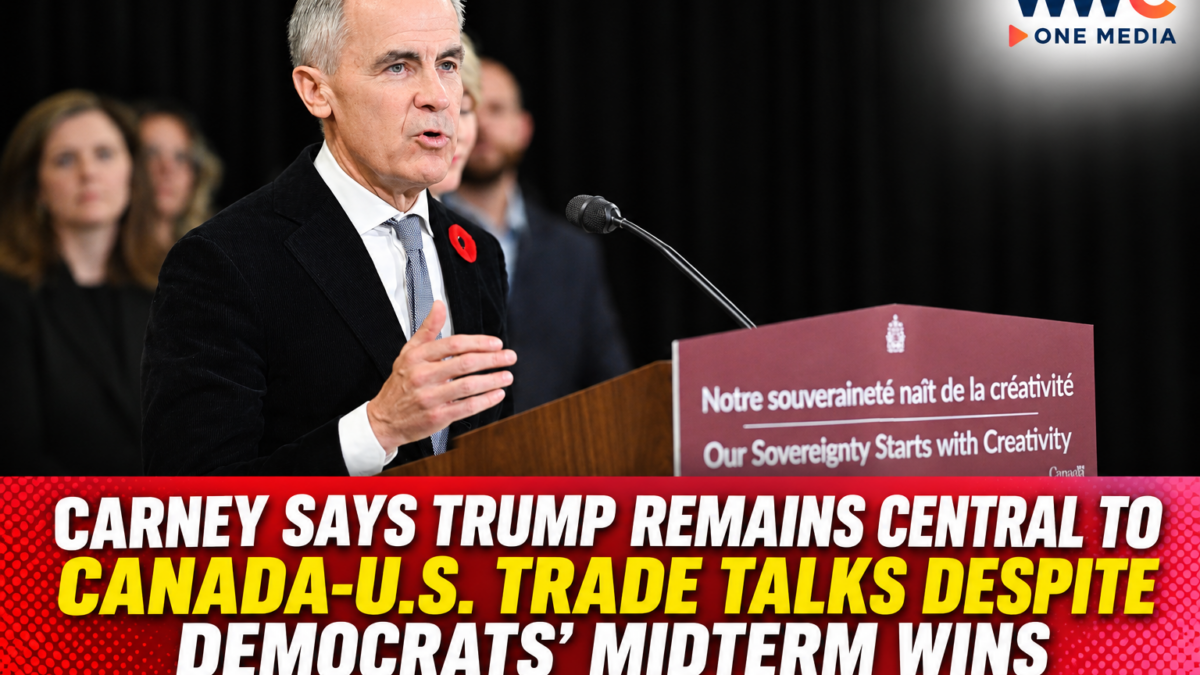
Carney Says Trump Still Holds the Key to Canada’s Trade Future Despite Democratic Midterm Victory — But Will Ottawa Accept His Deal?
TORONTO, Canada — Canadian Prime Minister Mark Carney is making one thing clear: even after Democrats secured sweeping victories in the United States midterm elections, Canada cannot afford to ignore President Donald Trump when negotiating the future of its trade relationship with Washington.
Carney said Tuesday, November 10, that the Trump administration will remain the central decision-maker on U.S. trade agreements over the next several years. His comments signal that Ottawa intends to continue negotiating directly with the White House rather than rely on the incoming Democratic-controlled Congress to reverse Trump’s tariffs.
The position comes at a critical moment for both countries.
Democrats are preparing to challenge Trump’s trade policies after winning control of Congress in the November 3 midterm elections. Their proposed efforts include repealing tariffs on Canadian products, a move that could ease pressure on businesses and consumers on both sides of the border.
But Carney is not treating that political shift as a substitute for a negotiated agreement.
“What is clear is that the people who decide on trade agreements are the executive in the United States over the next two or three years,” Carney told reporters in Montreal.
He added that the president, the executive branch and Americans—not necessarily legislators—will remain central to decisions on trade.
The message exposes Canada’s difficult position: Washington is still imposing costly trade measures, Congress may eventually challenge them, and Ottawa must decide whether to secure partial relief now or wait for a broader restoration of free trade.
Why Carney is still looking to Trump after the Democratic victory
Carney’s remarks came in response to plans by Quebec officials to contact American decision-makers, including governors and senators, as the province seeks to advance its economic interests.
But the Canadian prime minister emphasized the importance of having a single national negotiating position.
“In a negotiation, it’s always a good idea to have one negotiator. And that is the government’s responsibility,” he said.
The comment reflects Ottawa’s preference for managing trade discussions through the federal government rather than allowing individual provinces to pursue separate arrangements with Washington.
It also signals that Carney wants to avoid creating competing diplomatic channels while the two countries attempt to resolve their trade dispute.
The prime minister said he had spoken with Trump over the weekend and that the two leaders communicate regularly.
Although another face-to-face meeting could be useful, Carney indicated that it was not essential to making progress.
The larger priority is reaching an agreement that protects Canadian economic interests while addressing Washington’s demands.
Democrats want to repeal Trump’s Canada tariffs
The Democratic victory has created a new political opportunity for Canada.
Democrats have identified Trump’s tariffs on Canadian goods as an early target when they assume control of Congress in January 2027.
Sen. Ron Wyden, a leading Democrat on the Senate Finance Committee, has said he is already discussing legislation with colleagues aimed at reversing the tariffs.
Senate Democratic leader Chuck Schumer also introduced legislation in September intended to repeal Trump’s tariffs, including duties affecting Canadian products.
The effort has attracted attention because the trade dispute has become politically sensitive in American states with close economic ties to Canada.
Michigan and Maine are among the states where businesses and workers have raised concerns about the effects of higher import costs.
Some Republicans have also expressed support for easing the trade restrictions.
According to reporting by The Wall Street Journal, Wyden sees an opportunity to build support for reversing the tariffs, including among Republicans who oppose the trade war.
However, a Democratic-controlled Congress does not automatically mean the tariffs will disappear.
Trump retains broad authority over U.S. trade policy and could veto legislation seeking to repeal his measures. Democrats would need substantial Republican support to override that veto.
That makes the congressional route uncertain, even as the political pressure against the tariffs grows.
Canada’s difficult choice: accept partial relief or wait for free trade?
The central dilemma for Ottawa is becoming increasingly difficult.
Canada could accept an agreement that reduces some of Trump’s tariffs while leaving other restrictions in place.
Alternatively, it could hold out for a more comprehensive arrangement that restores freer trade between the neighboring countries.
Carney has not announced a change in Canada’s negotiating position following the American election.
His comments suggest that Ottawa wants to keep negotiations moving while avoiding an agreement that sacrifices important Canadian interests.
On November 6, Carney welcomed Democratic efforts to restore free trade, saying that eliminating the tariffs would benefit American families struggling with affordability and workers seeking stable, well-paying jobs.
But he also made clear that Canada would continue working directly with the U.S. administration.
The competing approaches leave Canada balancing two possibilities: a negotiated agreement with Trump or a future congressional effort to roll back the restrictions.
Neither path guarantees a complete solution.
How the trade war reached this point
The latest diplomatic developments follow months of tension between Washington and Ottawa.
Canada suspended trade negotiations in August after rejecting American demands that Carney described as unacceptable.
The disagreements involved Canadian sovereignty, French-language protections, cultural programming and Canada’s ability to negotiate independent trade agreements with other countries.
Trump subsequently imposed 50% tariffs on billions of dollars of Canadian goods, prompting retaliatory measures from Ottawa.
The dispute has affected important industries and increased uncertainty for companies that rely on cross-border manufacturing and supply chains.
Carney recently said Washington had moved away from some of the demands that helped derail the earlier negotiations.
However, he acknowledged that difficult issues remain.
Neither country has announced a comprehensive final agreement eliminating the disputed tariffs.
Steel and automobiles remain major obstacles
One of the most important areas of negotiation involves Canadian steel and automobile production.
A Reuters report published October 26 said American and Canadian officials were working on a possible agreement to ease tariffs on Canadian steel and automobiles.
The negotiations reportedly focused on measures imposed under Section 232 of U.S. trade law, including tariffs of up to 50% on Canadian steel and 25% on automobiles.
Reuters cited two U.S. and four Canadian sources familiar with the discussions.
The report also said the Trump administration wanted additional concessions from Canada, suggesting that a narrower agreement might be more achievable than a comprehensive trade settlement.
The auto industry is particularly vulnerable because Canadian and American factories are closely connected.
Vehicles and components frequently cross the border during production. Tariffs can therefore increase costs for manufacturers operating in both countries.
Trump has also threatened to increase tariffs on Canadian steel and automobile imports to 50% beginning January 1, 2027.
That prospect has added pressure on Canadian automakers and suppliers already dealing with uncertainty over future production.
For additional context, read WWC One Media’s report on Toyota and Honda facing another tariff shock as Trump targets Canadian auto imports.
Stellantis’ decision to move Jeep production adds pressure
The dispute is not limited to tariff negotiations.
Carney also criticized automaker Stellantis after the company shifted planned Jeep Compass production to Illinois and agreed to sell its idled Brampton, Ontario, plant to armored vehicle manufacturer Roshel.
The decision has become another sensitive issue in Canada’s efforts to protect domestic manufacturing jobs.
Trump has repeatedly pushed automakers to move production into the United States, arguing that domestic manufacturing should benefit American workers.
Carney’s criticism reflects concern that the trade dispute could accelerate changes in North American manufacturing, potentially weakening Canada’s industrial base.
The automobile sector is particularly important because factories, suppliers and workers on both sides of the border have spent decades operating as part of an integrated production network.
A prolonged trade conflict could make companies reconsider where they build vehicles and source components.
That could affect employment, investment and the competitiveness of the broader North American auto industry.
Canada is looking beyond the United States
The dispute has also strengthened Canada’s interest in diversifying its international economic relationships.
For decades, the United States has been Canada’s largest trading partner, making the two economies deeply interconnected.
But Trump’s tariffs and repeated threats involving Canadian sovereignty have encouraged Ottawa to seek additional markets.
Carney has promoted the goal of doubling Canadian exports to markets outside the United States over the next decade.
Canada has also pursued closer economic and diplomatic relationships with Europe and Asia.
At the upcoming Asia-Pacific Economic Cooperation summit in Shenzhen, Carney is scheduled to meet Chinese President Xi Jinping.
The Canadian prime minister has argued that Canada’s economic relationship with China carries fewer security risks than the broader U.S.-China relationship.
That position highlights a difficult balancing act: Canada wants to maintain its economic relationship with Washington while expanding its options elsewhere.
The strategy does not necessarily mean abandoning American markets.
Instead, Ottawa is seeking to reduce its dependence on a single trading partner whose policies can change sharply under political pressure.
WWC One Media previously examined the broader consequences of the dispute in its report, The Great Lakes Built a $376 Billion Trade Lifeline — Trump’s Tariffs Are Now Putting It Under Pressure.
The report explores how the integrated manufacturing and transportation system connecting Canada and the United States could be affected by prolonged trade restrictions.
Why the outcome matters to American families and businesses
The Canada-U.S. trade relationship is important far beyond the governments negotiating the agreement.
Manufacturers, retailers, farmers, transportation companies and consumers all depend on the movement of goods across the border.
Tariffs can increase the cost of imported materials and finished products. Businesses may absorb those costs, reduce investment or pass some of the additional expense on to customers.
Carney has repeatedly argued that the trade restrictions hurt American families as well as Canadian companies.
His November 6 remarks emphasized that restoring free trade would help American consumers facing affordability pressures and support workers seeking stable employment.
The dispute also creates uncertainty for companies deciding where to build factories, purchase materials and expand operations.
That uncertainty is especially difficult for industries that depend on long-term investment and cross-border supply chains.
For a manufacturer, a tariff announced today can affect decisions about factory locations and supplier contracts years into the future.
The longer the uncertainty continues, the harder it becomes for businesses to plan confidently.
What happens next in the Canada-U.S. trade negotiations?
Carney’s latest comments suggest that Canada will continue to treat the Trump administration as its main negotiating counterpart, even as Democrats prepare to challenge the tariffs in Congress.
The two governments have made some progress since negotiations collapsed in August, particularly over issues involving Canadian culture and French-language protections.
But the most difficult questions remain unresolved.
Canada wants a deal that protects its sovereignty, manufacturing industries and ability to pursue independent international trade relationships.
Trump wants concessions that advance his administration’s trade and manufacturing priorities.
Meanwhile, Democrats are preparing to use their incoming congressional majority to challenge the tariffs, although their ability to force a reversal remains uncertain.
The next stage of negotiations could determine whether the two countries reach a limited agreement covering key industries or remain locked in a wider trade dispute.
For now, Carney is refusing to bet Canada’s economic future entirely on what the new Congress might do.
The prime minister appears to recognize that the White House still has the power to shape the immediate direction of the relationship.
And that leaves Canada facing a difficult question: should it accept a compromise with Trump while negotiations remain possible, or hold out for a future Congress that may not be able to override the president?
The answer could shape the future of North American manufacturing, trade and economic cooperation for years to come.