
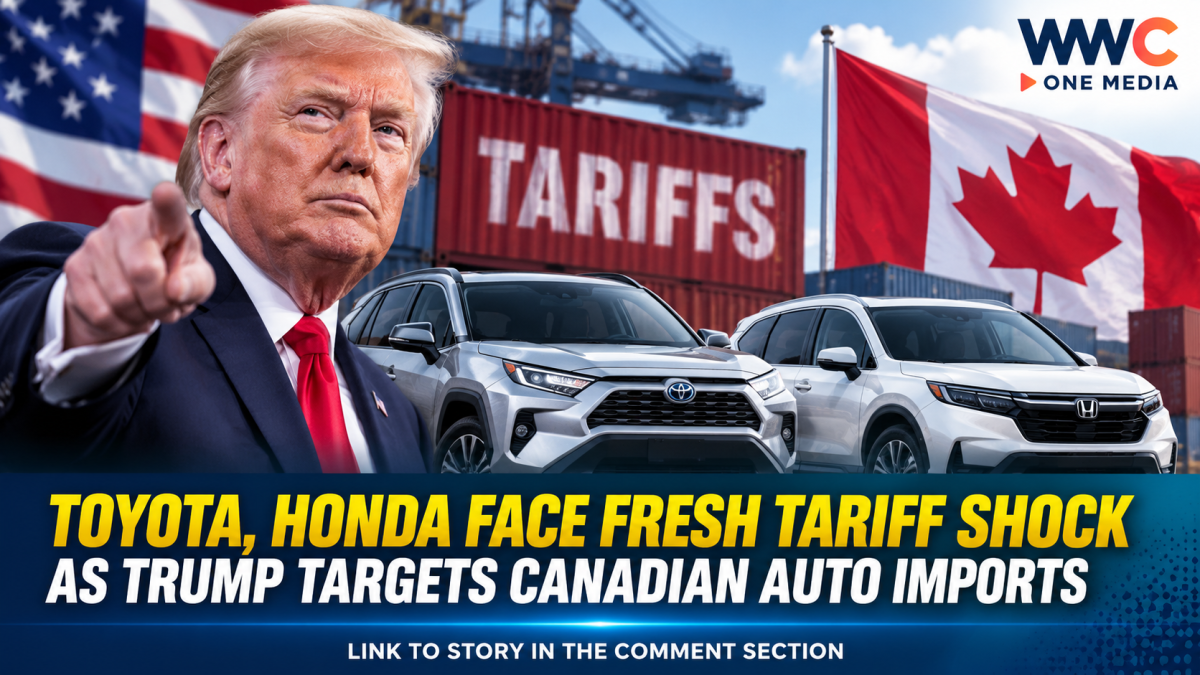
A new trade threat from Washington is putting Toyota and Honda in an increasingly difficult position, with analysts warning that proposed U.S. tariffs on vehicles imported from Canada could force major changes to their North American manufacturing strategies.
U.S. President Donald Trump has proposed a 50% tariff on Canadian vehicle imports, potentially doubling the current 25% levy. The measure, if implemented as proposed on January 1, 2027, could hit Toyota and Honda particularly hard because the two Japanese automakers account for more than three-quarters of Canada’s vehicle production.
Why Toyota and Honda are especially exposed
The problem is not simply the size of the proposed tariff. It is where Toyota and Honda manufacture vehicles destined for the U.S. market.
According to Barclays analysts cited by Reuters, Canadian-built vehicles represented almost one-quarter of Honda’s U.S. sales and about 17% of Toyota’s U.S. sales in 2025 — the highest exposure among major automakers.
That makes the proposed tariff particularly painful for two companies whose North American supply chains were designed around decades of relatively seamless cross-border manufacturing.
Toyota ships Canadian-built vehicles including the RAV4 into the United States, while Honda exports Canadian-built CR-V models. Both are major sellers in the U.S. SUV market.
If the tariff takes effect, analysts say Toyota and Honda could be forced to reduce or temporarily shut some Canadian assembly operations rather than absorb the additional cost.
The bigger problem: reshaping the supply chain
The immediate question is who ultimately pays the tariff.
Importers technically face the duty, but the economic burden can be distributed among automakers, suppliers, dealers and consumers through higher costs, reduced margins or higher vehicle prices.
Toyota and Honda could also attempt to redirect Canadian-built vehicles to other markets while increasing production elsewhere for U.S. customers.
That strategy, however, is far from simple.
Factories in the United States, Mexico and other markets may already be operating near capacity. Vehicles designed specifically for American regulations and consumer preferences also cannot necessarily be redirected or replaced overnight.
Seiji Sugiura, a senior analyst at Tokai Tokyo Intelligence Laboratory, described the potential changes as a major shift from the way North America’s auto industry has traditionally operated.
Canada’s auto industry is also in the firing line
The consequences extend well beyond Toyota and Honda.
Canada produces roughly 1.2 million vehicles annually, while its automotive sector indirectly supports approximately 427,000 jobs, according to Reuters.
The industry’s business model has been built around highly integrated North American supply chains, with vehicles and components crossing the U.S.-Canada-Mexico borders during the manufacturing process.
That system is now facing increasing uncertainty as Washington and Ottawa struggle over trade policy.
Reuters reported that Canada’s exports to the United States weakened in July, with U.S.-bound exports falling 6.6% during the month. The figures underscore how important the American market remains to Canada’s broader economy.
Toyota is already shifting toward U.S. production
Toyota has been preparing for a more protectionist U.S. trade environment.
The company has previously announced plans to invest up to $10 billion in expanding its U.S. operations, including a planned $3.6 billion plant in Texas. The automaker also intends to shift production of the Tacoma pickup from its Mexican operation to the United States.
The strategy could eventually give Toyota more flexibility if tariffs continue reshaping North American production.
But moving capacity is expensive, takes years and cannot instantly replace vehicles currently produced in Canada.
Honda faces another strategic dilemma
Honda is dealing with an additional problem: uncertainty over future North American investment.
A senior Honda executive has indicated that the company could reconsider plans for an eighth North American assembly plant if negotiations surrounding the United States-Mexico-Canada Agreement remain unresolved.
That uncertainty comes at a difficult time for Japanese automakers, which are already dealing with increasingly aggressive competition from lower-cost Chinese electric-vehicle manufacturers in markets across Southeast Asia, Europe and Latin America.
The U.S. remains particularly important because Chinese EV brands such as BYD do not currently have the same access to the American passenger-vehicle market.
The tariff threat comes with a major caveat
The proposed 50% Canadian auto tariff is not necessarily the final outcome.
Trade negotiations between Washington and Ottawa remain fluid, and analysts have repeatedly noted that an agreement could still prevent or alter the proposed measures.
The uncertainty itself, however, is already becoming a business problem.
Canada’s Prime Minister Mark Carney said this week that the United States had failed to provide assurances over future tariff levels, including duties affecting automobiles, steel and aluminum. The breakdown has raised concerns that the trade dispute could escalate further.
Meanwhile, the legal basis for some of the administration’s newer Canadian tariffs is also facing scrutiny. The Associated Press reported that the administration invoked Section 338 of the Tariff Act of 1930 for a 50% tariff covering about $20 billion of Canadian imports, a move legal experts say raises unresolved questions.
What happens next could determine the future of North American auto manufacturing
For Toyota and Honda, the issue is no longer simply about paying a higher import duty.
The companies may have to decide whether to absorb higher costs, raise prices, move production, redirect exports or reduce Canadian output.
For Canada, the stakes are even broader: the country risks seeing investment and production decisions increasingly shift toward the United States if tariff uncertainty persists.
And for American consumers, the eventual question may be much simpler:
Will the next tariff battle show up on the price tag of the next RAV4 or CR-V?
That answer could depend less on Toyota or Honda — and more on what Washington and Ottawa decide before the proposed January 1, 2027 deadline.




Leave a Reply