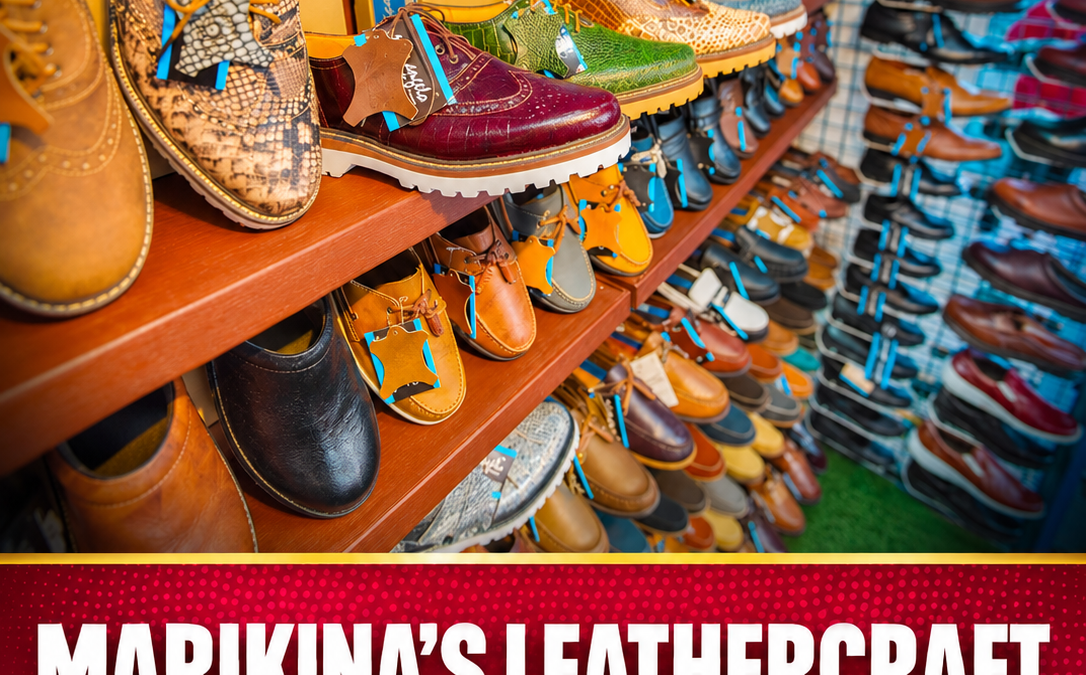
MARIKINA CITY, Philippines — Marikina’s footwear industry is gaining support from government-backed research and a technology business incubator designed to develop shoes and other leathercraft products, placing the city’s traditional manufacturing base within a broader effort to strengthen local creative enterprises.
The challenge is no longer limited to maintaining the city’s reputation for shoemaking. The industry must also develop products, production capabilities and business networks that can help manufacturers compete in a market extending beyond traditional footwear.
Government records show that this expansion is already being approached through several channels, including research involving local producers, startup support and a national footwear industry roadmap. These initiatives offer a more concrete picture of the work required to turn Marikina’s craftsmanship into a wider commercial opportunity.
Marikina’s footwear industry has a documented manufacturing base
The Philippine Footwear Industry Roadmap 2022–2037, prepared for the Department of Trade and Industry, identifies Marikina as a major centre of the country’s footwear manufacturing activity.
The roadmap traces the city’s shoemaking history to 1887, when community leader Laureano Guevarra, known as Kapitan Moy, introduced footwear production as an alternative livelihood for residents. It describes how the craft developed into an important source of income and local economic activity.
The document’s industry survey, based on information gathered in October and November 2021, counted approximately 295 footwear enterprises nationwide. Of these, 177 were in the National Capital Region, with the majority located in Marikina.
The survey classified 91.9% of the country’s footwear enterprises as micro businesses, 4.4% as small, 1.4% as medium and 2.1% as large. These figures illustrate the importance of smaller producers in the national footwear industry, although they should not be mistaken for a current 2026 count.
The roadmap also sets out a development strategy built around enterprise growth, access to markets, technology upgrading, workforce development and stronger supply-chain connections. Its long-term direction is to build a more competitive footwear industry with stronger domestic and international market links.
Research is examining how local producers operate
The industry’s development also depends on understanding the actual conditions faced by manufacturers, from larger factories to smaller workshops.
The Philippine Institute for Development Studies conducted key informant interviews with local footwear producers in Marikina on April 27, 2026, through its Creative Research, Analytics, and Policy Studies Project under the Creative Goods Cluster.
The research engagement included both a large-scale manufacturer and a backyard-style enterprise. PIDS said the work was intended to capture information about production dynamics, market conditions and operational challenges in the footwear sector.
The involvement of the Marikina Local Economic Development and Investment Promotions Office and the Marikina Shoe Industry Development Office in coordinating the engagement also shows that the research connected national policy work with local industry institutions.
This matters because a strategy designed for a large manufacturer may not be practical for a small workshop. Smaller producers may have different requirements for equipment, working capital, product development, marketing and access to buyers.
A wider leathercraft programme will need to account for these differences rather than assume that every manufacturer can expand at the same pace.
The experience of other traditional shoemaking communities also offers useful context. WWC ONE MEDIA previously examined the pressures facing Carcar’s shoemaking industry and the efforts to preserve its craft. The comparison highlights why maintaining craftsmanship requires more than protecting a city’s historical reputation: producers also need viable businesses and opportunities for the next generation.
DOST-backed incubator supports shoes and other leathercrafts
One of the clearest examples of a practical development programme is the Reinnovate Shoes and Other Leathercrafts for Entrepreneurship Start-ups Technology Business Incubator, or ReSOLES, established by Marikina Polytechnic College.
The Department of Science and Technology’s Philippine Council for Industry, Energy and Emerging Technology Research and Development reported that the centre was launched in January 2025. Its programme focuses on innovation in footwear and other leathercrafts, with support for product development, intellectual property protection, training, business growth and startup incubation.
DOST-PCIEERD said the centre received ₱12 million in funding for two years.
The programme is significant because it extends support beyond the production of finished shoes. Product development and intellectual property protection, for example, can help entrepreneurs work on designs and products that have a distinct identity. Training and startup incubation can also help new businesses move from an initial product concept towards a more organised enterprise.
DOST-PCIEERD’s report cited 91 registered shoemakers in Marikina. That figure provides a snapshot of the city’s manufacturing base in the agency’s published account, but it should not be treated as a complete count of every leathercraft business operating in the city.
Why product development must lead to market access
Developing new leather goods is only one part of building a stronger industry. Manufacturers must also find customers, maintain consistent quality and deliver products at prices that buyers are willing to pay.
The footwear roadmap treats market expansion as one of the industry’s central development objectives. It also identifies technology, investment, suitable manufacturing personnel and supply-chain development as areas requiring attention.
For small producers, these requirements are closely connected. A business may have the skills to create a new bag, wallet or accessory, but scaling production can require reliable material suppliers, equipment, trained workers and enough working capital to fulfil larger orders.
Market access also involves understanding what buyers expect. Product design, durability, branding, packaging and delivery arrangements can all influence whether a locally made product secures repeat purchases.
The wider challenge of preparing smaller businesses for regional competition is explored in WWC ONE MEDIA’s report on Bulacan businesses working towards ASEAN market readiness. While the products and industries differ, the underlying business lesson applies: being able to make a product is not the same as being ready to supply a larger market.
Local craftsmanship needs stronger business connections
The national footwear roadmap also places importance on cooperation between manufacturers, government and other industry stakeholders. This is particularly relevant to Marikina because the city has a concentration of footwear producers, while smaller businesses may need access to services and networks beyond their individual operations.
A manufacturer seeking to expand into leather accessories, for example, may need new suppliers, design support or a distribution partner. Collaboration can help businesses access capabilities that would be expensive to establish independently.
The same principle applies to participation in wider production networks. WWC ONE MEDIA’s examination of shifting ASEAN supply chains and the opportunities for Philippine firms discusses why companies need dependable production capacity, skilled workers and supplier relationships to compete for business beyond their home markets.
For Marikina’s leathercraft producers, international exposure may be an opportunity, but it should follow the development of reliable products and operations. Interest from potential buyers cannot substitute for consistent production and the ability to meet orders.
What happens next
The next measure of progress will be whether research, training and incubation support translate into stronger businesses and commercially successful products.
Important indicators include new products reaching the market, participating startups continuing operations, manufacturers improving production capabilities, and local enterprises securing repeat orders from domestic or overseas buyers.
The city’s footwear history provides a foundation, but a broader leathercraft industry will require sustained investment in skills, product innovation and market development.
The opportunity is to build on Marikina’s existing manufacturing knowledge while creating room for other leather products and new enterprises. Whether that becomes a lasting expansion will depend on the commercial results achieved by the businesses behind the craft.
FAQ
Why is Marikina known for footwear manufacturing?
Marikina has a long history of shoemaking dating to 1887. A footwear industry roadmap prepared for the Department of Trade and Industry identifies the city as the location of most footwear enterprises in the National Capital Region.
What is the ReSOLES Technology Business Incubator?
ReSOLES is a Marikina Polytechnic College programme supporting startups in shoes and other leathercrafts. Its activities include product development, intellectual property protection, training and business incubation.
How much funding did ReSOLES receive?
DOST-PCIEERD reported that the incubator received ₱12 million in funding for two years.
What did PIDS study in Marikina?
PIDS conducted key informant interviews with a large-scale footwear manufacturer and a backyard-style enterprise on April 27, 2026, to gather information about production, market conditions and operational challenges.
What could help Marikina leather goods reach wider markets?
Product innovation, consistent quality, skilled workers, reliable suppliers, business financing, branding and stronger distribution networks can help local manufacturers compete for wider markets.