
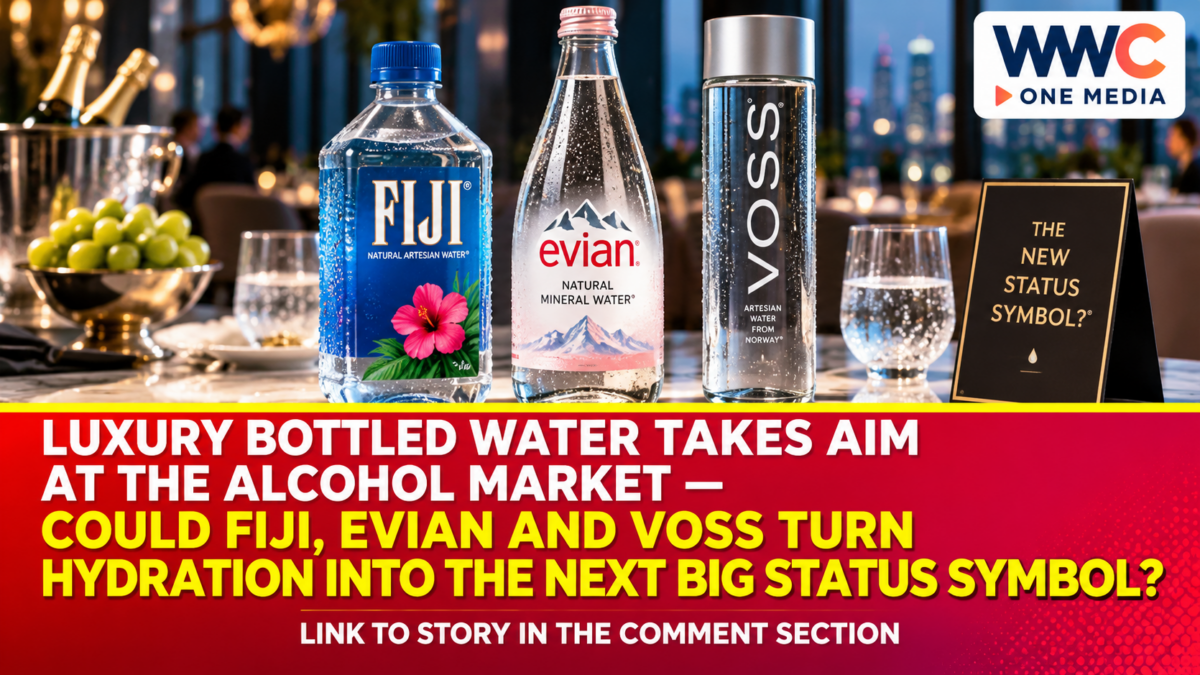
Luxury bottled water could be positioned to capture a greater share of consumer spending as changing drinking habits create new opportunities for premium nonalcoholic beverages.
With American alcohol consumption remaining at its lowest recorded level in decades, established brands such as FIJI Water, Evian and VOSS face an opportunity to strengthen their presence in restaurants, luxury hotels and lifestyle-oriented retail markets.
The commercial potential extends beyond selling drinking water. It involves transforming an everyday necessity into a product associated with personal preferences, distinctive presentation and premium hospitality.
But can bottled water become a meaningful competitor to wine and spirits in high-end dining and social occasions?
Luxury bottled water meets changing drinking habits
In 2026, just 54% of American adults reported consuming alcohol, matching the historical low recorded in 2025.
The proportion stood at 62% in 2023 before declining to 58% in 2024.
Additionally, 17% of Americans reported substituting nonalcoholic beverages for alcohol.
These figures suggest a potential opportunity for businesses offering alternatives to traditional alcoholic drinks.
However, nonalcoholic beverages encompass numerous product categories, including sparkling water, juices, alcohol-free beer and other refreshments.
The changing drinking habits do not independently establish that consumers are redirecting their spending specifically towards expensive bottled water.
For premium water producers, the challenge is converting this broader consumer shift into measurable demand for their products.
Traditional beverage companies face a related challenge in maintaining their relevance across different consumption occasions, as previously explored in WWC ONE MEDIA’s coverage of Tanduay’s holiday marketing strategy and changing consumer spending priorities.
FIJI, Evian and VOSS compete through distinctive brand identities
The premium bottled water industry offers an interesting example of how businesses differentiate products that serve the same fundamental purpose.
FIJI Water emphasises its geographical origins and natural artesian source in the South Pacific. Its water passes through volcanic formations before accumulating in an underground aquifer.
The brand incorporates this origin story into its commercial identity.
Evian, part of French food and beverage group Danone, similarly distinguishes its products through their natural source and mineral composition.
Its US product information identifies a total dissolved solids concentration of 345 milligrams per litre.
VOSS takes another approach by combining Norwegian water sourcing with distinctive bottle design.
Its original glass collection includes still and sparkling water, with the still-water range available in 375ml and 800ml formats.
These characteristics provide consumers with different reasons to select one product over another.
However, differences in mineral composition, packaging and geographical origin should not automatically be interpreted as evidence that an expensive bottled water offers superior health benefits.
The commercial proposition is as much about brand positioning and consumer experience as it is about hydration.
Danone’s €1.37 billion water business reveals the commercial opportunity
Financial disclosures from Danone provide a broader perspective on the scale of the packaged water industry.
The company reported €1.37 billion in third-quarter 2026 sales from its Waters division, representing like-for-like growth of 3.6%.
Sales performance varied significantly across geographical markets.
The Americas generated €278 million in water sales, with like-for-like growth of 11.7%.
Europe, the Middle East and Africa generated €681 million, growing 8.4%.
Asia-Pacific generated €411 million, although like-for-like sales declined by 7.5%.
Danone highlighted Evian’s solid performance in North America while identifying difficulties involving its Mizone brand in Asia-Pacific.
The contrasting regional results demonstrate that growth in one market does not guarantee similar performance elsewhere.
Importantly, the reported figures encompass Danone’s entire Waters division. They must not be interpreted as Evian’s individual revenue or the total value of the luxury bottled water market.
The broader competition for beverage consumers has also been explored in WWC ONE MEDIA’s reporting on Coca-Cola’s efforts to strengthen consumer relationships and maintain brand relevance.
Fine dining explores water as a premium experience
One potential growth opportunity for luxury bottled water lies in hospitality.
FineWaters, a business specialising in premium water experiences, has collaborated on a five-course food-and-water pairing dinner at Pelagos restaurant at the Four Seasons.
The dining experience was organised without alcoholic beverages, placing different waters alongside individual food courses.
The concept illustrates how restaurants could offer additional options to diners who prefer not to consume alcohol.
Instead of treating water solely as a complimentary accompaniment, establishments could develop dedicated menus featuring different origins, mineral profiles and levels of carbonation.
Such offerings may provide an additional source of beverage revenue.
However, their commercial success will depend on customers’ willingness to pay, supplier costs, service requirements and repeat demand.
The wider importance of differentiated hospitality experiences has been examined in WWC ONE MEDIA’s coverage of speciality fine-dining menus and culinary innovation at Mott 32 Cebu.
For premium restaurants, a carefully designed water selection could complement existing culinary experiences without requiring diners to order alcoholic beverages.
Why luxury hotels could become an important battleground
Premium hospitality provides another potential distribution channel for bottled water companies.
Luxury hotels can incorporate beverage products into restaurants, guest rooms, wellness facilities, corporate events and private dining experiences.
For water producers, these arrangements could offer greater visibility among customers already purchasing premium services.
For hotel operators, the potential benefit lies in developing distinctive experiences that differentiate their properties from competitors.
WWC ONE MEDIA previously examined this approach to market segmentation through its coverage of NUSTAR’s three-brand hospitality strategy spanning luxury and lifestyle hotels.
However, placing an expensive water brand inside a luxury hotel does not independently establish that guests will purchase it repeatedly.
Businesses must evaluate whether premium presentation generates sufficient revenue to justify procurement, storage and service costs.
Is expensive bottled water necessarily better?
The distinction between product quality and premium positioning remains important.
Water can differ in its geographical origin, dissolved minerals, carbonation and packaging.
These characteristics may influence individual preferences and the way a beverage complements food.
But an expensive glass bottle or an internationally recognised brand does not establish that the water provides superior hydration.
Environmental considerations also remain relevant.
Packaging choices, transportation requirements and the management of water sources are important issues for businesses seeking to develop internationally distributed bottled water products.
Evian’s product information identifies its plastic packaging as recyclable PET and also discusses glass recycling.
Nevertheless, recyclable packaging does not guarantee that every discarded bottle will actually be collected and recycled.
Premium water businesses must therefore balance their commercial ambitions with credible environmental practices.
What happens next for the premium water market?
The next test for luxury bottled water producers will be whether they can convert changing consumer preferences into sustained commercial growth.
Restaurants and hotels may provide opportunities to introduce premium water through curated dining experiences, while retail distribution can make products available to consumers outside hospitality settings.
However, businesses must demonstrate that customers are prepared to purchase these products repeatedly rather than simply experiment with them.
The decline in reported American alcohol consumption creates an opportunity, not a guaranteed transfer of spending from wine and spirits to premium water.
For FIJI Water, Evian, VOSS and other participants in the beverage industry, the strategic challenge is to offer a differentiated experience without relying on unsupported health claims.
The future of luxury bottled water may ultimately depend on whether consumers consider it an occasional indulgence, a regular lifestyle purchase or simply an expensive version of an everyday necessity.
Frequently Asked Questions
What is luxury bottled water?
Luxury bottled water is a premium-positioned beverage category distinguished through geographical origin, mineral characteristics, packaging, branding and customer experience.
Why are premium water brands interested in alcohol-free consumers?
Changing drinking habits may create opportunities for premium nonalcoholic beverages. In 2026, 54% of American adults reported drinking alcohol, while 17% reported substituting nonalcoholic beverages for alcohol.
What makes FIJI Water, Evian and VOSS different?
The brands differentiate themselves through water sourcing, mineral characteristics and packaging. FIJI emphasises its artesian source, Evian its natural origin and mineral composition, and VOSS its Norwegian sourcing and distinctive bottle design.
Is luxury bottled water healthier than ordinary drinking water?
A higher price does not establish superior health benefits. Drinking water should be evaluated based on safety, composition and individual requirements rather than branding alone.
How large is Danone’s water business?
Danone reported €1.37 billion in Waters division sales during the third quarter of 2026, representing like-for-like growth of 3.6%. This includes its wider water portfolio, not Evian alone.










