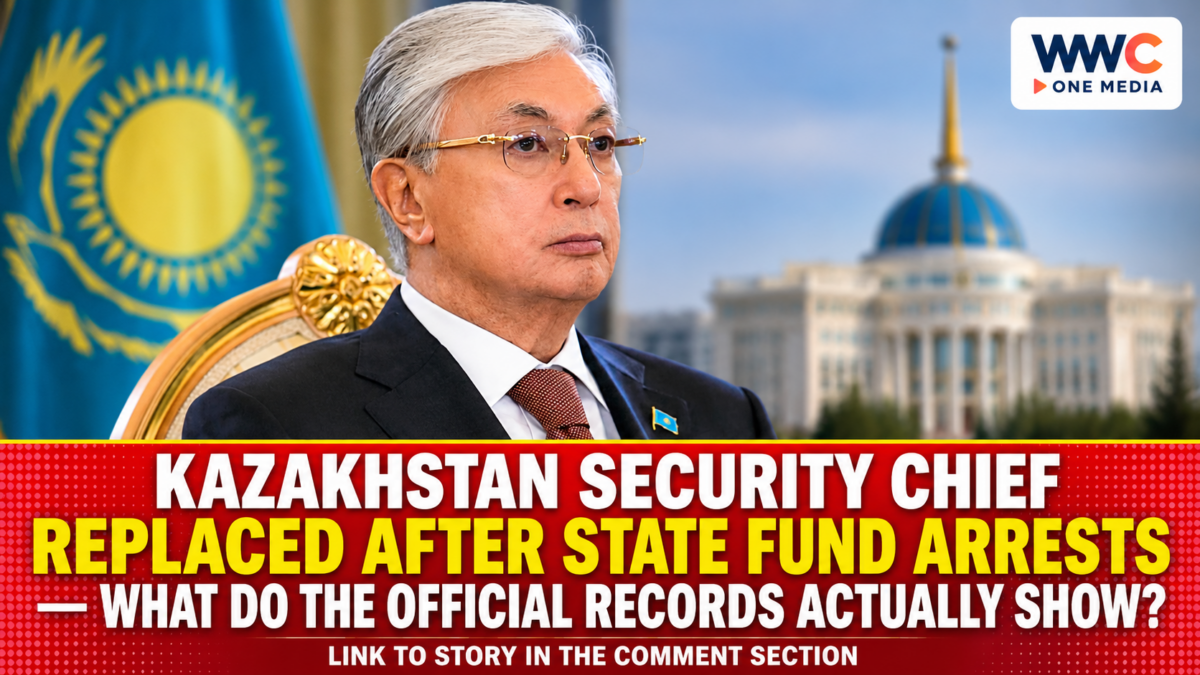
Kazakhstan has changed the leadership of its National Security Committee, with President Kassym-Jomart Tokayev appointing Marat Irmenov as its new chairman on Nov. 16, 2026. The appointment came days after the agency announced the detention of senior executives from the country’s sovereign wealth fund and national railway company in a corruption investigation.
The timing places the security leadership change alongside one of Kazakhstan’s most prominent recent investigations involving state-linked businesses. But the published presidential documents do not say the two developments are directly connected.
The distinction matters. The leadership change is official, the arrests are confirmed by the security agency, and the investigation remains ongoing. No public record examined for this report establishes that the former security chief was removed because of the arrests.
Kazakhstan’s Security Leadership Changes on Nov. 16
Two presidential legal notices dated Nov. 16 record the change at the top of the National Security Committee, commonly known by its Russian-language initials, KNB.
One notice states that Yermek Sagimbayev was relieved of his position as chairman. A separate presidential decree appoints Marat Gataullovich Irmenov as chairman of the committee.
The appointment decree is numbered 1566 and is dated Nov. 16, 2026. It also states that Irmenov is being released from his previously held position.
The documents establish the personnel change, but do not provide a reason for Sagimbayev’s departure. They also do not state that the change was ordered in response to the arrests announced the previous week.
That limit is important when interpreting a politically significant appointment. A sequence of events can be relevant without proving that one caused the other.
The Investigation Involves Two Major State-Linked Companies
Kazakhstan’s National Security Committee announced on Nov. 12 that its Anti-Corruption Service had detained the chairmen of the management boards of Samruk-Kazyna JSC and Kazakhstan Temir Zholy JSC.
The agency identified the executives by their surnames and initials: N. Zhakupov and E. Otynsheyev. It said they and other individuals were suspected of committing a corruption-related crime.
The announcement said investigative actions were under way to establish the circumstances of the case. It also said further information about the pretrial investigation could not be disclosed under Article 201 of Kazakhstan’s Criminal Procedure Code.
The public statement did not describe the alleged conduct, identify the other detained individuals, specify the evidence, or announce a court finding of guilt.
Those details should not be filled in through assumptions. Detention on suspicion of an offence is not a conviction, and the agency’s statement does not establish the guilt of the individuals named.
Tokayev Addresses the Case and Calls It a Serious Signal
On Nov. 13, Tokayev issued a statement during an operational meeting of the Security Council.
He described the reported detentions involving Samruk-Kazyna and Kazakhstan Temir Zholy as a serious signal of corruption within state companies. He also said the investigation had only begun and that investigative details could not be disclosed under the law.
The president highlighted the strategic role of Samruk-Kazyna, saying the fund manages national strategic assets, carries out large investment projects and works with major foreign companies and international financial institutions.
He also said the work of the fund’s administration and state companies, including Kazakhstan Temir Zholy, had not stopped. In his statement, he said their operations continued without interruption.
For investors and business partners, that assurance is relevant because the investigation concerns senior figures at institutions involved in major state-linked economic activities. However, the statement is not a substitute for company financial disclosures or independent evidence about the investigation’s effect on individual projects.
The broader debate about the governance of state-backed investment institutions is also relevant to other markets. WWC has examined the governance and funding questions surrounding Taiwan’s proposed sovereign wealth fund, where oversight and accountability are central to the design of a new public investment vehicle.
Why the Leadership Change Matters
The National Security Committee is a major state institution, and its chairman’s replacement is therefore more than a routine corporate management change.
The timing is notable because the agency’s Anti-Corruption Service announced the arrests, while the president publicly addressed the case and subsequently appointed a new committee chairman.
But the public documents do not establish that Sagimbayev was implicated in the investigation, that he was accused of wrongdoing, or that the arrests prompted his removal.
There is also no basis in the records examined to claim that the new chairman has been appointed to take over a particular investigation or to deliver a predetermined outcome.
The more defensible interpretation is that Kazakhstan is undergoing a significant security leadership transition while a sensitive investigation involving major state-linked companies remains active.
The issue also has a wider corporate-governance dimension. State-owned or state-controlled enterprises can operate across sectors that are important to national infrastructure and investment. Their management, accountability and disclosure practices can affect confidence among lenders, partners and investors.
WWC’s coverage of corporate ownership and restructuring in Japan’s railway sector provides a separate example of why ownership, oversight and management decisions matter in major transport businesses. The Japanese company is unrelated to Kazakhstan’s investigation.
What Happens Next?
The immediate questions concern the progress of the pretrial investigation and the practical transition at the National Security Committee.
The security agency has said investigative actions are continuing. Its announcement does not provide a timetable for further disclosures, and the restrictions it cited mean that detailed information may remain unavailable while proceedings are under way.
The presidential appointment record confirms Irmenov’s new role. The president’s Nov. 16 meeting with the committee’s leadership also confirms that he was introduced as the newly appointed chairman and given instructions concerning national security, institutional performance and anti-corruption measures.
Further official statements or court records would be needed to establish whether investigators have filed formal charges, whether a court has ordered additional measures, or whether the investigation has reached any findings.
The distinction between allegations and proven offences must remain clear as the case develops. That principle applies to all individuals involved, regardless of their former or current positions.
Frequently Asked Questions
Who is Kazakhstan’s new security chief?
Marat Gataullovich Irmenov was appointed chairman of Kazakhstan’s National Security Committee on Nov. 16, 2026.
Who was replaced?
Yermek Sagimbayev was relieved of his position as chairman on the same date.
Why were the Samruk-Kazyna and railway executives detained?
Kazakhstan’s National Security Committee said they were suspected of committing a corruption-related crime. It did not publicly disclose the specific alleged conduct or evidence in its announcement.
Has the investigation established that the executives are guilty?
No. The public announcement concerns detentions and an ongoing investigation. It does not report a conviction or final judicial finding.
Did the arrests cause the security chief’s replacement?
The official presidential records confirm the leadership change but do not state that it was caused by the arrests. A direct connection has not been established in the public documents examined.
The central question now is whether the investigation will produce further public findings about governance at Kazakhstan’s major state-linked companies. Until official records provide those details, the leadership change and the corruption probe should be treated as related developments in timing—not as proof of a single cause or outcome.