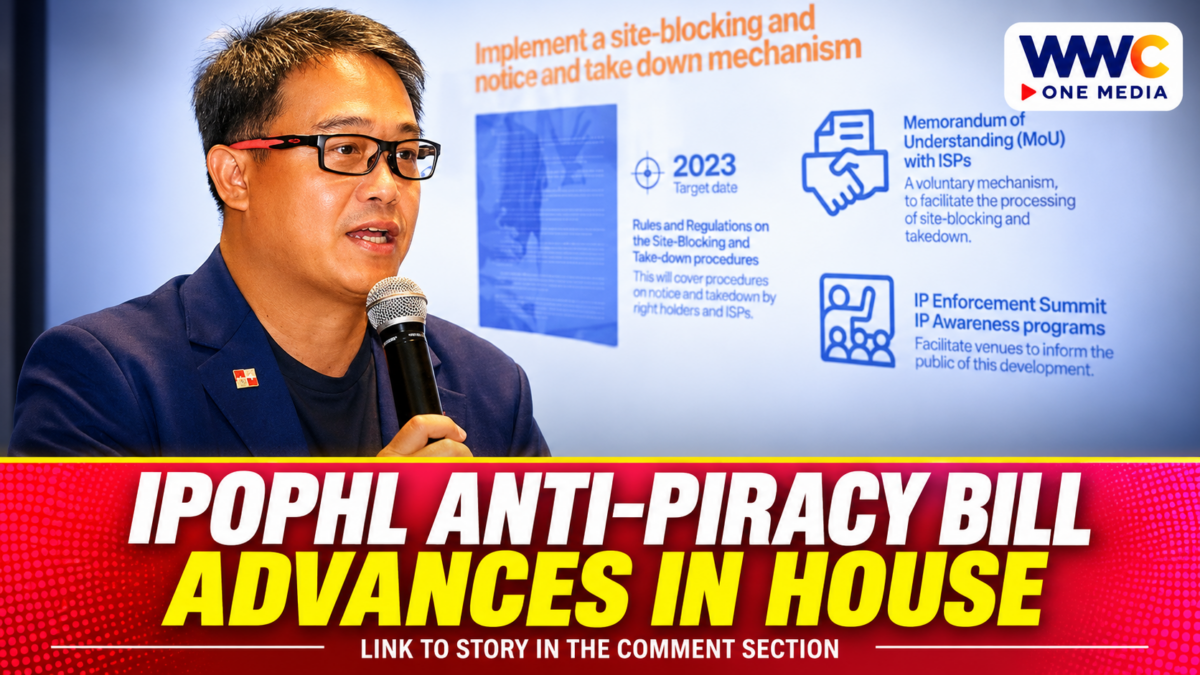
The House of Representatives approved House Bill No. 11616 on second reading on Nov. 11, 2026, advancing a proposal to expand the powers and functions of the Intellectual Property Office of the Philippines (IPOPHL). The measure seeks to amend the Intellectual Property Code, Republic Act No. 8293, and strengthen the government’s framework for protecting intellectual property.
The proposal matters to Filipino creators, publishers, software developers, businesses and consumers because piracy and counterfeiting affect more than entertainment. They also raise questions about lost income, brand protection, online distribution and the balance between enforcement and legitimate access to information.
The important distinction: House approval on second reading does not make the proposal a law. It must still complete the remaining legislative steps before it can take effect.
What HB 11616 could change for intellectual property enforcement
The House legislative record identifies the measure as HB 11616, filed on Oct. 6, 2026. Its principal authors are Representatives Adrian E. Salceda, Maximo Jr. Y. Dalog, Jan “Atty. JP” Padiernos, Rufus B. Rodriguez, Jose Manuel “JM” F. Lagdameo, Jorge Daniel S. Bocobo, Maria Angela S. Garcia and Kenneth T. Gatchalian.
The bill was referred to the House Committee on Trade and Industry and approved on second reading on Nov. 11. House of Representatives Philippines+1
Its stated purpose is to strengthen IPOPHL’s powers and functions by amending the Intellectual Property Code. The precise scope of the amendments should be assessed against the final legislative text, rather than assumed from the bill’s title.
That distinction is important because enforcement powers can affect different types of intellectual property, including copyright, trademarks, patents and industrial designs. Each category involves different rights, procedures and forms of infringement.
The existing law already gives IPOPHL administrative responsibilities. Under Section 5 of RA 8293, the agency examines applications for patents and trademarks, administers intellectual property policies, handles certain contested proceedings and coordinates with government agencies and the private sector.
The proposed legislation seeks to strengthen that existing institutional framework. Whether it will materially change investigations, enforcement procedures or administrative remedies will depend on the final provisions approved by Congress.
The Philippines already has administrative enforcement powers
The current Intellectual Property Code is not without enforcement mechanisms.
Section 10 of RA 8293 gives IPOPHL’s Bureau of Legal Affairs jurisdiction over specified administrative complaints involving intellectual property violations, subject to the statutory requirements.
Following a formal investigation, the agency may impose administrative penalties provided under the law. These include cease-and-desist orders, seizure or condemnation of certain products, administrative fines, cancellation or suspension of permits and registrations, and assessment of damages. Lawphil
Republic Act No. 10372, which amended the Intellectual Property Code in 2013, also strengthened the enforcement role of the IPO Director General.
It authorised enforcement functions supported by agencies such as the Philippine National Police, National Bureau of Investigation, Bureau of Customs, Optical Media Board and local government units. It also provided for visits to establishments and businesses suspected of violating intellectual property laws, based on reports, information or complaints received by the office. Lawphil
This history shows that HB 11616 is part of a continuing effort to update the country’s intellectual property enforcement framework.
The challenge is not simply creating more authority. It is ensuring that enforcement is effective, properly documented and consistent with due process.
Why Filipino creators and digital businesses should pay attention
Intellectual property protection has become increasingly important as more Filipino businesses earn money from digital content, software, music, video production, publishing, design and other creative services.
A creator’s work may be distributed through several platforms and commercial arrangements. Without effective protection, unauthorised copying or commercial use can undermine the value of that work.
The issue is particularly relevant as artificial intelligence changes how creative material is produced and distributed. WWC previously examined IPOPHL’s proposed approach to copyright protection for AI-assisted works, highlighting the importance of identifying original human contributions.
Stronger enforcement could potentially improve confidence among creators and businesses that invest in original content. However, protection must also distinguish genuine infringement from lawful activities such as fair use, authorised licensing, criticism, research and news reporting.
RA 10372 expressly recognises fair use of copyrighted works for purposes including criticism, comment, news reporting, teaching and research, subject to the law’s conditions. Lawphil
That safeguard matters. Anti-piracy enforcement should not become a reason to restrict legitimate reporting, education or public discussion.
Copyright protection also affects ordinary businesses
Intellectual property is not limited to musicians, filmmakers and software developers.
Businesses may use copyrighted music in commercial establishments, display protected designs, distribute licensed software or use trademarks to distinguish their products from competitors.
For example, the Department of Tourism’s initiative involving music licensing arrangements for accredited tourism establishments illustrates how copyright rules can affect hotels, restaurants and other businesses that use music commercially.
For companies, understanding licensing obligations can help avoid disputes and unexpected expenses. For rights holders, effective enforcement can help ensure that commercial use of their work is properly authorised.
The proposed amendments could therefore have implications beyond the traditional fight against pirated films or counterfeit merchandise. Their eventual effect will depend on the final text and how IPOPHL implements any new authority.
Stronger enforcement must come with safeguards
Expanding the authority of a government agency requires careful attention to accountability.
Intellectual property complaints can involve competing claims over ownership, licensing, originality and the scope of protected rights. An enforcement decision may affect a business, online service, creator or consumer even before a dispute reaches a court.
Any expanded powers should therefore operate with clear procedures, adequate notice, opportunities to respond and appropriate review mechanisms.
The existing law already provides administrative procedures and appeal structures for certain intellectual property disputes. The proposed amendments should be examined for how they preserve or improve those safeguards.
For digital enforcement in particular, transparency is important. A decision affecting access to online material should be based on clearly identified legal grounds and procedures, with a meaningful way for affected parties to challenge mistakes.
The objective should be to protect legitimate ownership without creating uncertainty for lawful platforms, publishers, educators and users.
What happens next?
HB 11616 has cleared the House second-reading stage, but it has not become law.
The measure must proceed through the remaining House legislative process, including approval on third reading, before it can be transmitted to the Senate for consideration. The Senate may approve its own version or act on the House measure, with any differences requiring resolution through the appropriate legislative process.
Only after both chambers approve the final version and it completes the constitutional process for presidential action can it become law.
Until then, RA 8293, as amended by existing legislation including RA 10372, remains the governing legal framework.
The next important development will be the final text of HB 11616 and the specific provisions that lawmakers approve. Those details will determine whether IPOPHL receives new investigative authority, additional administrative remedies or other enforcement responsibilities.
For Filipino creators and businesses, the bill deserves attention. But the measure should be judged not only by how strongly it targets piracy and counterfeiting, but also by how fairly and transparently its powers can be exercised.
The Philippines already recognises intellectual property as an important economic asset. The real test for HB 11616 is whether stronger enforcement can protect creators and businesses without weakening the legal safeguards that protect everyone else.