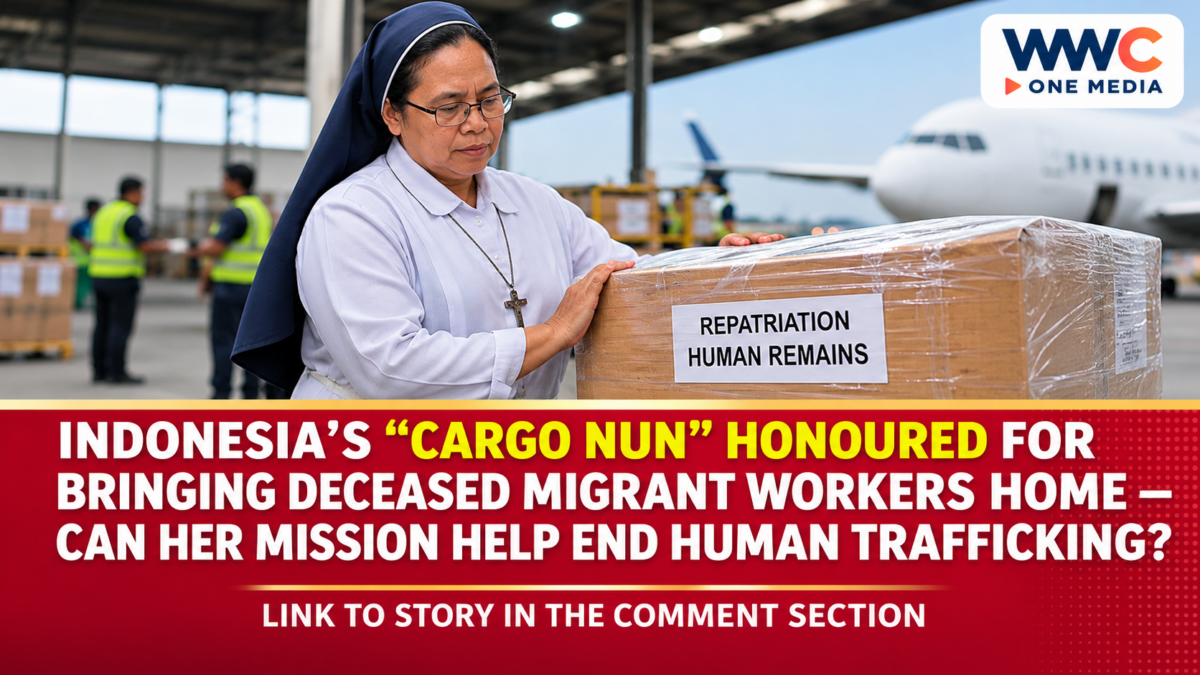
JAKARTA, INDONESIA — Sister Laurentina Suharsih has received national recognition for her extraordinary humanitarian commitment to Indonesian migrant workers, bringing renewed attention to the dangers of human trafficking, exploitative recruitment and inadequate protection for people seeking employment overseas.
The Catholic nun, widely known as Suster Kargo or Sister Cargo, received the 2026 Outstanding Woman Award in the humanitarian category during a ceremony in Jakarta on Nov. 19.
Over 16 years of humanitarian service, she has helped arrange the return of the remains of more than 700 migrant workers from East Nusa Tenggara.
Her latest recognition celebrates not only her commitment to grieving families but also her continuing efforts to protect vulnerable workers from exploitation.
Yet behind the award lies a difficult question: how can Indonesia strengthen migrant worker protection so that fewer families experience the tragedy that has defined much of her humanitarian mission?
Indonesia’s cargo nun: A mission built around human dignity
A member of the Congregation of the Sisters of Divine Providence, Sister Laurentina began her involvement in anti-trafficking work in 2011.
In 2017, her congregation assigned her to assist victims of human trafficking, an undertaking that subsequently included facilitating the repatriation of deceased Indonesian migrant workers.
Her responsibilities earned her the distinctive nickname Sister Cargo, reflecting her humanitarian activities at El Tari Airport in Kupang, East Nusa Tenggara.
For bereaved families, bringing a relative home from another country can involve complicated administrative, financial and transportation arrangements.
Sister Laurentina’s work helps families navigate these difficulties while ensuring that deceased workers are treated with dignity.
Her mission also includes supporting migrant workers requiring assistance and accompanying families affected by exploitation.
Importantly, the recorded number of deceased workers she has assisted should not be interpreted as a confirmed total of human trafficking fatalities. Individual causes of death and circumstances require separate investigation.
A second major recognition for years of humanitarian service
The November 2026 humanitarian award follows an earlier recognition of Sister Laurentina’s anti-trafficking commitment.
On Dec. 28, 2024, Indonesian President Prabowo Subianto presented her with a Lifetime Achievement Award acknowledging her longstanding service in protecting vulnerable individuals.
The latest honour was presented at SCTV Tower in Jakarta as part of an awards programme recognising Indonesian women for their contributions to society.
Six women received distinctions across healthcare, humanitarian service, social entrepreneurship, culture, education and environmental protection.
Sister Laurentina’s recognition provides another opportunity to draw public attention to the protection of migrant workers and the responsibilities of institutions involved in overseas employment.
During her acceptance remarks, she acknowledged the support of her religious congregation, donors, airport cargo personnel and the wider community sustaining her humanitarian activities.
Indonesia strengthens its fight against human trafficking
Sister Laurentina’s work comes as Indonesia continues developing more comprehensive safeguards for citizens seeking overseas employment.
Between March and May 2026, a joint international initiative delivered training workshops across five Indonesian districts with significant labour migration activity.
The participating locations were Cirebon, Deli Serdang, Kupang, Tulungagung and Lampung Timur.
The workshops brought together 203 participants, including representatives of government agencies, law enforcement, labour organisations, migrant worker resource centres and civil society.
The initiative focused on improving the identification of trafficking victims, strengthening case management and coordinating responses between institutions responsible for labour protection and criminal justice.
The involvement of Kupang is particularly relevant to Sister Laurentina’s humanitarian mission.
Concerns identified in the district include workers returning from overseas in critical condition and individuals who fail to return home.
Other areas face challenges involving illegal recruitment intermediaries and deceptive online employment opportunities.
Regional efforts to address these risks are also examined in WWC ONE MEDIA’s coverage of ASEAN’s response to cross-border online scam networks and deceptive recruitment.
Why protecting workers must begin before they leave home
Indonesia established a dedicated Ministry of Indonesian Migrant Worker Protection in October 2024 to strengthen institutional responsibility for the welfare of its overseas workforce.
In April 2025, the ministry collaborated with international labour and migration organisations to develop an accreditation framework for Indonesian migrant worker placement companies.
The proposed system is intended to improve transparency, accountability and service quality within recruitment agencies.
Its objectives include reducing fraudulent recruitment, excessive placement charges and other practices that expose workers to exploitation.
For individuals considering overseas employment, verifying the legitimacy of recruitment agencies and employment arrangements is an important preventive measure.
Prospective workers should pay particular attention to unclear contracts, excessive fees, unverifiable employers and requests to surrender personal documents.
The financial consequences of inadequate employment protection are illustrated in the case of nearly 240 migrant workers in Singapore who faced prolonged salary delays.
Although unpaid wages and human trafficking are not automatically equivalent, both issues demonstrate why workers need accessible complaint mechanisms and effective institutional protection.
Migrant worker support programmes reach thousands
Indonesia’s integrated migrant worker resource centres provide assistance extending beyond recruitment.
Services include employment preparation, legal assistance, psychosocial support, healthcare-related assistance and case management.
Programme records released in 2026 indicate that these centres have reached approximately 7,500 migrant workers, with women accounting for 85% of those receiving services.
Separate outreach activities have reached more than 69,000 women migrant workers.
These figures measure programme reach rather than the number of trafficking victims rescued.
Protecting workers also requires attention to their living conditions after arriving in destination countries.
The importance of accommodation standards is illustrated by Singapore’s enforcement action concerning an allegedly unlicensed dormitory housing 173 migrant workers.
Recruitment oversight, safe accommodation, accessible healthcare and effective wage protection should form part of a coordinated approach to migrant welfare.
Can humanitarian recognition lead to meaningful change?
Sister Laurentina’s mission highlights the importance of civil society organisations working alongside public institutions.
Religious communities, humanitarian organisations and local volunteers can provide practical assistance when families encounter administrative or financial difficulties.
However, individual humanitarian commitment cannot replace the institutional responsibilities of governments, recruitment agencies and employers.
Preventing exploitation requires effective enforcement, cooperation between countries, transparent employment arrangements and timely access to assistance.
For Indonesia, the ultimate measure of progress will not simply be the number of humanitarian awards presented or awareness programmes conducted.
It will be whether workers can obtain legitimate employment, receive fair treatment, seek assistance when necessary and return to their families safely.
Sister Laurentina’s latest recognition honours years of service to people whose suffering can easily remain overlooked.
Her mission also presents a wider challenge to society: protecting migrant workers while they are alive should receive at least as much attention as ensuring their dignity when they return home after death.
Frequently asked questions
Who is Indonesia’s cargo nun?
Sister Laurentina Suharsih is an Indonesian Catholic nun belonging to the Sisters of Divine Providence. She is known for supporting migrant workers, assisting trafficking victims and facilitating the repatriation of deceased workers.
Why is Sister Laurentina called Sister Cargo?
The nickname reflects her humanitarian work involving the arrival and onward transportation of deceased migrant workers through the cargo facilities of El Tari Airport in Kupang.
How many deceased migrant workers has she helped bring home?
The organisers of her November 2026 humanitarian award reported that she had helped arrange the repatriation of more than 700 deceased migrant workers from East Nusa Tenggara over 16 years of humanitarian service.
What award did Sister Laurentina receive in 2026?
She received the Outstanding Woman Award in the humanitarian category on Nov. 19, 2026, during an awards ceremony in Jakarta.
What is Indonesia doing to prevent migrant worker exploitation?
Indonesia is developing stronger recruitment oversight, placement agency accreditation, integrated migrant worker services and coordinated anti-trafficking training involving government agencies and international organisations.