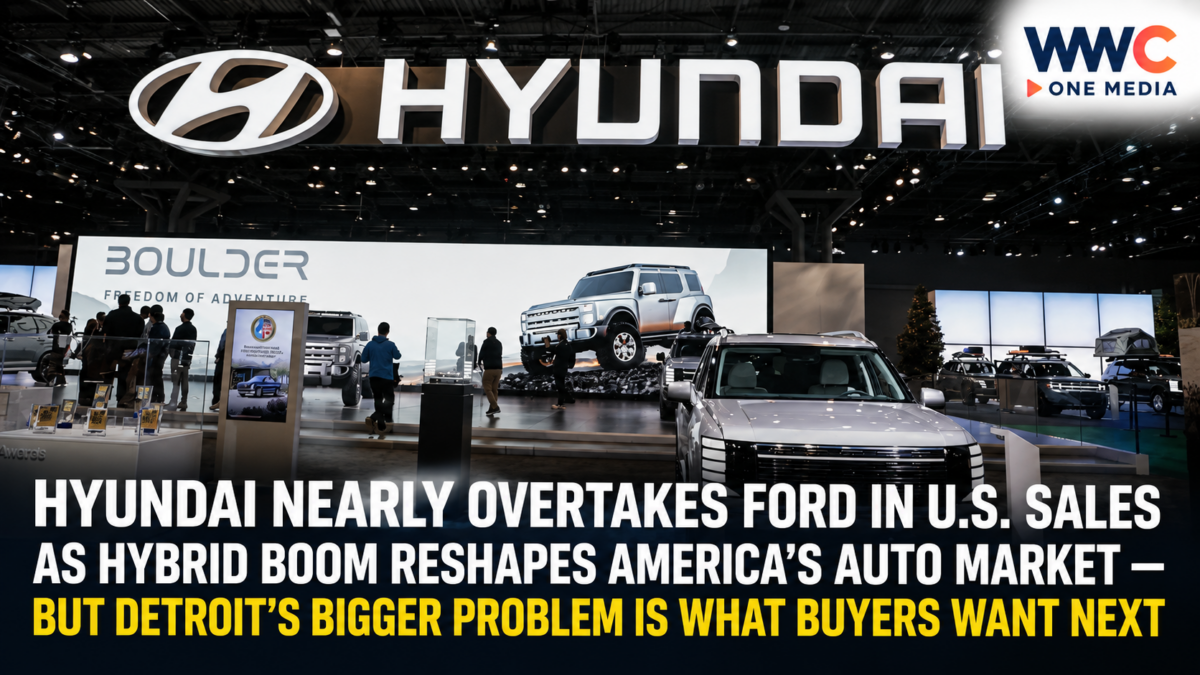
DETROIT — Hyundai Motor Group came within fewer than 1,200 vehicles of overtaking Ford in U.S. quarterly light-duty sales, a stunning shift that shows how quickly the American auto market is moving toward hybrids, smaller vehicles and more fuel-efficient models as gasoline prices rise and electric-vehicle demand becomes less predictable.
A week before the quarter ended, Cox Automotive projected that Hyundai Motor Group would outsell Ford for the first time ever.
It almost happened.
Hyundai, Kia and Genesis ultimately sold:
506,200 vehicles
in the United States during the third quarter.
That was up:
5.4% year over year.
Ford reported total U.S. sales of:
509,764 vehicles.
But Ford’s figure included some heavy-duty commercial vehicles.
On a more directly comparable light-duty basis, Ford sold approximately:
507,395 vehicles.
That left Ford ahead by only:
about 1,195 vehicles.
For one of America’s most iconic automakers, that margin is extraordinarily small.
And it points to a much bigger industry shift.
HYUNDAI DIDN’T QUITE PASS FORD — BUT THE GAP ALMOST DISAPPEARED
The original CNBC report was based on a Cox Automotive forecast released before final September sales were known.
Cox projected:
Hyundai Motor Group — 511,421 vehicles
and
Ford — 504,172 vehicles.
That would have put Hyundai ahead.
The actual result came out slightly differently.
Ford held onto the No. 3 position.
But barely.
The final gap was so small that the broader competitive message remains intact.
Hyundai Motor Group has moved from being a challenger to standing almost level with one of Detroit’s biggest manufacturers.
GM AND TOYOTA REMAIN AHEAD
General Motors retained the No. 1 U.S. sales position during the third quarter.
GM sold:
670,974 vehicles
down:
5.5% year over year.
Toyota followed with:
633,223 vehicles.
Toyota’s gap with GM has also narrowed.
That means the top of the U.S. auto market increasingly looks like:
GM
Toyota
then
Ford and Hyundai almost tied.
That would have been difficult to imagine a decade ago.
HYUNDAI JUST HAD ITS BEST Q3 EVER
Hyundai Motor America sold:
246,896 vehicles
during the quarter.
That was up:
3%
and marked the strongest third quarter in company history.
September itself was also a record.
Hyundai sold:
77,439 vehicles
up:
9% year over year.
The gains were broad.
September sales rose:
52% for Palisade
39% for Sonata
32% for Tucson
and
21% for Santa Fe.
That means the growth was not dependent on one model.
KIA ALSO SET A QUARTERLY RECORD
Kia sold:
236,659 vehicles
during Q3.
That was up:
8%.
September sales jumped:
18%
to:
77,009 vehicles.
Models including:
Sportage
Telluride
Sorento
Carnival
and
K4
helped drive the gains.
Hyundai and Kia together have become one of the strongest growth stories in the American auto market.
GENESIS PUSHED THE GROUP TOTAL ABOVE 500,000
Hyundai’s luxury Genesis brand added approximately:
22,645 vehicles
during the quarter.
Combined:
Hyundai
Kia
and
Genesis
sold:
506,200 U.S. vehicles.
That was enough to come within roughly:
0.2%
of Ford’s comparable light-duty sales.
This is not simply a quarterly statistical curiosity.
It reflects years of market-share gains by Korean automakers.
HYBRIDS WERE THE REAL ENGINE
The biggest growth driver was:
hybrid vehicles.
Combined Hyundai Motor Group hybrid sales climbed:
53.4%
to a record:
138,112 vehicles.
Hyundai alone said its Q3 hybrid sales increased:
35%.
In September, hybrid sales were up:
39%
and represented:
28% of Hyundai brand volume.
That is a major change in product mix.
Hybrids have gone from a niche efficiency option to one of the fastest-growing segments in the U.S. market.
ELECTRIC-VEHICLE SALES WENT THE OTHER WAY
While hybrids surged, Hyundai Motor Group’s EV sales fell sharply.
Combined EV sales dropped approximately:
51%
to:
22,311 vehicles.
That divergence shows just how quickly customer preferences have changed.
Buyers still want electrification.
But many do not necessarily want:
a full battery-electric vehicle.
Instead, they are choosing vehicles that reduce fuel consumption without requiring charging.
That is the hybrid sweet spot.
HIGH GAS PRICES ARE HELPING HYBRIDS
Gasoline prices have become a major factor.
U.S. gasoline averaged roughly:
$4.43 per gallon in September
compared with about:
$3.20 a year earlier.
That increase makes fuel economy much more important.
A consumer deciding between:
a conventional SUV
and
a hybrid SUV
can now see a much larger potential savings at the pump.
That is benefiting automakers with large hybrid portfolios.
HYUNDAI HAS BUILT A BROAD HYBRID LINEUP
Hyundai offers hybrid versions of major models including:
Tucson
Santa Fe
Sonata
and
Palisade.
Kia offers hybrids including:
Sportage
Sorento
Niro
and
Carnival.
The breadth matters.
Consumers can choose a hybrid without switching:
brands
vehicle sizes
or
body styles.
That reduces friction.
TOYOTA AND HONDA HAVE AN EVEN STRONGER HYBRID ADVANTAGE
Hyundai is not alone.
Toyota and Honda have also benefited strongly from the hybrid boom.
Toyota’s Corolla Hybrid sales jumped roughly:
36%
during the quarter.
Honda continues to generate strong demand from hybrid versions of:
CR-V
Accord
and
Civic.
These companies spent years developing hybrid systems while some Detroit competitors pushed much more aggressively toward fully electric vehicles.
That decision is now paying off.
ASIAN AUTOMAKERS ARE TAKING MORE THAN HALF THE U.S. MARKET
Reuters reported that Asian automakers were projected to capture more than:
50% of U.S. auto sales
during the third quarter.
At the same time, the combined share of:
GM
Ford
and
Stellantis
fell to a little over:
36%.
That is a major structural shift.
Detroit remains dominant in:
Pickup trucks
Large SUVs
and
Commercial vehicles.
But the rest of the market is becoming increasingly competitive.
DETROIT BET HEAVILY ON EVs
General Motors spent years promoting an:
“all-electric future.”
Ford invested billions into EV production.
Stellantis also developed multiple electric platforms.
Those strategies made sense when:
EV subsidies were strong
and
Regulations were pushing the market toward zero-emission vehicles.
But the environment changed.
Federal EV incentives expired.
EV growth slowed.
Gasoline prices rose.
And consumers moved toward hybrids.
GM IS THE CLEAREST EXAMPLE OF THE HYBRID GAP
GM has relatively few hybrids in the U.S.
The company focused heavily on:
full battery-electric vehicles.
That left it with a significant product gap when hybrid demand accelerated.
GM’s U.S. market share recently fell to around:
16.8%.
Dealers have openly told Reuters that customers are asking for hybrids GM largely does not have.
The company now plans to introduce:
plug-in hybrids
beginning in:
2027.
But competitors already have established portfolios.
MARY BARRA ONCE CALLED HYBRIDS AN INTERIM SOLUTION
GM CEO Mary Barra previously argued that hybrids represented an:
“interim solution.”
The company’s strategy was to move directly from gasoline vehicles toward EVs.
Long term, that may still prove correct.
But the transition is taking longer than expected.
Millions of consumers currently want:
better fuel economy
without
full dependence on charging.
That has created a very profitable middle market.
FORD ACTUALLY HAS A STRONGER HYBRID POSITION THAN GM
It would be wrong to say Ford lacks hybrids entirely.
Ford has several important hybrid products.
Its:
Maverick Hybrid
is particularly successful.
Maverick Hybrid Q3 sales reached:
27,793 vehicles
up:
59.6%.
That made it America’s best-selling hybrid pickup.
Ford also offers hybrid versions of the:
F-150
and other models.
So Ford is better positioned than GM in this category.
FORD’S Q3 DECLINE WAS NOT ONLY ABOUT HYBRIDS
Ford’s overall sales fell:
6.6%
to:
509,764 vehicles.
But several factors contributed.
The company is intentionally phasing out the:
Escape
and
Lincoln Corsair.
Ford said that excluding those planned discontinuations, its overall sales were approximately:
flat.
A temporary supplier issue also disrupted:
F-150 production
near the end of September.
That affected shipments.
So the quarter’s decline should not be attributed entirely to competition.
THE F-SERIES REMAINS FORD’S FORTRESS
Ford continues to dominate the pickup market.
Its F-Series remains on track for a:
50th consecutive year
as America’s best-selling truck.
September F-Series sales rose:
2.4%
to:
67,448 vehicles.
Super Duty production reached:
110,275 units
during Q3,
its best quarterly production result in:
19 years.
That truck franchise remains one of Ford’s most valuable advantages.
BUT BIG TRUCKS ARE MORE EXPOSED WHEN GAS PRICES SURGE
The same strength can also become a weakness.
Large trucks and SUVs consume more fuel.
When gasoline approaches:
$4.50 per gallon,
buyers become more sensitive to operating costs.
This does not mean consumers suddenly stop buying F-150s or Silverados.
Those vehicles remain essential for many customers.
But discretionary buyers can shift toward:
smaller pickups
crossovers
sedans
or
hybrids.
That is exactly what appears to be happening.
THE MAVERICK MAY SHOW FORD THE WAY FORWARD
The Maverick is relatively:
Affordable
Compact
and
Fuel efficient.
Its hybrid powertrain has become a major selling point.
Sales growth suggests there is strong demand for vehicles combining:
utility
with
lower fuel costs.
That could encourage Ford to expand hybrid options across more of its portfolio.
Ford CEO Jim Farley has increasingly emphasized flexibility rather than a rigid EV-only transition.
AMERICAN BUYERS ARE REDISCOVERING SEDANS
Another surprising Q3 trend was renewed demand for passenger cars.
Hyundai Elantra sales rose:
18%.
Sonata sales rose:
34%.
Toyota Corolla sales also strengthened.
Honda reported some of its strongest passenger-car demand since:
2020.
For years, industry executives believed the American sedan was dying.
High fuel prices and high vehicle prices are bringing it back.
SMALL SUVS ARE WINNING TOO
GM’s:
Chevrolet Trax
and
Trailblazer
performed relatively well despite the company’s overall decline.
The same pattern appeared across multiple brands.
Consumers are increasingly choosing:
Smaller
Cheaper
and
More fuel-efficient vehicles.
That suggests affordability is becoming just as important as electrification.
THE AVERAGE NEW VEHICLE NOW COSTS ABOUT $50,000
The average U.S. new vehicle transaction price reached approximately:
$50,089
in August.
That was up around:
1.9% year over year.
For many households, that is a huge purchase.
Even when loan rates decline slightly, monthly payments remain expensive.
Trade-in values have also weakened.
That means buyers are increasingly searching for:
Lower sticker prices
and
Lower operating costs.
Hybrids can address both fuel costs and range anxiety.
AFFORDABILITY MAY BE MORE IMPORTANT THAN TECHNOLOGY
For years, the auto industry framed the future mainly around:
EV versus gasoline.
Consumers may be framing it differently.
They may be asking:
What can I afford?
How much will gasoline cost?
Do I have access to charging?
What will the monthly payment be?
How reliable is the vehicle?
That set of questions naturally favors hybrids in today’s market.
EV TAX CREDITS DISAPPEARED
Another key change was the expiration of the federal:
$7,500 EV tax credit.
Without the subsidy, many electric vehicles effectively became more expensive overnight.
That hurt EV demand.
Ford’s Mustang Mach-E sales fell sharply.
GM’s Equinox EV and Blazer EV also suffered major declines.
Hyundai and Kia EVs weakened too.
So this is not a Detroit-only problem.
The entire U.S. EV market has become more difficult.
HYUNDAI’S EV SALES ALSO FELL HARD
Hyundai Motor Group’s strong overall quarter should not obscure that reality.
Its combined EV sales were down:
51%.
Models such as:
Ioniq 5
Kia EV6
and
EV9
experienced substantial declines.
That shows Hyundai’s success came largely because it could offset EV weakness with:
Hybrids
SUVs
and
Sedans.
That diversified product strategy is becoming one of its biggest strengths.
THIS MAY BE THE KEY LESSON FOR DETROIT
The winning strategy may not be:
gasoline or EV.
It may be:
everything.
Consumers are moving at different speeds.
Some want:
EVs.
Some want:
Hybrids.
Some still want:
Gasoline trucks.
A manufacturer with multiple powertrains can respond faster.
A manufacturer committed too heavily to one transition path can get caught when demand shifts.
TOYOTA LOOKS PARTICULARLY VINDICATED
Toyota faced years of criticism for moving slowly into battery EVs.
The company argued that hybrids could reduce emissions across far more vehicles because battery supply is limited.
That strategy now looks increasingly well matched to U.S. consumer demand.
Toyota is closing the sales gap with GM.
Its hybrid lineup spans nearly every major category.
That does not prove Toyota was right about the long-term future.
But it does show the value of flexibility during the transition.
HONDA IS ALSO BENEFITING
Honda has rapidly expanded hybrid sales through models like:
CR-V Hybrid
Accord Hybrid
and
Civic Hybrid.
Its passenger-car business has strengthened.
The company also benefits from relatively strong residual values and leasing.
That allows customers to return to the brand more easily when leases expire.
In an affordability-sensitive market, that can be a major advantage.
HYUNDAI AND KIA HAVE ALSO IMPROVED BRAND PERCEPTION
The Korean automakers’ growth is not only about hybrids.
Over the past decade, they have transformed perceptions around:
Design
Technology
Quality
and
Warranty coverage.
Genesis has strengthened the group’s luxury presence.
Hyundai and Kia have also built products competitive with:
Toyota
Honda
and
Detroit brands
across multiple segments.
That long-term brand improvement is now translating into market share.
THEIR U.S. MANUFACTURING FOOTPRINT IS EXPANDING TOO
Hyundai Motor Group has also increased North American production.
Its Georgia manufacturing investments are designed to support:
EVs
Hybrids
and
Battery production.
Local manufacturing can reduce exposure to:
Tariffs
Shipping costs
and
Currency movements.
It can also allow faster response to American consumer demand.
That matters as trade policy becomes increasingly unpredictable.
THE THIRD-QUARTER RANKING WAS ALMOST HISTORIC
Ford ultimately survived the quarter in third place.
But the numbers tell the real story.
Ford light-duty sales:
approximately 507,395.
Hyundai Motor Group:
506,200.
Difference:
about 1,195 vehicles.
That is effectively a statistical photo finish in an industry selling millions of vehicles every quarter.
One production disruption, fleet order or strong model launch could reverse the ranking next time.
FORD’S SUPPLIER PROBLEM MAY HAVE MATTERED
Ford temporarily halted some F-150 production near the end of September because of a supplier problem.
The company said the issue was resolved.
But the disruption affected third-quarter dealer shipments.
Given that Ford beat Hyundai by fewer than:
1,200 light-duty vehicles,
even a small production disruption could have influenced the final ranking.
That shows how narrow the competitive gap has become.
HYUNDAI COULD STILL PASS FORD SOON
The fact that Hyundai missed by such a small amount means a first quarterly victory remains plausible.
If Hyundai-Kia-Genesis continue growing while Ford’s overall volume stays flat or falls, the ranking can change quickly.
But one quarter does not establish a permanent trend.
Ford’s truck franchise remains enormously powerful.
And Ford is actively reshaping its lineup.
The more important question is whether Hyundai can maintain hybrid-driven growth over multiple quarters.
DETROIT’S COMBINED SHARE IS STILL FALLING
The bigger issue extends beyond Ford.
The Detroit Three have gradually lost U.S. market share.
GM remains No. 1.
Ford remains No. 3.
But collectively, they now control a smaller portion of the market than in previous decades.
Asian manufacturers have steadily expanded.
That long-term trend has accelerated as U.S. buyers prioritize:
Reliability
Fuel economy
Affordability
and
Hybrid availability.
DETROIT STILL OWNS THE MOST PROFITABLE SEGMENTS
There is an important counterargument.
Market share is not everything.
Detroit dominates:
Full-size pickups
Large SUVs
and
Commercial trucks.
These vehicles often generate much higher profits than small sedans or compact hybrids.
Ford does not need to sell more cars than every competitor if it earns substantially more per vehicle.
GM follows a similar strategy.
The question is whether that profit model remains sustainable if buyers move toward smaller and more efficient vehicles.
HIGH FUEL PRICES COULD MAKE THAT MODEL HARDER
If gasoline stays above:
$4 per gallon,
large vehicle demand could soften.
Automakers may respond by:
Increasing incentives
Adding hybrid powertrains
or
Reducing prices.
Any of those moves could pressure margins.
That is why the hybrid gap matters even for companies that make most of their money from trucks.
Efficiency is becoming a competitive feature again.
THE BIGGER STORY: HYUNDAI DIDN’T PASS FORD — BUT IT MAY HAVE PROVED THE MARKET HAS ALREADY CHANGED
The final scoreboard says:
Ford won.
But only by a little more than:
1,000 light-duty vehicles.
The trend underneath the numbers is harder for Detroit to dismiss.
Hyundai Motor Group sold:
506,200 vehicles.
Hybrid sales surged:
53%.
Hyundai recorded its best third quarter ever.
Kia recorded its best quarter.
Meanwhile, Ford sales fell more than:
6%.
GM fell:
5.5%.
And Toyota continued closing the gap at the top of the market.
The common thread is clear.
American consumers increasingly want:
fuel efficiency,
affordability,
and
flexibility.
For now, hybrids are delivering that combination better than either traditional gas-only vehicles or many fully electric models.
Detroit’s largest automakers are not disappearing.
They still dominate some of the industry’s most profitable categories.
But their strategic gamble on moving rapidly from gasoline to EVs created a vulnerable middle ground.
Toyota, Honda, Hyundai and Kia filled it.
And the fact that Ford needed fewer than 1,200 vehicles to hold off Hyundai may be the clearest sign yet that the competitive hierarchy of the U.S. auto market is no longer secure.
Hyundai didn’t quite beat Ford in Q3 — but if America’s hybrid boom continues, the bigger question may be how long Ford can keep that lead.