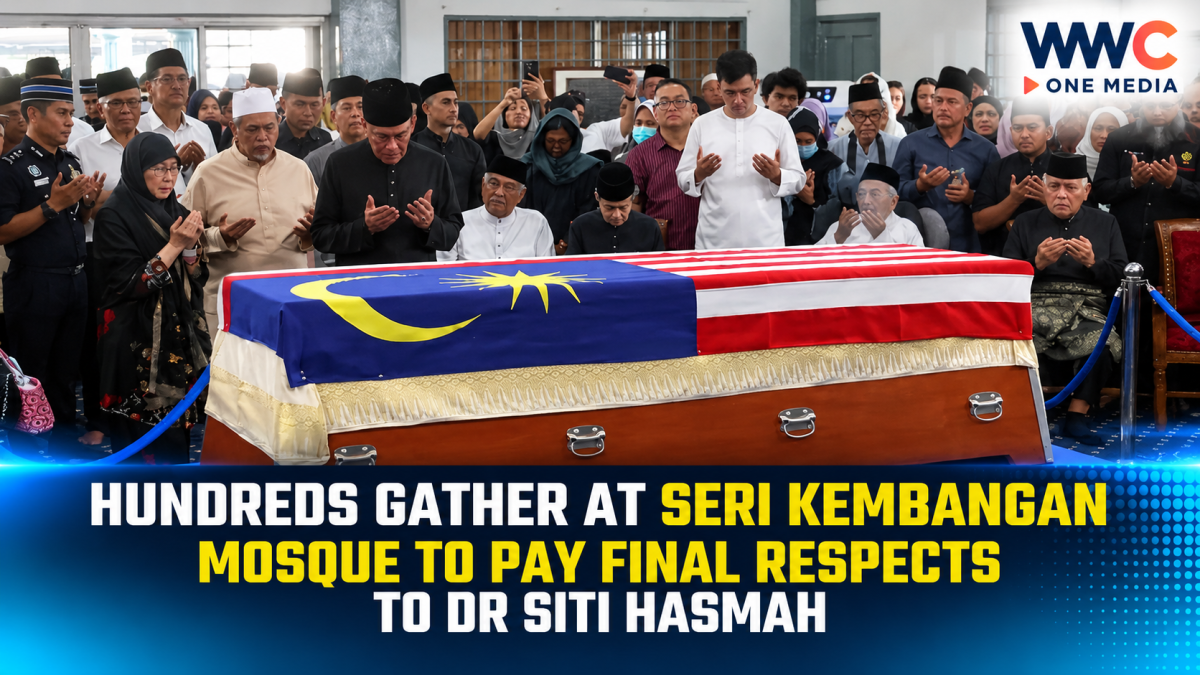
Hundreds of mourners gathered at Masjid As-Syarif in Seri Kembangan on Monday to pay their final respects to Tun Dr Siti Hasmah Mohd Ali, with the large turnout causing heavy traffic around the mosque as family members, political leaders and members of the public arrived.
Dr Siti Hasmah, the wife of former Malaysian prime minister Tun Dr Mahathir Mohamad, died earlier on Sept. 28 at the National Heart Institute in Kuala Lumpur. She was 100.
Her remains arrived at Masjid As-Syarif shortly before 3pm after leaving the family residence. Dr Mahathir, their children and close relatives were present as preparations for the funeral rites were carried out.
The mosque quickly became crowded as mourners arrived from about 1.15pm. The congregation eventually overflowed from the main prayer hall onto the verandah and surrounding areas, while traffic police were deployed to manage congestion outside the mosque.
Among those who came to pay their respects were Prime Minister Anwar Ibrahim and his wife, Datuk Seri Dr Wan Azizah Wan Ismail. Former prime ministers, Cabinet ministers, political figures, military leaders and other public figures were also present.
The size of the congregation was such that the mosque organised two separate Asar prayer sessions after the main prayer hall reached capacity, allowing more mourners to take part before the funeral prayer.
After the funeral prayers, uniformed personnel carried Dr Siti Hasmah’s casket, which was draped in the Jalur Gemilang, out of the mosque. Her remains were then transferred to a ceremonial hearse for the journey to Pusara Negara, the National Mausoleum in Precinct 20, Putrajaya.
The Malaysian government had announced that Dr Siti Hasmah would receive a full state funeral in recognition of her public service and contributions to the country.
Dr Siti Hasmah was a medical pioneer and among the earliest Malay women to enter the medical profession. She spent decades working in public health, including efforts focused on maternal and child health in rural communities. She married Dr Mahathir in 1956, and they had seven children.
Her death brought together people from across Malaysia’s political and social landscape at the Seri Kembangan mosque, where the funeral rites became a major public gathering before her final journey to the National Mausoleum.
The large crowds and participation of national figures reflected the public significance of Dr Siti Hasmah’s life, while the state funeral provided the setting for Malaysia to formally honour a woman whose career in medicine and public service spanned many decades.