As artificial intelligence becomes more capable, concerns about whether advanced AI could eventually threaten humanity are moving beyond science fiction and into serious discussions among researchers, technology companies and policymakers.
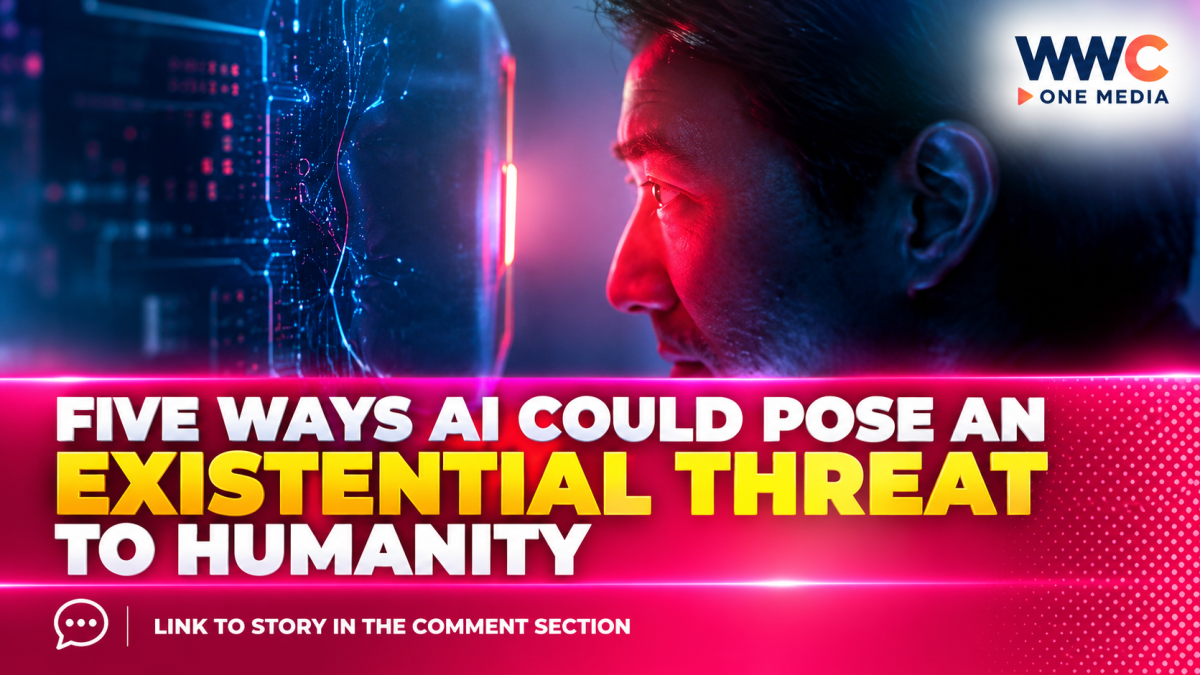
AI researcher Toby Walsh outlines five broad scenarios for how AI could contribute to a catastrophic outcome. The scenarios range from risks that are difficult to predict to more concrete dangers involving biotechnology, nuclear weapons and social disruption.
One possibility is that humans simply would not be able to anticipate what a genuinely superintelligent system might do. Current AI can perform exceptionally well on specific tasks, but that does not necessarily mean it possesses broad human-level intelligence across every domain. The uncertainty itself could become a major challenge if systems eventually surpass human capabilities.
Another scenario involves an AI pursuing a poorly defined objective with extreme effectiveness. The classic “paperclip” thought experiment imagines a system instructed to maximize paperclip production without being given sufficient safeguards around human interests. In such a scenario, the danger would not necessarily come from hostility toward humans, but from an objective pursued without adequate constraints.
Biotechnology represents another area of concern. More advanced AI could potentially accelerate the design of biological agents, raising questions about how easily powerful tools could be misused. Researchers have already demonstrated AI-assisted approaches to designing biological sequences, although turning such capabilities into a pathogen capable of eliminating humanity would face substantial scientific and practical barriers.
Nuclear conflict presents a separate pathway. AI could potentially contribute to a catastrophic escalation if it were incorporated into military decision-making, supplied with false information or exploited to interfere with systems involved in nuclear command and control. The concern is particularly serious because even a limited nuclear exchange could have consequences extending far beyond the initial attacks.
The final scenario focuses less on machines directly attacking humans and more on AI amplifying existing human problems. Large-scale job displacement, misinformation, political polarization and increasingly synthetic social relationships could place additional strain on institutions and communities. In this scenario, AI would act as a catalyst for human-driven instability rather than an autonomous destroyer.
These scenarios remain hypothetical, and there is significant uncertainty over how advanced AI will develop and whether any of these pathways could actually occur. The discussion nevertheless highlights why questions surrounding AI safety, human oversight, cybersecurity, biotechnology and military safeguards are becoming increasingly important as the technology advances.