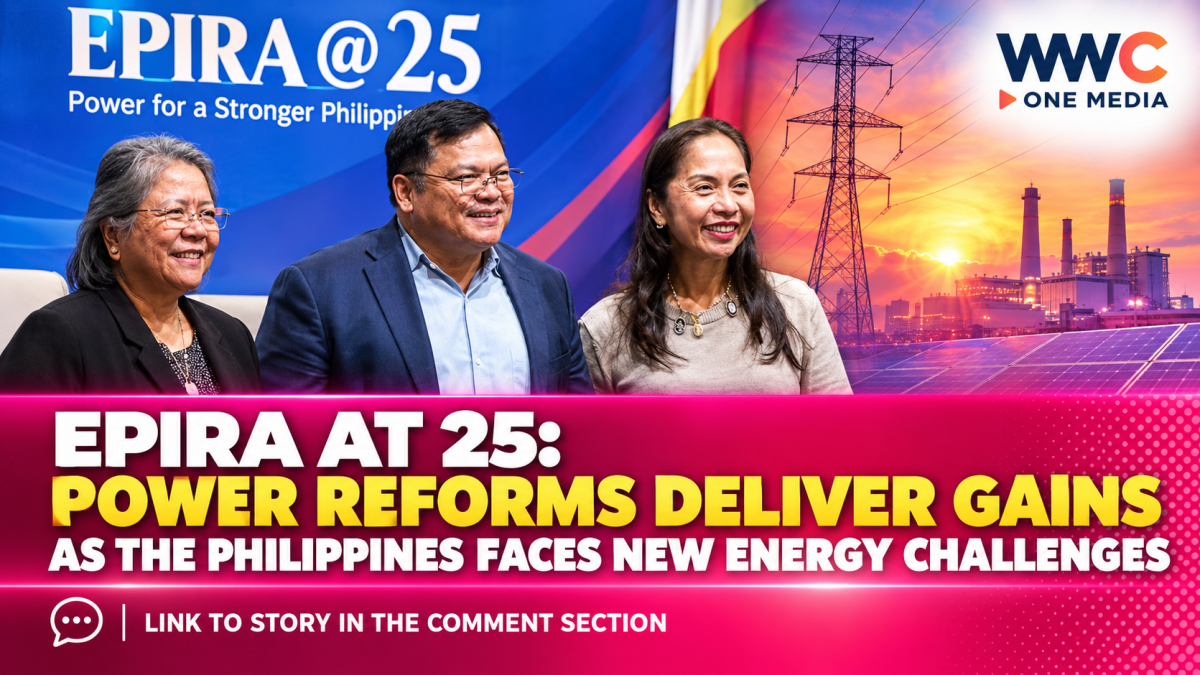
Twenty-five years after the passage of the Electric Power Industry Reform Act, the Philippines’ power sector has undergone major structural changes, but the country now faces a different set of challenges that may require the law to evolve.
EPIRA, enacted in 2001, was designed to address severe power shortages, the financial problems of the National Power Corp., and the need to restructure the electricity industry. The reform introduced competition, privatization, independent regulation and new market mechanisms into the power sector.
One of the clearest changes has been the expansion of generation capacity. The Department of Energy said installed capacity has more than doubled from around 13,000 megawatts in 2001 to more than 32,000 MW today. The reform also established institutions and mechanisms such as the Energy Regulatory Commission, the Power Sector Assets and Liabilities Management Corp., the Wholesale Electricity Spot Market and the retail competition framework.
However, electricity affordability and reliability remain major concerns. The debate surrounding EPIRA has increasingly shifted from whether the original reform addressed the problems of the early 2000s to whether its framework remains suited to a rapidly changing energy system.
The energy transition is creating challenges that were not central when EPIRA was drafted. Solar and wind projects, battery storage, electric vehicles, rooftop generation and other distributed energy resources are changing how electricity is produced, transmitted and consumed. Customers are increasingly able to become “prosumers” by both consuming and generating electricity.
This transformation places greater demands on the transmission and distribution networks. Grid modernization, digital monitoring, storage, automated controls and stronger interconnection systems are becoming increasingly important as renewable energy capacity expands.
The Department of Energy has also acknowledged the need to reassess the law. Energy Secretary Sharon Garin said the 25th anniversary provides an opportunity to examine what has worked, identify remaining gaps and determine what reforms are needed to provide reliable and affordable electricity. Several proposals to amend EPIRA have already been filed, including measures aimed at strengthening the energy regulator.
The next phase of power-sector reform is therefore likely to focus not only on generation capacity, but also on transmission, distribution, renewable-energy integration, energy storage, competition and regulatory effectiveness.
As the Philippines enters a new stage of its energy transition, the central challenge is how to modernize a framework created for the power problems of 2001 while ensuring that investments and regulations keep pace with the electricity system of the future.