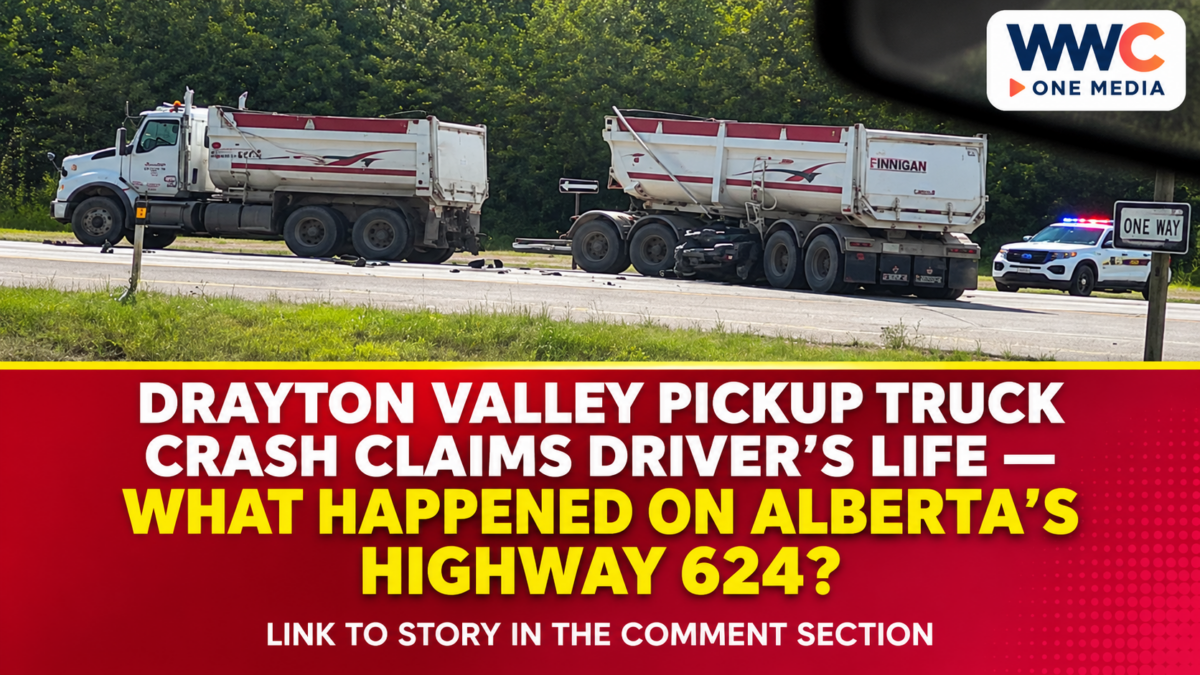
ALBERTA, Canada — November 28, 2026 — A reported fatal collision involving a pickup truck and a semi-truck near Drayton Valley has brought renewed attention to highway safety and the risks associated with collisions between passenger vehicles and heavy commercial trucks.
The reported Drayton Valley crash occurred along Highway 624, with the circumstances surrounding the incident awaiting direct confirmation through an official police statement.
The incident comes against a backdrop of increasing concern over Canadian road fatalities, with national statistics recording the highest annual death toll in 12 years during 2024.
Drayton Valley Crash Highlights Highway Safety Concerns
Establishing the circumstances surrounding a fatal collision requires distinguishing the immediate consequences of the incident from the events that caused it.
The involvement of a commercial truck does not automatically establish responsibility on the part of its driver or operator.
Similarly, the location of a collision does not independently establish whether road infrastructure, weather conditions or vehicle performance contributed to the incident.
WWC ONE MEDIA’s earlier coverage of the fatal Coteau-du-Lac truck collision in Quebec examines another Canadian incident in which establishing the sequence of events was an important part of the investigation.
The two incidents are unrelated, and no common cause has been established.
Canada’s Annual Road Fatalities Reach a 12-Year High
Transport Canada’s national collision statistics provide a broader picture of the country’s road-safety challenges.
In 2024, Canada recorded:
- 2,050 motor vehicle fatalities.
- 9,357 serious injuries.
- 130,551 total injuries.
The annual number of road fatalities increased by 2.5% compared with 2023, when 2,000 deaths were recorded in the revised national dataset.
Serious injuries increased by 2.7%, while total injuries increased by 5.5%.
Despite these increases, the fatality rate relative to distance travelled declined from 4.6 deaths per billion vehicle-kilometres in 2023 to 4.5 in 2024.
The national figures also show that road fatalities have fallen by 29% since 2005.
These statistics describe nationwide road-safety conditions and do not establish the cause of any individual collision.
Separate coverage of the fatal East Windsor collision and Canada’s road-safety statistics provides additional context on the country’s efforts to address serious traffic incidents.
How Alberta Monitors Commercial Vehicle Safety
Alberta maintains a commercial vehicle carrier profile system designed to monitor the safety performance of regulated transport operators.
Under National Safety Code Standard 7, Canadian jurisdictions maintain records for carriers operating vehicles covered by the applicable safety regulations.
Alberta’s monitoring system incorporates information involving:
- Reportable vehicle collisions.
- Driver and carrier convictions.
- Commercial vehicle inspection results.
- Administrative penalties.
- Facility audit findings.
The provincial government uses this information to identify higher-risk commercial transport operators.
Its risk-factor scoring system identifies the 5% of carriers considered to present the greatest safety risk, allowing regulators to determine where intervention may be necessary.
However, the existence of this monitoring framework does not establish that any safety violation occurred in the reported Drayton Valley collision.
Commercial Vehicle Collision Reviews in Alberta
Alberta also maintains a formal process through which regulated commercial transport operators can request reviews of collision-related points recorded on their carrier profiles.
Supporting documentation may include a signed driver statement, an internal company investigation report and relevant insurance correspondence.
Applications must be submitted within 12 months of the collision.
Where sufficient justification exists, the provincial government may remove the associated collision points while retaining a record of the incident.
This administrative framework is distinct from determining criminal or civil responsibility for a collision.
No information has been independently established indicating that such a review has been requested in connection with the reported Highway 624 crash.
Road Closures and Emergency Response
Serious highway collisions can disrupt transportation while emergency personnel and investigators work at the scene.
Motorists should follow official traffic directions and consult current road advisories before travelling through affected areas.
WWC ONE MEDIA previously examined emergency response and traffic disruptions following an Innisfil construction zone collision in Ontario.
Although the Ontario incident involved different circumstances, it provides additional reading on how road collisions can affect both emergency operations and surrounding transportation networks.
What Remains Unknown About the Drayton Valley Collision?
Further official information is necessary to establish the circumstances surrounding the reported crash, including the movements of the vehicles before impact and whether any traffic offences were involved.
The cause of the collision should not be attributed to speeding, driver fatigue, impaired driving, mechanical failure or adverse weather without supporting investigative findings.
The priority remains establishing an accurate account of the incident while respecting the privacy of the individuals and families affected.
Frequently Asked Questions
Where was the Drayton Valley crash reported?
The collision was reported along Highway 624 near Drayton Valley, Alberta, Canada. The precise location remains pending direct primary-record verification.
What vehicles were reportedly involved?
A pickup truck and a semi-truck were reportedly involved in the collision.
Has the cause of the crash been established?
No verified final investigative finding has been obtained for this article.
How many road fatalities did Canada record in 2024?
Canada recorded 2,050 motor vehicle fatalities in 2024, representing a 2.5% increase over the revised 2023 figure.
How does Alberta monitor commercial vehicle safety?
Alberta maintains carrier safety profiles incorporating collision histories, inspection findings, convictions and other regulatory information.