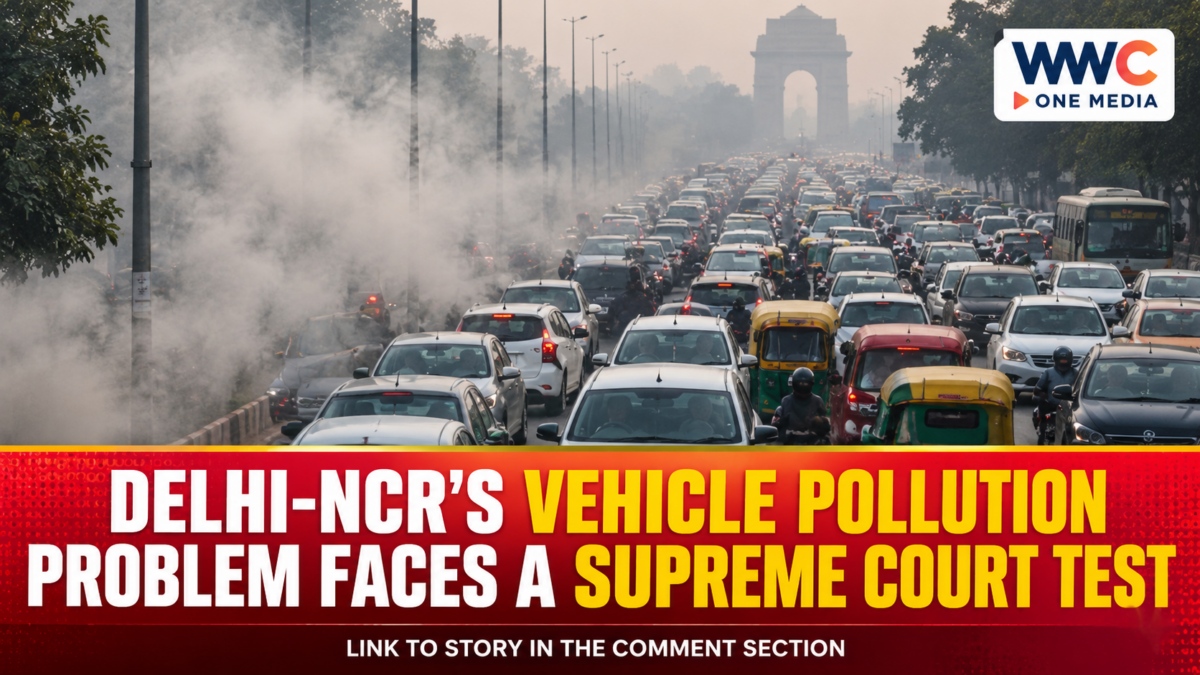
NEW DELHI — India’s Supreme Court has ordered Delhi and neighbouring state authorities to provide detailed accounts of how they are controlling vehicle emissions across the National Capital Region, directing them to explain enforcement measures and submit a time-bound roadmap. The November 6 order places particular attention on older vehicles, pollution-control certification and the movement of vehicles across state borders.
The direction comes as the Commission for Air Quality Management (CAQM) continues to pursue measures targeting high-emission vehicles, cleaner commercial transport and the gradual replacement of older fleets.
The issue is no longer only whether rules exist on paper. The court is asking authorities to demonstrate what they have actually implemented, how many vehicles have been checked or stopped, and whether agencies across the region are working together. That makes enforcement—not another announcement of restrictions—the central test for the next stage of Delhi-NCR’s pollution response.
Delhi-NCR vehicle pollution moves into a separate Supreme Court proceeding
The November 6 order was issued in a suo motu case concerning air pollution in the National Capital Region. The court noted that vehicle emissions had become a pressing concern as reported incidents of stubble burning declined during the period examined.
It also recognised that Delhi’s pollution burden is not confined to vehicles registered within the capital. Traffic entering from Uttar Pradesh, Haryana and Rajasthan adds to the volume of vehicles operating across the region.
The court directed the Municipal Corporation of Delhi, the Government of the National Capital Territory of Delhi, Delhi Police’s Traffic Department and the governments of Haryana, Rajasthan and Uttar Pradesh to file detailed responses.
Those submissions must address the existing rules for commercial and private vehicles, systems used to identify vehicles that do not meet emission standards, and steps taken to prevent over-age or otherwise non-compliant vehicles from operating.
The court also asked for enforcement figures, including vehicles inspected, challaned, denied entry or otherwise proceeded against. Authorities must explain how they coordinate across state borders and identify additional short- and long-term measures, supported by a time-bound implementation roadmap.
The order separates vehicle emissions from other parts of the wider air-pollution case so the issue can receive focused judicial attention.
The rules already exist, but enforcement has faced practical obstacles
The age-based restrictions on older vehicles have a long legal history. Delhi’s transport department refers to Supreme Court and National Green Tribunal directions under which diesel vehicles more than 10 years old and petrol vehicles more than 15 years old are not permitted to ply in the NCR.
However, enforcement has not been a simple matter of identifying a vehicle’s registration year.
In July 2025, the CAQM disclosed that Delhi authorities had raised operational concerns about the use of automated number-plate recognition systems to identify end-of-life vehicles. The issues included camera placement, sensor and speaker performance, integration with neighbouring states’ vehicle databases and difficulties identifying vehicles with high-security registration plate problems.
The commission amended its Direction No. 89 to extend the timetable for denial of fuel to identified end-of-life vehicles. It set November 1, 2025, for Delhi and five adjoining high-vehicle-density districts, and April 1, 2026, for the rest of the NCR.
But a subsequent CAQM amendment dated October 17, 2025, placed Direction No. 89 in abeyance until further orders, citing the Supreme Court’s August 12, 2025 direction that coercive steps should not be taken against owners solely because their diesel vehicles were 10 years old or petrol vehicles were 15 years old.
That sequence illustrates why the latest court scrutiny matters: authorities must explain which measures are currently operative, how they are being applied and what legal or technical barriers remain.
Scrapping policy is also an environmental management issue
Removing an older vehicle from the road is only one part of the process. Its disposal must also be handled safely.
India’s Environment Protection (End-of-Life Vehicles) Rules, 2025, notified by the Ministry of Environment, Forest and Climate Change, establish an extended producer responsibility framework. Producers are assigned obligations connected to the scrapping of vehicles introduced into the domestic market.
The rules require registered vehicle scrapping facilities to receive end-of-life vehicles and undertake treatment, depollution, dismantling, segregation and scrapping. Materials recovered from vehicles must be directed to registered recyclers or refurbishers, while hazardous or non-recyclable materials must be handled through authorised waste-treatment facilities.
Registered owners or bulk consumers are required to deposit an end-of-life vehicle at a designated collection centre, sales outlet or registered vehicle scrapping facility within 180 days from the date it becomes an end-of-life vehicle.
This creates a broader policy challenge. A successful programme needs not only enforcement against vehicles that should no longer be on the road, but also accessible collection points, authorised dismantling capacity and traceable recycling.
A January 2026 NITI Aayog report on the circular economy of end-of-life vehicles likewise examines the need to strengthen the vehicle-scrapping ecosystem. Its focus includes the environmental risks of informal dismantling and the importance of responsible recovery and reuse of materials.
Cleaner transport policies are moving beyond private cars
The CAQM’s approach also includes changing the type of vehicles entering the region.
In August 2026, the commission approved Direction No. 102, which sets phased restrictions on new registrations of certain light goods vehicles and requires a shift towards cleaner vehicle types. The first phase for diesel, petrol and CNG N1 light goods vehicles begins in Delhi on January 1, 2027, followed by high-vehicle-density districts on July 1, 2027. Further restrictions are scheduled for other NCR districts and later vehicle categories.
The commission’s published explanation said light goods vehicles represented about 1.2% of the active vehicle stock but contributed approximately 3.3% of particulate-matter emissions from the total active fleet.
The September 2026 revision of the Graded Response Action Plan also adjusted vehicle restrictions, including provisions affecting certain older petrol and diesel light motor vehicles and goods vehicles during specified pollution stages.
The direction of policy is clear: the region is attempting to reduce emissions through a combination of vehicle-age controls, fuel and entry restrictions, cleaner fleet registrations and enforcement. Whether those measures work depends on consistent implementation across the region.
The transition has implications for manufacturers, transport operators and the wider mobility industry. In the Philippines, WWC has examined the industrial side of the shift through its coverage of government support for local automotive manufacturing and the push to develop Filipino-made electric jeepneys and tricycles. Those developments show why cleaner mobility involves manufacturing capacity and infrastructure as well as vehicle replacement.
The enforcement question is bigger than the vehicle count
The reported scale of end-of-life vehicles in Delhi-NCR has drawn attention, but a headline figure alone cannot explain the region’s enforcement performance.
A useful assessment needs to distinguish between vehicles identified as over-age, vehicles that remain registered, vehicles actually operating on public roads, vehicles impounded, and those formally scrapped or moved out of the region. Those categories are not interchangeable.
The court’s demand for detailed enforcement data is therefore important. Without consistent reporting from Delhi and neighbouring states, it is difficult to determine whether a vehicle-control programme is reducing the number of non-compliant vehicles or simply identifying them.
There is also a coordination issue. A restriction applied in one jurisdiction may be weakened if a vehicle can obtain fuel, registration-related services or access to roads elsewhere in the region. The CAQM’s earlier concerns about cross-border database integration show why shared systems and consistent enforcement procedures matter.
The wider air-quality problem is not caused by vehicles alone. Industrial emissions, construction dust, waste burning and other sources also require action. But the court’s November order makes clear that vehicle emissions require a more focused response and measurable accountability.
WWC has previously reported on the importance of monitoring pollution across different locations in its coverage of air-quality concerns and haze monitoring in the Philippines. The regional circumstances differ, but the underlying public-policy issue is similar: reliable monitoring must be matched by effective action.
What happens next
The Supreme Court’s November 6 order gave the states two weeks to place their submissions on record. It also scheduled the separate vehicular-emissions proceeding for November 23, 2026.
The next important development is the content of the responses: whether authorities provide clear enforcement figures, explain gaps in vehicle identification and cross-border coordination, and present a practical timeline for additional measures.
For Delhi-NCR, the challenge is to turn an extensive regulatory framework into consistent action on the road. The outcome will depend not simply on how many old vehicles are identified, but on whether authorities can demonstrate that non-compliant vehicles are being dealt with lawfully and that cleaner transport alternatives are becoming viable.
Frequently asked questions
1. What did India’s Supreme Court order regarding Delhi-NCR vehicle pollution?
The court directed Delhi, the neighbouring states and relevant agencies to explain their vehicle-emission rules, enforcement activity, cross-border coordination and proposed measures.
2. Which states are involved in the Supreme Court’s directions?
The November 6 order names Delhi, Haryana, Rajasthan and Uttar Pradesh, alongside the Municipal Corporation of Delhi and Delhi Police’s Traffic Department.
3. What qualifies as an end-of-life vehicle in India?
Under India’s vehicle-scrapping framework, the category includes vehicles that are no longer validly registered, have been declared unfit by an authorised authority, have had registration cancelled or have been voluntarily declared as waste by their legitimate registered owner. Applicable age-based restrictions also affect vehicles operating in the NCR.
4. What are India’s age limits for older diesel and petrol vehicles in the NCR?
The restrictions referred to by Delhi’s transport department cover diesel vehicles more than 10 years old and petrol vehicles more than 15 years old. Their enforcement has also been subject to subsequent court directions.
5. What is India doing with vehicles that reach the end of their useful life?
The Environment Protection (End-of-Life Vehicles) Rules, 2025, establish producer obligations and require authorised scrapping facilities to handle vehicles through processes that include depollution, dismantling, segregation and recycling.