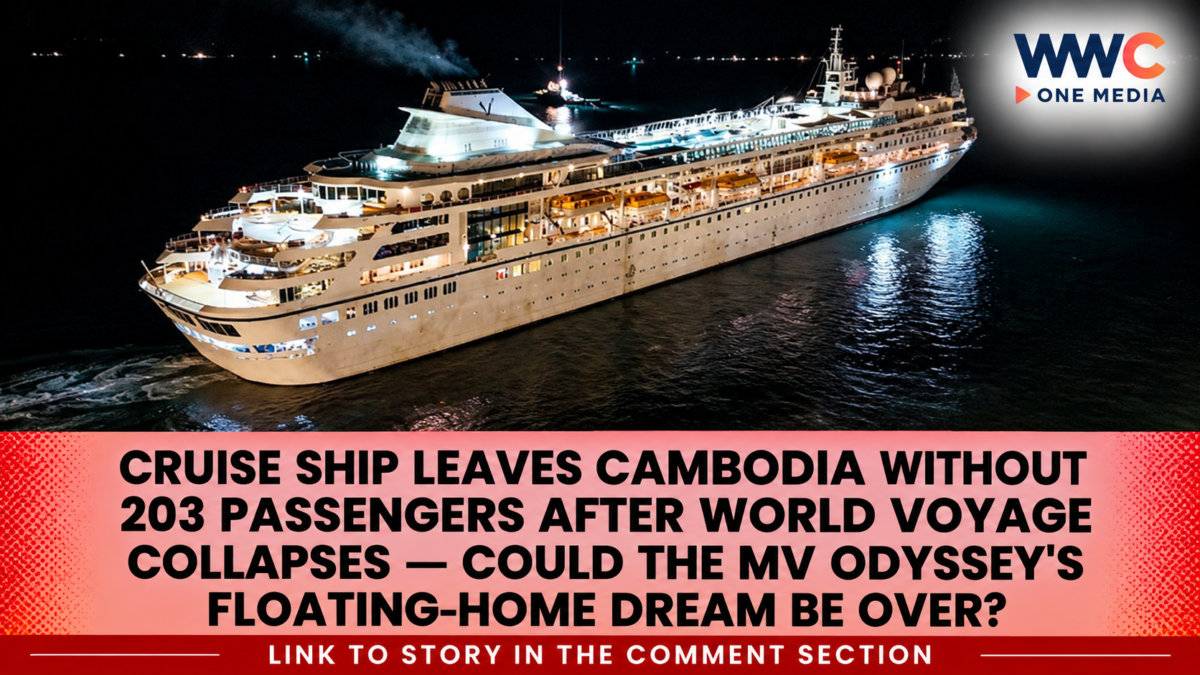
A cruise ship marketed as a floating home for people who wanted to spend years travelling around the world has sailed away from Cambodia without its passengers, leaving dozens of residents facing an uncertain future after their extraordinary voyage abruptly collapsed.
The Villa Vie Odyssey departed Sihanoukville early on November 4, carrying crew members but no passengers. The vessel’s Florida-based operator, Villa Vie Residences, had suspended its operations after saying soaring fuel expenses linked to the Iran conflict made the business financially unsustainable.
The departure came days after 203 passengers were told to leave the ship during a scheduled stop in Cambodia. Many had paid tens or even hundreds of thousands of dollars for long-term or permanent residential arrangements aboard the vessel.
According to Cambodian tourism officials, approximately 50 crew members remained aboard when the ship departed, while around 100 former passengers were still in Cambodia. Others had travelled to different destinations across the region.
The ship had spent at least 755 days travelling internationally before its operations were suspended.
For passengers who believed they had purchased a home at sea, the situation has become far more than an interrupted holiday. Some invested substantial savings in cabins, while others reorganised their lives around the promise of years of continuous international travel.
Now, the vessel has left without them, its next destination remains uncertain, and there is no confirmed date for the resumption of the voyage.
The company has cited rising fuel costs and said it would explore restructuring and recapitalisation options. But questions are growing about the financial sustainability of the residential cruise business and what protection passengers have when a company selling long-term homes at sea suddenly stops operating.
MV Odyssey Leaves Cambodia Without Its Passengers
The Villa Vie Odyssey departed Sihanoukville on November 4 after the operator suspended its around-the-world voyage.
The ship left without passengers and with approximately 50 crew members aboard, according to Taing Sochitkrishna, head of the Sihanoukville tourism department.
The departure followed the disembarkation of 203 passengers on October 28, when residents were informed that the company could no longer sustain its operations under the prevailing fuel costs.
Cambodian officials said approximately 100 passengers remained in the country after the vessel departed. Some had arranged flights to other destinations, while others stayed in Sihanoukville or travelled elsewhere in Cambodia.
Passengers collected their remaining belongings before the ship left. Several said they did not expect to return to the vessel.
One passenger, Shirine Thomas of Wilmington, North Carolina, expressed sadness over the belongings she could not retrieve, describing the experience of leaving the ship as an emotional one.
The ship’s final destination has not been officially confirmed. Some passengers and maritime tracking websites suggested that it could be heading to Singapore, but that remains unverified.
Villa Vie Residences had not responded to requests for comment from Reuters when the report was published.
The departure has intensified uncertainty over whether the ship will be sold, transferred to another operator or eventually return to passenger service.
Passengers Were Given Only Hours to Leave Their Floating Homes
The most shocking part of the incident was the short notice given to passengers.
The ship arrived at Sihanoukville for a scheduled stop before continuing its international itinerary. Instead, residents were told that operations were being suspended and that they needed to disembark.
Some passengers said they received approximately seven hours’ notice to leave the vessel.
For conventional cruise passengers, an unexpected change in an itinerary can be frustrating. For the Odyssey’s residents, however, the consequences were much more serious.
Many had been living aboard the ship for months or years. Their cabins contained personal belongings, clothing, documents and items associated with their everyday lives.
Some had sold or left traditional homes to pursue the residential cruising lifestyle.
Suddenly, they had to arrange accommodation, transportation and onward travel in a foreign country.
Cambodian authorities helped affected passengers and provided assistance during the disembarkation process. However, some residents said they had to make their own arrangements and were dissatisfied with the information they received from the operator.
The company said it was working to coordinate temporary living arrangements and support residents, crew members and employees.
The difference between the company’s stated intentions and the experiences described by some passengers has become an important part of the controversy.
The Iran Conflict Sent Fuel Expenses Soaring
Villa Vie Residences has identified rising fuel costs as the immediate reason it could no longer continue the voyage.
According to the company’s explanation, monthly fuel expenses that historically averaged approximately US$1,800 per cabin increased to an estimated US$6,000 to US$8,000 in parts of Asia.
That represents more than a threefold increase in the fuel expense allocated per cabin.
The company said it attempted to reduce consumption by slowing the ship’s itinerary and spending more time in ports instead of continuously sailing.
However, those adjustments were not enough to offset the increase.
Villa Vie said passing the entire additional expense on to residents was not a realistic solution and that it could no longer absorb the resulting operating losses.
The company also announced plans to explore restructuring and recapitalisation options over the following 60 days.
The explanation connects the Odyssey’s financial difficulties to a much wider geopolitical crisis.
The conflict involving Iran has disrupted shipping activity through the Strait of Hormuz, a major international route for energy supplies.
When the movement of petroleum products is disrupted, the effects can spread far beyond the immediate conflict zone.
Businesses that depend on marine fuel, including cruise operators, shipping companies and other transport providers, can face higher costs and greater uncertainty.
For the Odyssey, which was designed to travel continuously across international destinations, the fuel-price increase created a particularly difficult financial challenge.
However, rising fuel prices are the company’s stated explanation for the suspension; they do not, by themselves, establish that fuel was the only financial problem affecting the business.
Passengers Had Paid Hundreds of Thousands of Dollars to Live at Sea
The Odyssey was not marketed as an ordinary cruise ship.
Villa Vie Residences promoted it as a residential community that would allow customers to live aboard a vessel while travelling around the world.
Passengers could purchase cabins or arrange long-term stays, with the possibility of living aboard for years.
The advertised prices varied according to accommodation type and ownership arrangements.
The Associated Press reported that some passengers had paid more than US$300,000 for lifetime suites. Other reported cabin prices included approximately US$120,000 for certain residences.
The company also offered monthly residential arrangements, allowing people to experience continuous international travel without purchasing a traditional home on land.
For some customers, the concept represented an alternative retirement lifestyle.
Instead of settling in one city, they could wake up in different countries, visit multiple continents and maintain a permanent residential space aboard the same vessel.
But the suspension has raised questions about what happens when the company operating such a business can no longer fulfil its promises.
A passenger who purchases a conventional holiday generally expects accommodation for a defined period. Someone who invests in a residential cruise arrangement may be making a much larger financial and personal commitment.
The Odyssey’s sudden suspension demonstrates how vulnerable those arrangements can become when the operator encounters serious financial difficulties.
Some Residents Say the Problems Started Before Fuel Prices Exploded
Although the company cited fuel expenses as the immediate reason for suspending operations, some passengers have suggested that the financial problems began earlier.
Reports from The Wall Street Journal and other news organisations described concerns involving the company’s finances, passenger numbers and operating model.
Some residents reportedly complained about repeated requests for additional money, itinerary changes, internet problems and declining food quality.
Passengers also described uncertainty over whether the company could maintain the service levels originally promised.
Business Insider reported that the company had warned residents in an August communication that its finances had reached a critical point and that additional financial support was needed to preserve the voyage.
The outlet also reported that Villa Vie had previously asked residents for loans, offering interest rates of between 12% and 24%.
These reports suggest that the business had been experiencing financial pressure before the final suspension announcement.
However, passenger accounts and media reporting should be distinguished from independently audited financial findings. They do not, on their own, establish the full financial condition of the company.
Villa Vie’s public explanation has focused on the sharp increase in fuel costs and the inability to continue absorbing operating losses.
The wider financial questions may become increasingly important if the company seeks investors, restructuring arrangements or a new operator.
The Odyssey Had Been Travelling for More Than Two Years
The vessel’s around-the-world journey began in October 2024 in Belfast, Northern Ireland.
The voyage was originally planned as a multi-year international journey covering all seven continents and hundreds of potential stops.
Villa Vie acquired the ship in 2023 and marketed it as a long-term residential cruising opportunity.
The vessel itself was built in 1993 and had previously operated under different names and ownership arrangements.
Before the suspension, the Odyssey had spent at least 755 days travelling around the world.
The ship’s concept attracted people looking for an alternative to conventional retirement, long-term travel and residential living.
For many residents, the attraction was not simply visiting tourist destinations. It was the idea of maintaining a familiar home environment while travelling internationally.
The suspension therefore disrupted more than a travel itinerary.
It interrupted a lifestyle that some passengers had spent years planning and substantial amounts of money financing.
What Happened to the 203 Passengers?
The passengers have been left to make different arrangements following the suspension.
According to Cambodian tourism officials, around 100 remained in Cambodia after the ship departed.
Others had travelled to other countries in the region, while some were making arrangements to return home.
Most passengers were Americans, although the residential community included people from other countries.
Some residents expressed gratitude to Cambodian officials for their assistance during the disembarkation process.
Others described frustration over the limited information they received about the ship’s future.
Mary Ann Demsar, a 67-year-old retired teacher from Ontario, Canada, said residents had not received clear information from the owners about whether the voyage would continue.
Her comments reflect one of the central concerns facing passengers: they do not know whether the suspension is temporary or whether the residential cruise venture has effectively ended.
The uncertainty is especially difficult for people who invested in lifetime or long-term cabin arrangements.
Their next steps may depend on the company’s restructuring plans, the status of their contracts and any available financial or legal remedies.
Will Villa Vie Residences Be Able to Save the Cruise Business?
Villa Vie Residences has indicated that it intends to explore restructuring and recapitalisation options.
The company previously said it would use a 60-day period to seek possible solutions.
However, no confirmed financing arrangement or guaranteed restart of the voyage had been announced in the latest reports.
Several possible outcomes remain:
A new investor could rescue the operation.
A financial partner might provide capital to cover outstanding expenses and support a return to passenger service.
Another operator could take over the vessel.
A new company might acquire or lease the ship and develop a different business model.
The vessel could be sold to satisfy financial obligations.
If restructuring fails, creditors or other interested parties could seek to sell the ship.
The residential cruise could remain suspended indefinitely.
If no financially viable solution emerges, passengers may have to accept that their planned years at sea will not continue as expected.
These are possible scenarios, not confirmed decisions. The ship’s departure from Cambodia does not establish that it has been sold or that its original voyage has permanently ended.
Why the Odyssey Crisis Matters to the Cruise Industry
The incident raises broader questions about the business model behind residential cruising.
Traditional cruise companies generally operate on defined itineraries, scheduled departures and shorter passenger commitments.
Residential cruise operators face a different challenge.
They must maintain a vessel for long periods while providing accommodation, food, maintenance, medical arrangements, entertainment, transportation and other services.
Their business models also depend on keeping enough cabins occupied and generating sufficient revenue to cover the ship’s operating costs.
Fuel prices can be particularly important because a vessel travelling continuously across international destinations consumes substantial amounts of marine fuel.
A sudden increase in expenses can place pressure on a company that has already committed to long-term residential agreements.
The Odyssey situation highlights why people considering residential cruise purchases should examine the financial structure behind the offer, the terms of their contracts, refund provisions and protections available if the operator stops operating.
A promise of a home at sea is not the same as owning a conventional property on land.
The legal rights attached to a cabin, the duration of the agreement and the financial position of the operating company all matter.
Cambodia Has Once Again Become the Centre of an Extraordinary Cruise Ship Story
The Odyssey’s situation has also brought attention to Sihanoukville, a Cambodian port city on the Gulf of Thailand.
The city has previously been involved in a high-profile cruise ship incident.
In February 2020, the MS Westerdam was allowed to dock in Cambodia after being turned away from several other ports because of concerns about COVID-19.
The ship carried more than 1,400 passengers and hundreds of crew members.
Cambodia’s decision to allow it to dock received international attention during the early stages of the pandemic.
The two incidents are very different.
The Westerdam’s 2020 situation involved public-health concerns and passengers stranded at sea, while the Odyssey’s 2026 crisis involves a suspended residential cruise and passengers disembarking because of financial difficulties.
Nevertheless, both cases placed Cambodia at the centre of an international maritime story involving passengers far from their home countries.
WWC One Media Previously Reported the Odyssey’s Sudden Suspension
The November 4 departure is the latest development in a story WWC One Media covered when the operator first suspended the voyage.
Our earlier report, MV Odyssey Cruise Suspends World Voyage in Cambodia, Leaving 203 Passengers Stranded After Fuel Costs Skyrocket, examined the initial disembarkation order, the company’s explanation for the fuel-cost increase and the uncertainty facing passengers who had purchased long-term residences.
The latest development is significant because the vessel has now physically left Cambodia without its former residents.
The earlier suspension had left open the possibility that the ship might resume its voyage after refuelling or securing new financial support.
Its departure without passengers does not prove that the business is permanently finished, but it makes the immediate future of the residential cruise considerably less certain.
The Bottom Line
The Villa Vie Odyssey has departed Cambodia without its 203 passengers after its operator suspended the ship’s around-the-world voyage, citing soaring fuel costs linked to the conflict involving Iran.
The vessel left Sihanoukville on November 4 with approximately 50 crew members aboard. Around 100 former passengers remained in Cambodia, while others travelled to different destinations.
For many residents, the disruption is deeply personal. They had paid tens or even hundreds of thousands of dollars for the opportunity to live aboard a floating home and travel around the world for years.
The company says fuel expenses per cabin increased from an average of approximately US$1,800 a month to an estimated US$6,000 to US$8,000 in parts of Asia. It has said it will explore restructuring and recapitalisation options, but there is no confirmed timetable for the return of passenger operations.
Reports of earlier financial difficulties and passenger complaints also raise questions about whether the fuel crisis was the final blow to a business already facing operational challenges.
The ship’s next destination remains unconfirmed, and the future of the passengers’ residential arrangements is still uncertain.
Will Villa Vie Residences find a way to rescue the Odyssey and restore the dream of living at sea — or has the ship’s departure from Cambodia marked the end of one of the world’s most ambitious residential cruise experiments?