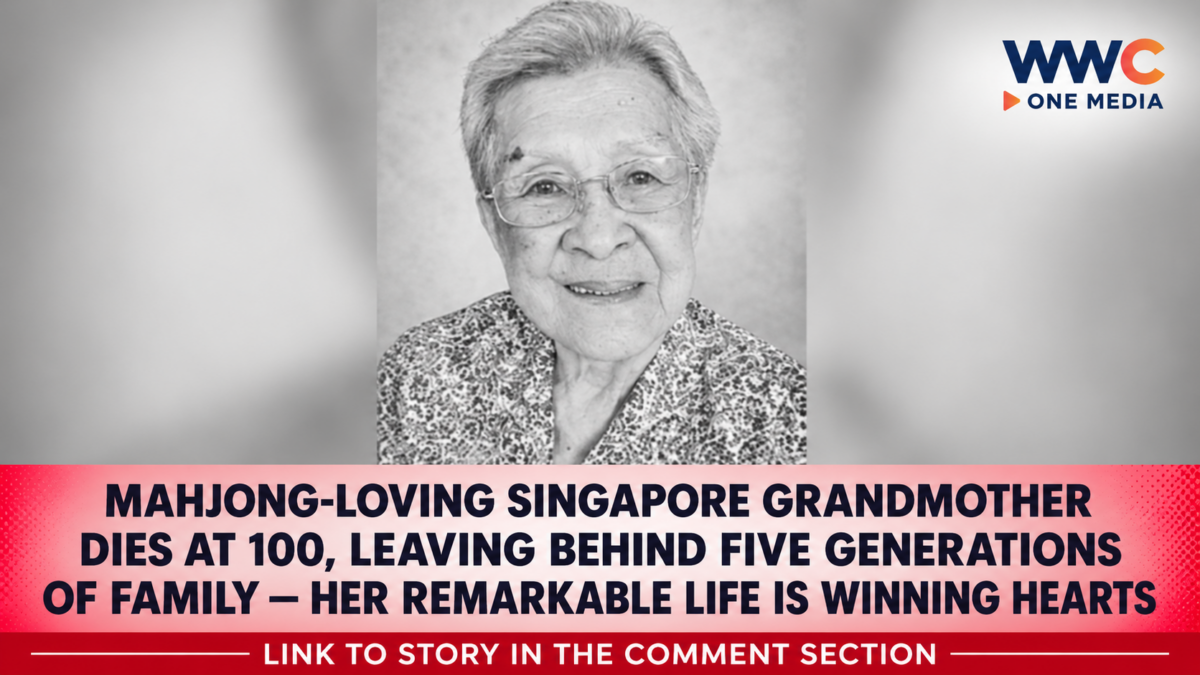
A century-long life built around family, simple pleasures and quiet dedication has come to an end.
A Singapore grandmother who continued playing mahjong into her 90s, remembered the names of her relatives and devoted much of her life to raising her children has died peacefully at the age of 100.
Chuah Tuah Moey leaves behind a remarkable five-generation family comprising six children, 14 grandchildren, 18 great-grandchildren and one great-great-grandchild.
Her story has attracted attention not simply because she reached the milestone of 100 years old, but because of the family memories that reveal the woman behind the extraordinary age: a hardworking mother, a devoted grandmother, an enthusiastic mahjong player and someone who found happiness in gardening and preparing meals for the people she loved.
According to her obituary and reports from Chinese-language media, Chuah died at Changi General Hospital in early November.
Her life offers a glimpse into a generation of Singaporeans whose personal histories stretch across enormous changes in the country — from a very different pre-war Singapore to the modern city-state of today.
A Singaporean life that began in 1926
Born in Singapore in 1926 to a family with ancestral roots in Chaozhou, China, Chuah married at the age of 18.
She and her husband eventually raised six children — three sons and three daughters.
Her husband worked in the rice wholesale business and was frequently away from home. That meant Chuah took on much of the responsibility for running the household and raising their children.
Her second daughter-in-law, Guo Miaoyin, 73, described her as a traditional, family-oriented woman who worked hard for most of her life.
The family’s account suggests that Chuah’s responsibilities extended well beyond ordinary household chores. She managed daily family matters and helped ensure that her children grew up while her husband spent considerable time working outside the home.
Her years of hard work eventually gave way to a more relaxed chapter of life as her children established themselves in their careers.
For a woman who had spent decades putting her family first, retirement finally offered more time to enjoy the things she loved.
Her wish was simple: A garden of her own
More than 30 years ago, Chuah and her husband moved to Lucky Heights in the Bedok area to live with their son and daughter-in-law.
One family memory stood out.
When her son asked what she wanted, Chuah reportedly said she wished to have a garden at home.
The family later bought a house with a garden, giving her a place to grow flowers and spend time tending to them.
It was a modest wish, but one that reflected the kind of happiness she valued.
Rather than asking for something extravagant, she wanted a space where she could enjoy gardening and make the most of her later years.
She also continued cooking, an activity that had long been part of her family life.
Her granddaughter, Hsu Shu-en, 45, recalled the meals she used to eat after returning home from school.
One dish remained particularly memorable: her grandmother’s stir-fried potatoes with chicken.
Although it was a simple home-cooked meal, Hsu said it had a distinctive taste that she could not find elsewhere.
For many families, these are the memories that last longest — not necessarily major celebrations, but familiar meals, everyday routines and the people who made an ordinary home feel special.
Mahjong remained part of her life well into her 90s
One of the most memorable details about Chuah was her continued enjoyment of mahjong.
Even in her 90s, she reportedly played the game twice a month.
She also retained the ability to remember the names of family members, according to her daughter-in-law.
Her interests were not limited to mahjong. She enjoyed cooking, gardening and spending time with her family.
She was also described as someone who maintained a regular daily routine and paid attention to what she ate.
Her family said she avoided fried and raw foods and preferred soup and fish.
In her 60s, she was still able to cook and help care for her grandson.
Even in her 90s, she reportedly continued living upstairs and used a walking stick to go up and down the stairs each day. After a fall, she eventually moved to a downstairs bedroom.
These details provide a more complete picture of her later years: she remained involved in familiar activities for as long as she could, while adjusting her living arrangements as her mobility changed.
Her story also echoes the experiences of other older Singaporeans who have found companionship and enjoyment through familiar social activities.
A separate report by CNA in 2025 profiled 105-year-old Singaporean Lin Geok I, whose favourite pastime was also playing mahjong several times a week at an active ageing centre in Bedok.
The examples show how a familiar game can remain meaningful to older people, offering opportunities for social interaction, enjoyment and connection across generations.
Five generations — and a family legacy that will continue
Chuah’s family is one of the most striking parts of her story.
She leaves behind six children, 14 grandchildren, 18 great-grandchildren and one great-great-grandchild.
That means her descendants span four generations beyond her own.
For the youngest members of the family, she represented a direct connection to a much earlier period of Singapore’s history.
For her children and grandchildren, her legacy is also found in the routines and traditions she passed down — preparing meals, caring for relatives, maintaining a household and finding happiness in simple activities.
Her granddaughter’s recollection of the potato-and-chicken dish is particularly telling.
Food can become a powerful connection to family history. A recipe may be simple, but the memory of who prepared it, where it was eaten and how it brought relatives together can remain meaningful long after the person is gone.
In Chuah’s case, the garden she wanted, the meals she prepared and the mahjong games she continued playing all became part of the story her family can remember.
Her passing also comes at a time when Singapore is confronting a major demographic shift.
Singapore has entered a new era of population ageing
Chuah’s death at 100 comes as Singapore officially enters the category of a super-aged society.
According to the Population in Brief 2026 report, 21.4 per cent of Singapore’s citizen population was aged 65 and above in June 2026. That is more than one in five citizens.
The figure was 20.7 per cent in 2025 and 13.7 per cent a decade earlier.
The number of citizens aged 80 and above also reached 152,000 in 2026, compared with 95,000 in 2016.
Singapore’s ageing population has placed greater attention on healthcare, caregiving, senior-friendly housing and opportunities for older people to remain active and socially connected.
The Government’s Age Well SG programme is among the initiatives intended to support seniors in maintaining their independence and quality of life.
WWC One Media has also examined this demographic change in its report on Singapore officially becoming a super-aged society as seniors reach 21.4 per cent of citizens.
The issue is not simply about helping people live longer. It is also about ensuring that older residents can continue to enjoy meaningful relationships, familiar routines and a sense of belonging.
Chuah’s life illustrates why those everyday experiences matter.
Her enjoyment of gardening, cooking and mahjong was part of a life in which family and personal interests remained important even as she grew older.
For more on Singapore’s efforts to support older residents, readers can also explore WWC One Media’s coverage of healthy eating programmes designed to help seniors age well and why staying active is an important part of healthy ageing.
A grandmother remembered through the little things
Chuah’s story is not one of fame, wealth or public recognition.
It is the story of a woman who raised six children, managed a household, made time for her interests and became the centre of a family spanning five generations.
Her life also reflects the experiences of many older Singaporeans whose contributions may not appear in history books but remain deeply important to their families.
Another Singaporean matriarch, Ng Lye Poh — affectionately known as Sheng Siong Ah Ma — was also remembered by her family and the wider community after her death at 91. Her story, covered by WWC One Media, can be read here: ‘Sheng Siong Ah Ma’ dies at 91 as family recalls her life and legacy.
Although their lives were different, both stories highlight the lasting influence that mothers and grandmothers can have on the people around them.
For Chuah’s family, her memory will likely live on through the garden she once wished for, the meals her grandchildren remember and the mahjong games she continued enjoying long after reaching old age.
The Bottom Line
Chuah Tuah Moey’s death at 100 marks the end of a remarkable chapter for a family spanning five generations.
She lived through a century of change, raised six children and remained connected to the simple activities that brought her happiness. Her love of mahjong, gardening and cooking may seem ordinary, but those details are precisely what make her story so personal.
Her granddaughter’s memory of a simple home-cooked dish perhaps captures her legacy best: sometimes, the things people remember most are not grand achievements, but the everyday moments shared with someone they love.
As Singapore grows older as a society, stories like Chuah’s also remind us that ageing is about more than reaching a particular number.
It is about the relationships, memories and experiences that make those years meaningful.
What is the one memory, meal or family tradition from your grandparents that you will never forget?