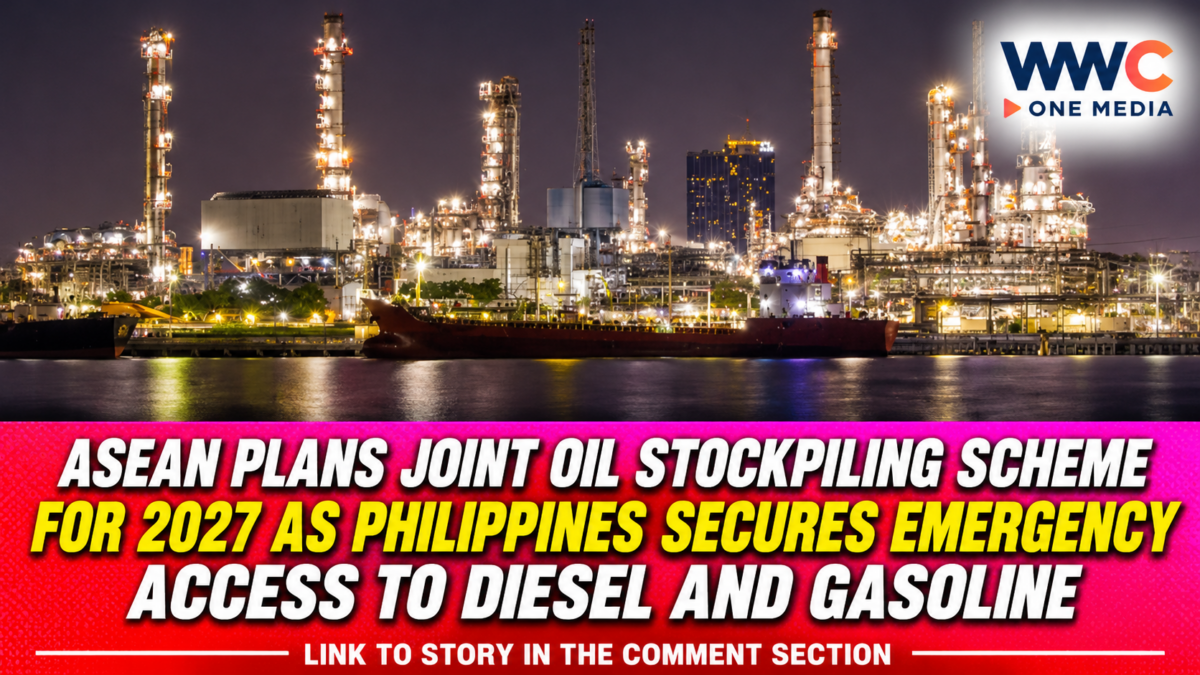
The Philippines could soon gain access to emergency supplies of diesel and gasoline stored in Indonesia and Thailand under a proposed ASEAN joint oil stockpiling arrangement targeted for launch as early as 2027.
The initiative marks a major step toward strengthening Southeast Asia’s energy security as the region confronts supply disruptions, geopolitical tensions and its continued dependence on imported petroleum.
Under the proposed arrangement, participating countries or companies would pay an upfront fee to secure the right to purchase a specified quantity of petroleum products held in another country’s commercial storage facilities. The system, known as oil ticketing, is designed to give participants priority access to fuel during emergencies without requiring every country to build and maintain large reserves of its own.
The plan was reported by Japan’s Nikkei business daily on November 12 and subsequently carried by Reuters and other international news organisations.
The Philippines is expected to become the first country to benefit from the initial arrangement, with companies affiliated with the Philippine National Oil Company (PNOC) expected to sign letters of intent with storage operators in Indonesia and Thailand on November 14.
The initiative is being led by the Economic Research Institute for ASEAN and East Asia (ERIA), an international research organisation established in Indonesia by Japan’s Ministry of Economy, Trade and Industry.
For the Philippines, the proposed agreement could provide another layer of protection against fuel shortages if international supply routes are disrupted.
However, the arrangement is not yet an operational emergency reserve, and it does not guarantee lower gasoline or diesel prices.
How ASEAN’s Oil Ticketing System Will Work
The proposed system uses a relatively straightforward concept: countries pay in advance for the right to purchase a certain volume of petroleum products stored by companies in another participating country.
Instead of immediately purchasing and physically transporting all the fuel into their own territory, participating countries secure contractual access to supplies that remain in existing storage facilities.
If an emergency occurs, the ticket holder can exercise its right to buy the reserved quantity, subject to the agreement’s conditions.
The model is similar to arrangements used in the European Union, where countries and companies can secure access to petroleum stocks held in other locations.
For the Philippines, the initial arrangement would provide access to diesel and gasoline stored in Indonesia and Thailand.
This could help the country respond to supply interruptions without having to wait for new domestic storage infrastructure to be completed.
Nevertheless, the actual amount of fuel available, the financial terms, the conditions for activating purchases and the delivery arrangements have not yet been publicly detailed.
The system’s effectiveness will depend on enforceable contracts, available inventories, transportation capacity and cooperation among the participating companies and governments.
Why the Philippines Is Expected to Benefit First
The Philippines is particularly vulnerable to international oil market disruptions because it relies heavily on imported petroleum.
Disruptions affecting Middle Eastern production or shipping routes can quickly influence the country’s fuel supply and domestic prices.
The proposed ASEAN arrangement could give the Philippines access to additional supplies stored closer to home, reducing its dependence on emergency purchases from more distant markets.
It also offers a potential solution to one of the country’s biggest challenges: limited government-controlled petroleum storage capacity.
Rather than waiting for large domestic facilities to become operational, the country could secure contractual access to fuel already held in neighbouring countries.
This approach complements the Philippine government’s broader strategy of diversifying supply sources and expanding national petroleum reserves.
However, the initial agreement is not a guarantee that the Philippines will receive unlimited fuel during a regional crisis. Access will depend on the quantities reserved, the contractual arrangements and whether the stored products remain available when emergency demand arises.
Indonesia and Thailand to Become Initial Storage Locations
Indonesia and Thailand have been identified as the first storage locations under the proposed arrangement.
Their role is important because regional stockpiling depends not only on the availability of petroleum but also on existing infrastructure, commercial storage operators and the ability to transport fuel quickly when required.
The initial arrangement will allow the Philippines to purchase diesel and gasoline from participating storage operators in the two countries.
Laos and Timor-Leste are also considering joining the initiative, according to the Nikkei report.
The broader objective is to expand the arrangement across ASEAN and potentially include crude oil in addition to refined petroleum products.
If more countries participate, the system could eventually become an important part of the region’s emergency energy infrastructure.
But the initial project remains limited in scope. It should not yet be described as a fully integrated ASEAN-wide strategic petroleum reserve.
Japan Is Helping Push the Regional Energy Security Initiative
Japan is playing a central role in promoting the proposed arrangement through ERIA and its wider regional energy cooperation programme.
The initiative has gained urgency following the disruptions associated with the war involving Iran, which exposed the vulnerability of Asian economies that depend heavily on Middle Eastern petroleum shipments.
Japanese Prime Minister Sanae Takaichi is expected to announce cooperation on joint oil stockpiling at the Asia Zero Emission Community summit in Manila on November 17.
The announcement could give the initiative greater political momentum and help encourage additional countries to participate.
ERIA also released a policy paper on November 12 titled “Operationalising ASEAN Joint Oil Stockpiling: From Policy Recommendations to Pilot Implementation.”
The paper argues that ASEAN should begin with practical, voluntary public-private pilot projects rather than attempting to establish one massive regional reserve immediately.
It recommends a hybrid approach that makes use of existing infrastructure, private-sector capabilities and national arrangements while respecting the sovereignty of individual member states.
The strategy is intended to turn years of regional discussions about energy cooperation into practical emergency supply arrangements.
The New Scheme Is Different From ASEAN’s Petroleum Security Agreement
An important distinction is that the proposed oil ticketing arrangement is not the same as the ASEAN Framework Agreement on Petroleum Security (APSA).
APSA provides a broader framework for cooperation when member countries experience serious petroleum supply disruptions.
According to the ASEAN Centre for Energy, six of ASEAN’s 11 members had ratified the renewed agreement as of October 2026, with the remaining countries still working through domestic approval procedures.
The agreement was signed in October 2025 and is intended to replace the previous 2009 framework once it enters into force.
Under its provisions, member states are expected to endeavour collectively to provide assistance equivalent to 10 per cent of a country’s normal petroleum requirements when a qualifying emergency occurs.
However, assistance is voluntary and based on negotiated commercial terms rather than an automatic guarantee of fuel delivery.
A critical shortage under the framework is defined as a shortfall of at least 10 per cent of normal domestic requirements lasting at least 30 consecutive days. The affected country must also implement demand-reduction measures before requesting assistance.
The distinction matters because APSA establishes a regional cooperation framework, while the new ticketing initiative seeks to create more concrete contractual access to petroleum products stored in participating countries.
Together, the two mechanisms could strengthen ASEAN’s ability to respond to future energy emergencies.
Middle East Conflict Exposes Southeast Asia’s Fuel Vulnerability
The push for regional oil stockpiling comes as the Middle East conflict continues to expose the risks associated with Southeast Asia’s dependence on imported energy.
The Strait of Hormuz is particularly important because it serves as a major shipping route for petroleum exports from the Gulf.
Before the latest disruptions, a substantial share of the oil transported through the waterway was destined for Asian markets.
Reuters previously reported that more than half of the crude oil imported by ASEAN refineries originates from the Middle East.
This creates a significant vulnerability for countries that depend on international shipments to keep transportation, manufacturing, electricity generation and other essential industries operating.
A prolonged interruption could affect fuel availability, increase shipping costs and push international oil prices higher.
The International Energy Agency has also been working with ASEAN countries to strengthen oil supply security and emergency preparedness.
At a regional workshop in Bangkok in October 2026, representatives from nine ASEAN countries discussed emergency stockholding systems, financing arrangements, infrastructure requirements and possible regional cooperation.
Indonesia, Malaysia, the Philippines and Thailand were among the countries considering stronger emergency stockholding arrangements.
The discussions reflect growing recognition that individual national reserves may not be sufficient to protect the region from major international supply shocks.
Philippines Is Also Building Its Own Strategic Petroleum Reserve
The regional initiative is only one part of the Philippines’ energy security strategy.
The government is also developing plans for a national strategic petroleum reserve, including a government-owned storage facility in Bataan.
Energy Secretary Sharon Garin previously said the Philippine National Oil Company was targeting the first one-million-barrel storage tank by the end of 2027.
The project is intended to increase the country’s ability to hold emergency petroleum supplies under government control.
The Department of Energy has also discussed a broader goal of building a reserve equivalent to approximately 60 days of national requirements.
A proposed legislative framework would require the government to maintain a 60-day strategic stockpile while increasing private oil companies’ minimum inventory requirements from 15 to 30 days.
However, the proposed national reserve framework should not be confused with an already completed or fully operational stockpile. Construction, funding, legislation and implementation arrangements remain important steps.
The government is also exploring international partnerships to secure additional petroleum storage and supply options.
These efforts complement the ASEAN initiative by combining domestic storage development with access to fuel held abroad.
Singapore’s Saudi Oil Storage Deal Shows a Wider Regional Shift
Another development illustrating Asia’s growing focus on petroleum security is the proposed crude oil storage arrangement between Singapore and Saudi Arabia.
Announced on October 26, the arrangement would allow Saudi crude oil to be stored at the Jurong Rock Caverns on Jurong Island.
Singapore’s Energy Market Authority and JTC Corporation exchanged a memorandum of understanding with Saudi Aramco as an initial step toward implementing the project.
Storage operations are expected to begin in the second half of 2027.
The arrangement is intended to strengthen Singapore’s energy security while making the city-state a more important regional hub for Saudi crude oil distribution.
Although the Singapore-Saudi agreement is separate from the ASEAN ticketing initiative, both developments reflect the same strategic shift: Asian economies are seeking more reliable access to petroleum supplies and more flexible storage arrangements as geopolitical risks increase.
The emerging network of storage partnerships could eventually make regional energy supply chains more resilient.
Will the Oil Stockpiling Plan Lower Fuel Prices in the Philippines?
For Filipino motorists, transport operators and businesses, the most important question is whether the new arrangement will translate into cheaper gasoline and diesel.
The answer is not necessarily.
Emergency stockpiling is primarily designed to protect the availability of fuel during supply disruptions.
It does not automatically reduce international oil prices, eliminate taxes or guarantee lower retail prices at local petrol stations.
The price consumers pay will continue to depend on international petroleum benchmarks, currency movements, taxes, refining expenses, transportation costs and local market conditions.
The ticketing system could help prevent or reduce the severity of physical supply shortages if it provides reliable access to additional fuel.
But if global oil prices remain high, the cost of purchasing the reserved petroleum could also remain expensive.
The arrangement should therefore be understood as an energy security measure, not a direct fuel-price reduction programme.
ASEAN’s Energy Security Strategy Faces Its Biggest Test Yet
The proposed 2027 stockpiling initiative represents an important shift from regional discussions toward practical cooperation.
For years, ASEAN members have recognised their vulnerability to global energy disruptions, but differences in national storage capacity, financing and domestic priorities have made a fully integrated reserve system difficult to establish.
The initial ticketing arrangement offers a more flexible starting point.
The Philippines could secure emergency access to diesel and gasoline stored in Indonesia and Thailand, while other countries consider joining the system.
Japan’s involvement through ERIA could also provide technical and institutional support as ASEAN develops its longer-term stockpiling roadmap.
Still, the success of the programme will depend on details that have yet to be fully disclosed, including the amount of fuel reserved, the financial commitments involved, the conditions for releasing supplies and the reliability of delivery during simultaneous regional emergencies.
For the Philippines, the initiative could become an important addition to its domestic reserve plans and international energy partnerships.
For ASEAN, it could serve as an early building block for a stronger regional emergency response system.
The challenge is turning the agreement into dependable fuel access before another major international crisis strikes.
As Southeast Asia moves toward a shared petroleum security strategy, one question remains: Will this regional oil-sharing plan give the Philippines and its neighbours a genuine safety net against the next global energy shock, or will limited reserves and competing national demands expose the weaknesses of the system when it matters most?