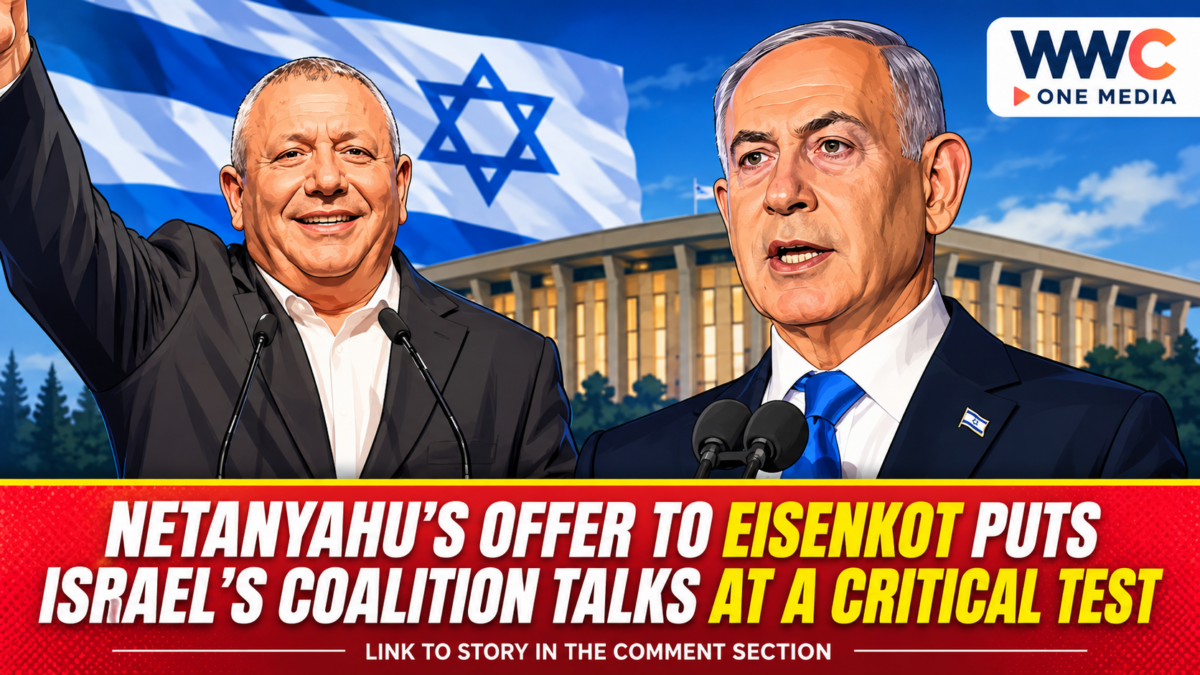
Israeli caretaker Prime Minister Benjamin Netanyahu said on November 28, 2026, that he was prepared to serve second in a proposed rotating government, allowing political rival Gadi Eisenkot to take the first turn as prime minister. Eisenkot responded by inviting Netanyahu and his Likud team to immediate negotiations, setting a short window for the proposal to be tested.
The development introduces a new possibility in Israel’s effort to form a government after the October election. It also places a practical question before the rival camps: can a public offer of shared leadership become an agreement on policy, coalition partners and the distribution of power?
Israel unity government proposal changes the negotiating picture
Netanyahu’s announcement represented a shift from his previous position that the leader of the largest party should head a unity government or take the first turn in a rotation arrangement.
Under the proposed arrangement, Eisenkot would initially become prime minister while Netanyahu would serve as alternate prime minister. The proposal was presented as an effort to bring rival political groups into a national unity government.
The announcement came while Eisenkot was pursuing a separate route to assemble a governing coalition. The central issue is therefore not simply who would occupy the prime minister’s office first. It is whether the parties can agree on the policies and political conditions that would allow a government to function.
A rotating premiership would require more than a public declaration. The negotiating parties would need to settle the structure of the government, its policy commitments, the responsibilities of each leader and the timing and conditions of any leadership transition.
Eisenkot holds the presidential mandate
The negotiations are taking place under a formal government-formation process.
President Isaac Herzog tasked Eisenkot with forming a government on November 8. The President’s official announcement recorded that factions representing 67 members of the incoming Knesset had recommended Eisenkot, while factions representing 46 recommended Netanyahu. A seven-member faction did not recommend either candidate.
Herzog also acknowledged that Likud was the largest faction but said he had selected Eisenkot because he had received the clear support of a majority of lawmakers on the question of who had the better chance of forming a government that could win the Knesset’s confidence.
The appointment gave Eisenkot 28 days to form a government, with a possible extension of up to 14 additional days under the applicable law.
That mandate matters because Netanyahu’s proposal does not automatically replace the process already underway. Eisenkot remains the lawmaker formally tasked with trying to form the next government unless the constitutional process changes.
The distinction between party negotiations and the presidential mandate is important. A proposed unity arrangement can influence the negotiations, but it does not itself establish a government.
The offer now faces a test of substance
Eisenkot’s response was an invitation to begin direct negotiations. He said his side was prepared to assess the seriousness of Likud’s position over the following 24 hours and invited Netanyahu and his team to meet with his negotiating group in Herzliya.
Eisenkot also said a detailed proposal had previously been conveyed to Netanyahu through a confidential channel and that his side had not received a response on the issues raised in that document.
His response left the door open to talks without treating the announcement as a completed political agreement.
That distinction is significant. The parties still need to determine whether they can agree on the government’s guiding principles and policy questions. A leadership rotation may be politically attractive, but it cannot resolve disagreements automatically.
The next stage will depend on whether both sides are willing to negotiate concrete terms rather than rely on public statements about unity.
Coalition partners and policy disagreements remain central
The proposal also affects political groups outside Likud and Eisenkot’s Yashar party.
A unity government would require agreement on which parties participate, how cabinet positions are distributed and which policies become the government’s programme. Those questions can be difficult even when the main leaders agree on who should serve first.
Issues such as military conscription, religious-party demands, judicial reform and the structure of the governing coalition have been part of Israel’s wider political debate. Any agreement would need to address the positions of the parties expected to support it.
The political arithmetic is also important. A government must be able to secure the confidence of the Knesset, not merely obtain agreement between two party leaders.
For readers following Israel’s political institutions, WWC has previously examined the difference between parliamentary recommendations and the votes required to sustain a government in its coverage of Eisenkot’s mandate and the 61-seat threshold.
The wider negotiations also follow a period of political uncertainty after the election. WWC has tracked the competing coalition paths in its report on Eisenkot’s challenge in forming a government.
A rotation agreement would need clear legal and political terms
Israel’s Basic Law: The Government provides a framework for a government with a prime minister and an alternate prime minister. A political agreement would still need to be translated into the formal arrangements required by law and supported by a government that wins the Knesset’s confidence.
That means the proposed rotation should not be confused with an actual transfer of office. Until a government is formed and approved through the required parliamentary process, Netanyahu remains caretaker prime minister and Eisenkot remains the lawmaker holding the mandate to form a government.
A workable agreement would also need to specify the timing of the rotation and the responsibilities of both officeholders. Without clear terms, the arrangement could leave unresolved questions about authority and decision-making.
The broader stakes are institutional as well as political. Israel needs a government capable of passing legislation, approving policy and maintaining parliamentary support. A deal that settles only the order of succession would leave much of that work unfinished.
What happens next
The immediate question is whether Netanyahu and Eisenkot proceed with substantive negotiations and whether their teams can produce an agreed framework.
Eisenkot’s initial mandate runs for 28 days from the November 8 appointment, with a possible extension of up to 14 days. The deadline therefore gives the negotiations a defined timetable.
If the parties reach an agreement, they would still need to settle the coalition’s composition and policy programme before presenting a government for parliamentary approval. If talks fail, Eisenkot may continue pursuing another coalition arrangement within the mandate period.
For now, Netanyahu’s announcement is an offer, not a completed unity deal. Its significance will depend on what the two political camps are prepared to put in writing and whether they can secure the support needed in the Knesset.
Frequently asked questions
Did Benjamin Netanyahu offer to let Gadi Eisenkot become prime minister first?
Yes. On November 28, Netanyahu said he was prepared to serve second in a proposed rotation arrangement, with Eisenkot serving first.
Who is currently tasked with forming Israel’s government?
President Isaac Herzog tasked Gadi Eisenkot with forming a government on November 8, 2026.
How long does Eisenkot have to form a government?
The initial period is 28 days. The President may grant an extension of up to 14 additional days under the applicable law.
Does Netanyahu’s offer mean Israel already has a unity government?
No. The announcement is a political proposal. A government must still be formed through the required process and secure the confidence of the Knesset.
What could prevent the proposed unity government from happening?
Disagreements over coalition partners, policy commitments, military conscription, religious-party demands and the distribution of government responsibilities could prevent the parties from reaching an agreement.